Confirm this specific model, usage limits, and billing terms with the provider. A subscription does not automatically include API credits.
No login needed to compare. Prices are in USD; provider charges are separate from AI Market Cap plans. Context length, caching, tools, taxes, and regional terms can change the final cost. Open weights do not mean free hosting.
58.5
Quality Score
1199
Arena ELO
Undisclosed
Parameters
256K
Context
Evidence profile
How complete is this record?
This measures the amount of verifiable public evidence we have, not how capable the model is. A missing field means it has not been verified yet, not that its value is zero.
Epoch AI, Data on AI Models. Used under CC BY with attribution.
Launches
1
high
Benchmarks
2
high
Research
18
low
General
9
low
What Changed Recently
Recent launch, pricing, benchmark, and API signals linked to this model or its provider.
LaunchesMicrosoft2mo ago
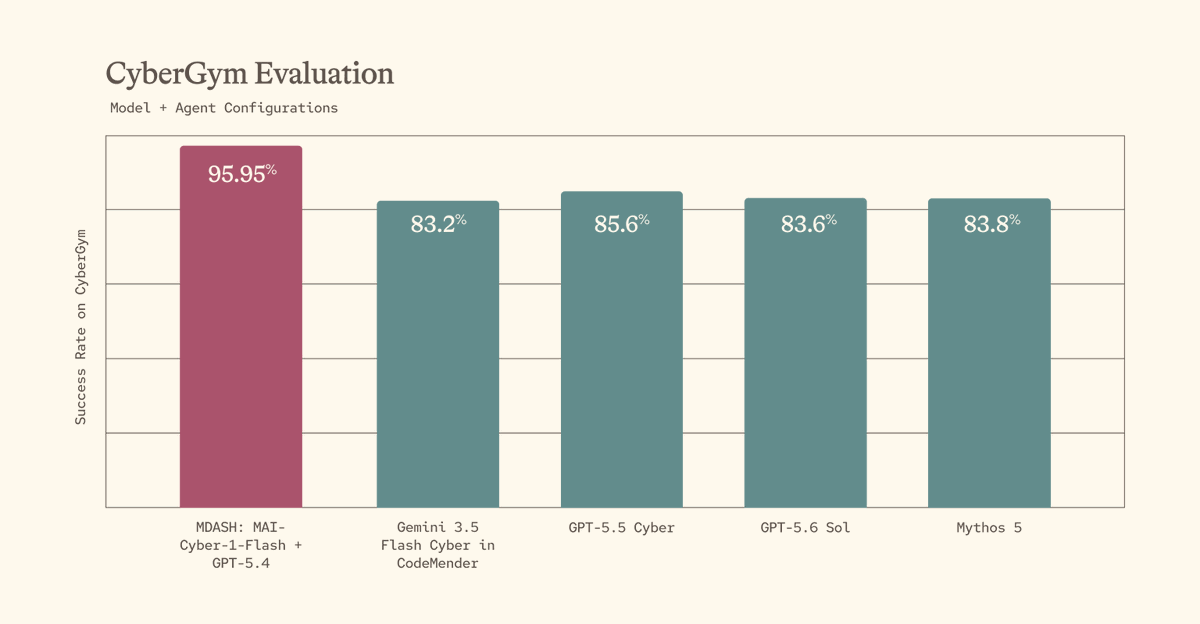
Introducing MAI-Cyber-1-Flash, our new in-house cybersecurity model running inside of MDASH, our multi-agent harness that detects and remediates vulnerabilities across large-scale code bases. MDASH: M
Introducing MAI-Cyber-1-Flash, our new in-house cybersecurity model running inside of MDASH, our multi-agent harness that detects and remediates vulnerabilities across large-scale code bases. MDASH: MAI-Cyber-1-Flash+GPT-5.4 model combination out-performs Mythos by 12 points on https://t.co/qHz5Ika6Fz
Social & Blog Posts10
BlogOpenAIannouncementgeneral
Research Papers18
HF PapersDavidAUresearch4d ago
Other
provider-benchmarksOpenAI2d ago
Introducing GPT-5.4
Introducing GPT-5.4 | OpenAI Skip to main content Research Products Business Developers Company Foundation (opens in a new window) Log in Try ChatGPT (opens in a new window) Research Products Business Developers Company Foundation (opens in a new window) Try ChatGPT (opens in a new window) Login OpenAI March 5, 2026 Product Release Introducing GPT‑5.4 Designed for professional work Loading… Share Knowledge work Knowledge work Computer use and vision Coding Tool use Tool searc
Introducing GPT-5.4 | OpenAI Skip to main content Research Products Business Developers Company Foundation (opens in a new window) Log in Try ChatGPT (opens in a new window) Research Products Business Developers Company Foundation (opens in a new window) Try ChatGPT (opens in a new window) Login OpenAI March 5, 2026 Product Release Introducing GPT‑5.4 Designed for professional work Loading… Share Knowledge work Knowledge work Computer use and vision Coding Tool use Tool searc
Introducing GPT-5 for developers | OpenAI Skip to main content Research Products Business Developers Company Foundation (opens in a new window) Log in Try ChatGPT (opens in a new window) Research Products Business Developers Company Foundation (opens in a new window) Try ChatGPT (opens in a new window) Login OpenAI August 7, 2025 Product Introducing GPT‑5 for developers The best model for coding and agentic tasks. Loading… Share Introduction Introduction Coding Frontend engin
ToM2Vec: Continuous Theory-of-Mind Tokens for Multi-Agent Coordination
Forming an accurate theory-of-mind (ToM) is key to successful multi-agent collaboration and requires reasoning under uncertainty to capture multiple possible partner states. This is hard to do in the text representation space native to large language model (LLM) agents, which more easily describe a single partner state. To address this challenge, we introduce ToM2Vec, which learns to form abstract theories-of-mind in a rich latent space via a fixed budget of continuous reasoning tokens. During training, supervision for these tokens comes from the partner's actual thoughts, which the ToM tokens are trained to abstract and match. At test-time, ToM tokens are generated by each agent and act as conditioners for that agent's thoughts and actions. Across several environments covering collaborative, competitive, and mixed-motive settings (Overcooked-AI, multiparty negotiation, Decrypto, Hanabi, and Collab Escape/Capture), we evaluate ToM2Vec's ability to support multi-agent interactions and collaboration, finding consistent improvements over the base model and a variety of competitive trained and prompted baselines. We show that latent reasoning is critical, with performance dropping when reasoning is expressed in text. Moreover, we show that ToM2Vec training generalizes to partner model families not seen at train-time, including a proprietary model (GPT-5.4). In our analysis, we provide evidence that the latent tokens encode a ToM, rather than task-specific information: ToM2Vec's tokens improve the agent's ability to directly answer questions about partner beliefs, desires, and next actions.
Same Simulation, Different Evidence: Where Retrieved Tool Output Costs LLM Agents Accuracy
LLM agents that compute the right answer can still answer wrongly. Agent harnesses increasingly keep long tool outputs out of the context window, saving them to files that the agent searches or reads on demand. We ask where this costs accuracy with a real scientific tool: PHREEQC, a widely used geochemistry simulator from the USGS, whose reports reach 846.8k characters and whose determinism lets every printed value be traced. Agents use it to answer 158 execution-verified multiple-choice items. When agents read the simulator's report through a section index rather than in context, GPT-5.1 and GPT-5.2 lose 11.3 and 7.9 points of accuracy, while Claude Opus 4.6 and Claude Sonnet 4.6 show no detectable cost. Re-running all 11,007 logged simulator calls shows that both GPT models compute the keyed value about as often as before; what changes is the evidence they answer from. Under retrieval they often skip the report, answer from their own higher-precision output files, and misround to a neighboring option, a failure we call evidence substitution. With the simulation held fixed, retrieval still costs GPT-5.2 9.4 points. For GPT-5.4, more frequent correct simulations mask an evidence-use loss of about ten points, leaving a net change indistinguishable from zero. Naming the authoritative output raises accuracy by 6.3-7.9 points over plain retrieval for the three GPT models; for GPT-5.1 and GPT-5.2, inlining outputs that fit works as well, while asking for correct rounding does not. Context-management choices in agent harnesses should be judged by where accuracy is lost, not only by final accuracy.
GPT-Rosalind surfaced a new lead for drug discovery: could restoring cholesterol transport protect neurons from degeneration? DCTN1 is a gene linked to Perry syndrome, a rare neurodegenerative disorde
GPT-Rosalind surfaced a new lead for drug discovery: could restoring cholesterol transport protect neurons from degeneration? DCTN1 is a gene linked to Perry syndrome, a rare neurodegenerative disorder. In mouse-brain data, disrupting it increased expression of genes involved in
Our latest model advances bring stronger capabilities for building and migrating software in low-resource programming languages such as COBOL, Fortran, and Visual Basic. These languages power software
Our latest model advances bring stronger capabilities for building and migrating software in low-resource programming languages such as COBOL, Fortran, and Visual Basic. These languages power software that banks, governments, and businesses depend on. Progress here means https://t.co/Mulo5P3iCO
Introducing MAI-Cyber-1-Flash, our new in-house cybersecurity model running inside of MDASH, our multi-agent harness that detects and remediates vulnerabilities across large-scale code bases. MDASH: M
Introducing MAI-Cyber-1-Flash, our new in-house cybersecurity model running inside of MDASH, our multi-agent harness that detects and remediates vulnerabilities across large-scale code bases. MDASH: MAI-Cyber-1-Flash+GPT-5.4 model combination out-performs Mythos by 12 points on https://t.co/qHz5Ika6Fz
GPT-5.4 helped drive a medicinal chemistry project from literature review to a validated experimental result. Paired with https://t.co/gcDaph8b2B’s Maria AI and specialized lab, the model proposed an
GPT-5.4 helped drive a medicinal chemistry project from literature review to a validated experimental result. Paired with https://t.co/gcDaph8b2B’s Maria AI and specialized lab, the model proposed an unexpected way to improve a widely used reaction in drug discovery. https://t.co/KmyBlHLX8y
ToM2Vec: Continuous Theory-of-Mind Tokens for Multi-Agent Coordination
Forming an accurate theory-of-mind (ToM) is key to successful multi-agent collaboration and requires reasoning under uncertainty to capture multiple possible partner states. This is hard to do in the text representation space native to large language model (LLM) agents, which more easily describe a single partner state. To address this challenge, we introduce ToM2Vec, which learns to form abstract theories-of-mind in a rich latent space via a fixed budget of continuous reasoning tokens. During training, supervision for these tokens comes from the partner's actual thoughts, which the ToM tokens are trained to abstract and match. At test-time, ToM tokens are generated by each agent and act as conditioners for that agent's thoughts and actions. Across several environments covering collaborative, competitive, and mixed-motive settings (Overcooked-AI, multiparty negotiation, Decrypto, Hanabi, and Collab Escape/Capture), we evaluate ToM2Vec's ability to support multi-agent interactions and collaboration, finding consistent improvements over the base model and a variety of competitive trained and prompted baselines. We show that latent reasoning is critical, with performance dropping when reasoning is expressed in text. Moreover, we show that ToM2Vec training generalizes to partner model families not seen at train-time, including a proprietary model (GPT-5.4). In our analysis, we provide evidence that the latent tokens encode a ToM, rather than task-specific information: ToM2Vec's tokens improve the agent's ability to directly answer questions about partner beliefs, desires, and next actions.
Same Simulation, Different Evidence: Where Retrieved Tool Output Costs LLM Agents Accuracy
LLM agents that compute the right answer can still answer wrongly. Agent harnesses increasingly keep long tool outputs out of the context window, saving them to files that the agent searches or reads on demand. We ask where this costs accuracy with a real scientific tool: PHREEQC, a widely used geochemistry simulator from the USGS, whose reports reach 846.8k characters and whose determinism lets every printed value be traced. Agents use it to answer 158 execution-verified multiple-choice items. When agents read the simulator's report through a section index rather than in context, GPT-5.1 and GPT-5.2 lose 11.3 and 7.9 points of accuracy, while Claude Opus 4.6 and Claude Sonnet 4.6 show no detectable cost. Re-running all 11,007 logged simulator calls shows that both GPT models compute the keyed value about as often as before; what changes is the evidence they answer from. Under retrieval they often skip the report, answer from their own higher-precision output files, and misround to a neighboring option, a failure we call evidence substitution. With the simulation held fixed, retrieval still costs GPT-5.2 9.4 points. For GPT-5.4, more frequent correct simulations mask an evidence-use loss of about ten points, leaving a net change indistinguishable from zero. Naming the authoritative output raises accuracy by 6.3-7.9 points over plain retrieval for the three GPT models; for GPT-5.1 and GPT-5.2, inlining outputs that fit works as well, while asking for correct rounding does not. Context-management choices in agent harnesses should be judged by where accuracy is lost, not only by final accuracy.
HandsOn: A Large-Scale Simulation Benchmark for Generalizable Dexterous Manipulation
General-purpose manipulation requires reliable behavior across embodiments, objects, and task demands. We introduce HandsOn, a composable simulation platform and benchmark for cross-embodiment dexterous manipulation. It supports five robotic arms, six dexterous hands, and approximately 200 rigid, articulated, and deformable assets in randomized scenes. The benchmark pairs 18,000 curated human demonstrations with 66 human-verified tasks: Core-50 supports demonstration-based learning and execution tests, while Transfer-16 evaluates asset and relation transfer, skill composition, and deformable manipulation without target-task training demonstrations. Qualitative real-robot rollouts illustrate sim-to-real transfer. Across diffusion, vision-language-action, world-action, and prompted VLM-based methods, the best trained multi-task policy achieves 29.1% Core-50 success. Without benchmark finetuning, GPT-6 using move_eef for palm-and-finger control achieves 5.2% on Core-50 and 1.9% on Transfer-16 over 660 trials. Trained-policy stage diagnostics expose failures in contact establishment, action coordination, and maintaining achieved goals, with additional sequencing errors in composed tasks. HandsOn provides a shared basis for investigating manipulation generalization and the limits of reliable physical interaction.
WOVEN: Weaving Visual World Modeling into Multimodal LLMs
Multimodal large language models (MLLMs) struggle with spatial, embodied, physical, and temporal reasoning. We hypothesize that these failures reflect a shared deficit in visual transition reasoning, and test whether this capability can serve as a shared training primitive, one that different models can learn from different supervision sources and reuse across different tasks, with a systematic training recipe. Existing benchmarks document these deficits separately but do not support controlled comparisons across scenes, actions, and reasoning operations. We therefore introduce WOVEN, a training source and benchmark for visual transition reasoning that organizes transition supervision by scene, action, and reasoning type, using diverse, realistic rollouts from video-pretrained generative models: 36,076 examples across 20 scene types, 5 action types, and 8 reasoning types. We first evaluate 38 frontier MLLMs (e.g., GPT-5.4 and Qwen3-VL-235B-A22B) and find a substantial and systematic deficit: even the strongest models fall far below humans, and the failures recur across model families and persist with scale. We then train MLLMs at multiple scales on WOVEN and find that they learn a shared capability that transfers broadly: training subsets of only about 2,000 items each collectively improve 22 of 26 external benchmarks by up to 27.3 percentage points, and WOVEN data can replace 30-50% of a task's own training data with comparable accuracy. Controlled comparisons further yield a training recipe for visual world modeling, validated prospectively on held-out benchmarks: select supervision by the reasoning operation it teaches rather than by the actions, scenes, or domains it shows, and prefer larger changes to the visual state for robustness. Our work establishes visual transition reasoning as a reusable foundation for systematic visual world-model training in MLLMs.
From Given to Gathered Evidence: Agentic Learning for Longitudinal Medical Reasoning
Foundation models can serve as clinical agents through tool-use harnesses. However, conventional medical benchmarks assess reasoning over preselected evidence rather than the ability to seek it across clinical records and longitudinal imaging. We propose CASE: a series of role-specific Clinical Agents for Seeking Evidence, together with a tool-use harness and an agentic post-training framework for compact vision-language policy models. We further introduce a longitudinal multimodal benchmark built on UK Biobank, comprising 50,401 clinical questions derived from real-world ICD-10-coded diagnoses of 4,739 participants. Each question links to a patient-specific environment containing clinical context and multi-sequence MRI from baseline and follow-up visits, where agents autonomously select which visits, organs, modalities, slices, and specialist tools to inspect and compare. Supervised fine-tuning transfers evidence-seeking workflows from 14,734 frontier-model interaction trajectories, followed by agentic reinforcement learning on the learner's own environment interactions. Privileged on-policy self-distillation and rubric-based LLM feedback refine evidence-to-conclusion reasoning without prescribing tool sequences. Experiments show that CASE moves beyond question-answer imitation toward transferable investigation policies, strengthening evidence-grounded longitudinal reasoning. Under matched evaluation conditions, our Qwen3-VL-8B based agent achieves over 16% and 10% relative improvements in answer accuracy over GPT-5.4 and Claude Opus 4.8. Code will be available at https://github.com/VinyehShaw/CASE.
Inducing Process Supervision from Outcome-Only Reinforcement Learning
Process reward models (PRMs) have become a key component for LLMs, as their step-level feedback supports both post-training and test-time reasoning. However, training strong PRMs remains costly: human step annotation is difficult to scale, while Monte Carlo estimation is computationally expensive and can drift from the intrinsic correctness of steps. To get effective PRMs at low cost, we introduce TIPS (Thinking-Induced Process Supervision), an outcome-only reinforcement learning (RL) framework for training generative PRMs. In TIPS, the model generates a chain-of-thought (CoT) followed by step-level labels and an outcome label. The reward depends solely on whether the predicted outcome matches the ground truth, and the resulting group-relative advantage is used to optimize the entire generated response. Intuitively, when checking intermediate steps helps determine the outcome, more accurate checks can lead to better outcome judgments and higher rewards. Outcome-only RL can therefore reinforce step-level verification without explicit process supervision. We validate the effectiveness of TIPS across math and agent benchmarks and four backbone families. Notably, TIPS-Qwen3-4B-Thinking-2507 reaches 85.2 F1 on ProcessBench with only 3.2K outcome-labeled trajectories, surpassing all evaluated trained PRMs and strong prompt-only judges such as GPT-5.4-Instruct and Claude-4.7-Opus, while still trailing o1-mini. Code and data are available at https://github.com/RUCBM/TIPS.
GraphSkillEvo: Evolutionary Optimization of Graph-Structured Agent Skills
Skills can improve the performance of Large Language Model (LLM) agents by providing task-specific procedural guidance, while skill optimization further improves their effectiveness through iterative refinement. However, existing skill optimization methods typically represent skills as unstructured natural-language instructions, creating two key challenges: 1) Unstructured skills often lack explicit workflow-level guidance and contain substantial redundancy, making them difficult for LLMs to execute; 2) the vast search space of unconstrained natural-language skills makes skill optimization ineffective. To address these challenges, we propose representing skills as graph-structured natural-language artifacts. In graph-structured skills, each node represents an execution step together with its operational guidance, while directed edges encode context-dependent transitions between steps. Compared to unstructured skills, graph-structured skills can provide clear workflow-level guidance. Moreover, the proposed graph-structured skill can also facilitate skill optimization. Building on this structured representation, we introduce GraphSkillEvo, a population-based evolutionary optimization framework with mutation and crossover operators for graph-structured skills. By maintaining multiple candidate skills and combining effective components, GraphSkillEvo enables broader and more comprehensive exploration of the structured skill space than purely LLM-based iterative self-refinement. Extensive experiments across five agent benchmarks demonstrate that GraphSkillEvo consistently outperforms the strong skill optimization baseline SkillOpt, improving average accuracy by 4.01% on GPT-5.4-nano and 1.76% on GPT-5.4. Our code is available at https://github.com/ruisun7/GraphSkillEvo.
T1: Terminal Agent Reinforcement Learning for Long-Horizon Tasks
Agent usage is shifting toward long-horizon tasks such as coding and scientific discovery, among which terminal tasks are especially important. We introduce T1, a Mixture-of-Experts model of 122B total trained with reinforcement learning, operating a real shell in a cloud sandbox for up to 300+ tool-call turns per task, rewarded by executing each task's own verifier. We provide a comprehensive recipe: First, an aggressively warm-started to stabilize actor-critic training, with a dense process reward scoring trajectories by the absolute number of passing verifiers. Second, stable optimization through TITO construction, training on the exact sampled token identifiers with drift repair at turn boundaries, and rollout routing replay, recording the sampler's per-token expert choices at every MoE layer and replaying them during training. Third, fully out-of-distribution training corpus: isolated seeds and synthesized tasks disjoint from Terminal-Bench 2.1 ensures gains reflect genuine capability transfer over benchmark overfitting. Together, TITO and R3 cut the training-to-inference log-probability difference from 0.021 to 0.013, with exactly aligned zero token drift in the loss region. On Terminal-Bench 2.1, our post-train pipeline raises initial base model from 43.8% to T1 with 64.0% resolved. On Long-Horizon Terminal Bench, T1 reaches 27.9% and surpasses GPT-5.4 and GLM-5.1.
MetroLLM-Bench: Evaluating Language Models as Transit Kiosk Runtimes
We introduce MetroLLM-Bench, a 955-case benchmark for testing language models as the policy layer of a transit kiosk. It covers six real metro systems, ranging from 37 to 414 stations, and eleven categories that include routing, fare calculation, disruptions, accessibility, and adversarial input. In each case, the model must call structured tools and submit a machine-renderable terminal state containing an outcome, a per-ticket fare quote when applicable, and a kiosk action. Fourteen deterministic scoring components form Tier 1; eight semantic-quality components form Tier 2, six of which use a language-model judge. We report Tier 1 and the combined score of both tiers. A stratified 75/25 split reserves 717 cases for training-data generation and 238 for held-out evaluation.
We evaluate twenty-six models from six vendors, of which twenty-three are ranked. On the held-out partition, a 4B Qwen 3.5 student trained through parameter-efficient fine-tuning (PEFT) exceeds both GPT-5.6 tiers on Tier 1 (91.3 against 90.6 and 90.0) and matches GPT-5.4 full at maximum reasoning effort (91.4), with a 2.6 GB Q4_K_M footprint. Larger 9B and 27B students provide no further Tier 1 improvement over the 4B student at this training scale. Across the four Qwen sizes, the PEFT gain over the corresponding base model decreases from +7.03 points at 2B (three training seeds) to -0.91 at 27B; every seed shows the same direction at every size. A deterministic rule-based baseline reaches 84.6 on Tier 1, with the remaining language-model advantage concentrated in policy adaptation, compound scenarios, accessibility, and temporal reasoning. Muse Glimmer 30B leads the composite ranking, and serving configuration alone moves the Qwen 3.5-to-3.8 comparison by 2.7 Tier 1 points. The benchmark, harness, reproduction guide, and fine-tuned students are released at https://github.com/continker/metrollm-bench.
AutoTrainess: Teaching Language Models to Improve Language Models Autonomously
Training language models (LMs) remains a highly human-intensive process, even as frontier language model agents become increasingly capable at software engineering and other long-horizon tasks. A central challenge is that autonomous post-training is not just a coding problem: it requires the agent to repeatedly plan iterations, construct benchmark-aligned data, run stable training jobs, evaluate checkpoints, and preserve experiment state across many hours of interaction. We present AutoTrainess, a LM agent that exposes these operations as a repository of agent-computer interfaces for planning, data preparation, training, evaluation, and logging. Rather than leaving the agent to operate in a raw CLI environment with an underspecified action space, AutoTrainess externalizes prior human experience as explicit workflows, rules, and execution constraints that guide the agent toward effective and reliable training behavior. On PostTrainBench, AutoTrainess consistently outperforms CLI-only baselines, achieving 26.94 average score with GPT-5.4 (Codex) versus 23.21 for CLI-only. It also generalizes across models and harnesses, improving DeepSeek-V4-Flash (OpenCode) from 12.13 to 19.58.
Trust in an AI system is often anchored by explanations of how it works, which one then uses to forecast its behavior on new inputs. For large reasoning models (LRMs), this conventional route is particularly difficult to follow: explanation methods for single token generations do not naturally generalize to long trajectories, and the trajectories themselves are often not faithful when read as natural language. We propose an alternative that bypasses the explanation step: treat behavior forecasting as a learnable task and train Behavior Forecasters that operates on a single reasoning trajectory to make the same forecasts one would typically seek from an explanation. The forecaster's training data is obtained by querying the LRM with no human annotation, and its inference is done in a single forward pass. We instantiate this approach on two tasks: how likely the LRM is to repeat its answer on re-runs, and how removing parts of the input changes its answer. We evaluate this approach on both tasks across three diverse reasoning datasets and find that trained Behavior Forecasters are more accurate than GPT-5.4 and Claude Opus-4.6 reading the same trajectories as naive readers, at a small fraction of their inference cost. We find that fine-tuning the backbone end-to-end and initializing it from the target LRM are each necessary for strong performance. These results show that the reasoning trajectory carries information about the LRM's future behavior that goes beyond what naive reading conveys.
Embodied-R1.5: Evolving Physical Intelligence via Embodied Foundation Models
We introduce Embodied-R1.5, a unified Embodied Foundation Model (EFM) that integrates comprehensive embodied reasoning capabilities, spanning embodied cognition, task planning, correction, and pointing, within a single architecture toward general physical intelligence. Leveraging three automated data construction pipelines to significantly expand the data coverage of critical capabilities, we build a large-scale data system of over 15B tokens, and design a multi-task balanced RL recipe to alleviate heterogeneous task conflicts. We further introduce a Planner-Grounder-Corrector (PGC) closed-loop framework that enables a single model to autonomously execute and self-correct over long-horizon tasks. With only 8B parameters, Embodied-R1.5 achieves SOTA on 16 out of 24 embodied VLM benchmarks, surpassing leading models like Gemini-Robotics-ER-1.5 and GPT-5.4. Benefiting from the internalized embodied capabilities, Embodied-R1.5 can be fine-tuned into a VLA with only a small amount of data, outperforming leading VLA models like π_{0.5} across 4 popular manipulation benchmark suites. We further conduct extensive zero-shot real-robot experiments, validating performance in instruction following, affordance grounding, articulated object manipulation, and long-horizon complex tasks, demonstrating strong generalization to the physical world. We open-source model weights, datasets, training code, and EmbodiedEvalKit, an evaluation framework tailored for embodied tasks, to facilitate future research in EFMs.
τ-Rec: A Verifiable Benchmark for Agentic Recommender Systems
As recommender systems transition toward agentic, multi-turn conversational interfaces, evaluation paradigms have struggled to keep pace. Current benchmarks often rely on "LLM-as-a-judge" evaluations, which introduce subjectivity, high costs and inconsistency. We present τ-Rec, a benchmark for agentic recommender systems that replaces subjective evaluation with verifiable rewards and a reveal-tagged elicitation (RTE) mechanism that controls how task constraints surface during dialogue. By testing agents against structured catalog predicates and employing a pass^k reliability metric, τ-Rec provides a systematic test for consistent reasoning. Our evaluation of nine configurations across five model families -- GPT-5.4, Claude Sonnet 4.6, Gemini 2.5 Flash, DeepSeek V4 Flash, Qwen3-32B and GPT-5 mini -- reveals a steep reliability cliff, where even the best model achieves only ~57% at pass^1 and ~38% at pass^4, highlighting a critical gap in current conversational agent deployment. All code and data are publicly available at https://github.com/nbharaths/tau-rec.
From Prompt Injection to Persistent Control: Defending Agentic Harness Against Trojan Backdoors
LLM agents are evolving from conversational chatbots to operational tools in real-world workspaces. In local agentic harnesses, an LLM can read and write files, call tools, and reuse workspace state across sessions. While such capabilities enhance utility, they also expose a new attack surface for attackers. Attackers can embed a prompt injection within a file or tool output. Agents may read this hidden instruction, store it, and execute it later. In this multi-step trojan attack paradigm, no individual step appears malicious on its own, but these steps can collectively turn untrusted text into persistent control content. However, existing defenses often inspect each step in isolation. As a result, they can block a clear harmful action, but fail to detect the earlier write operation that plants the backdoor. To reveal this threat, we introduce ClawTrojan, a benchmark designed to identify multi-step trojan attacks in local agentic harnesses. In an OpenClaw-style simulated workspace with GPT-5.4, ClawTrojan reaches a 95.5% attack success rate (ASR), while existing single-turn prompt-injection attacks produce near-zero ASR on the same model. To address this threat, we propose DASGuard, which scans control-like text in sensitive local files, traces its origin, and removes control content that does not originate from a trusted source. Our results show that DASGuard achieves strong dynamic defense by combining runtime attack blocking with sanitized commits to the workspace.
AgentDoG 1.5: A Lightweight and Scalable Alignment Framework for AI Agent Safety and Security
Modern open-world agents such as OpenClaw exhibit powerful cross-environment execution capabilities yet introduce broad new safety risk sources. Meanwhile, advanced frontier AI models drastically lower attack barriers, rendering current agent alignment frameworks inadequate for real-world deployment. To tackle these emerging threats, we propose a lightweight and scalable agent safety alignment framework. Specifically, we update the agent safety taxonomy to accommodate emergent risks from Codex and OpenClaw execution scenarios. We further build a taxonomy-guided data engine with influence-function purification to train lightweight AgentDoG 1.5 variants (0.8B, 2B, 4B, and 8B parameters) using only around 1k samples, achieving comparable performance with leading closed-source models (e.g., GPT-5.4). Based on AgentDoG 1.5, we construct a highly efficient agentic safety SFT and RL training environment, which reduces deployment overhead in Docker-level environments by two orders of magnitude. Finally, we deploy AgentDoG 1.5 as a training-free online guardrail for real-time safety moderation. Extensive experimental results indicate that AgentDoG 1.5 achieves state-of-the-art performance in diverse and complex interactive agentic scenarios. All models and datasets are openly released.
Useful Memories Become Faulty When Continuously Updated by LLMs
Learning from past experience benefits from two complementary forms of memory: episodic traces -- raw trajectories of what happened -- and consolidated abstractions distilled across many episodes into reusable, schema-like lessons. Recent agentic-memory systems pursue the consolidated form: an LLM rewrites past trajectories into a textual memory bank that it continuously updates with new interactions, promising self-improving agents without parameter updates. Yet we find that such consolidated memories produced by today's LLMs are often faulty even when derived from useful experiences. As consolidation proceeds, memory utility first rises, then degrades, and can fall below the no-memory baseline. More surprisingly, even when consolidating from ground-truth solutions, GPT-5.4 fails on 54% of a set of ARC-AGI problems it had previously solved without memory. We trace the regression to the consolidation step rather than the underlying experience: the same trajectories yield qualitatively different memories under different update schedules, and an episodic-only control that simply retains those trajectories remains competitive with the consolidators we test. In a controlled ARC-AGI Stream environment that exposes Retain, Delete, and Consolidate actions, agents preserve raw episodes by default and double the accuracy of their forced-consolidation counterparts; disabling consolidation entirely (episodic management only) matches this auto regime. Practically, robust agent memory should treat raw episodes as first-class evidence and gate consolidation explicitly rather than firing it after every interaction. Looking forward, reliable agentic memory will require LLMs that can consolidate without overwriting the evidence they depend on.
Covering Human Action Space for Computer Use: Data Synthesis and Benchmark
Computer-use agents (CUAs) automate on-screen work, as illustrated by GPT-5.4 and Claude. Yet their reliability on complex, low-frequency interactions is still poor, limiting user trust. Our analysis of failure cases from advanced models suggests a long-tail pattern in GUI operations, where a relatively small fraction of complex and diverse interactions accounts for a disproportionate share of task failures. We hypothesize that this issue largely stems from the scarcity of data for complex interactions. To address this problem, we propose a new benchmark CUActSpot for evaluating models' capabilities on complex interactions across five modalities: GUI, text, table, canvas, and natural image, as well as a variety of actions (click, drag, draw, etc.), covering a broader range of interaction types than prior click-centric benchmarks that focus mainly on GUI widgets. We also design a renderer-based data-synthesis pipeline: scenes are automatically generated for each modality, screenshots and element coordinates are recorded, and an LLM produces matching instructions and action traces. After training on this corpus, our Phi-Ground-Any-4B outperforms open-source models with fewer than 32B parameters. We will release our benchmark, data, code, and models at https://github.com/microsoft/Phi-Ground.git
IndustryBench: Probing the Industrial Knowledge Boundaries of LLMs
In industrial procurement, an LLM answer is useful only if it survives a standards check: recommended material must match operating condition, every parameter must respect a regulated threshold, and no procedure may contradict a safety clause. Partial correctness can mask safety-critical contradictions that aggregate LLM benchmarks rarely capture. We introduce IndustryBench, a 2,049-item benchmark for industrial procurement QA in Chinese, grounded in Chinese national standards (GB/T) and structured industrial product records, organized by seven capability dimensions, ten industry categories, and panel-derived difficulty tiers, with item-aligned English, Russian, and Vietnamese renderings. Our construction pipeline rejects 70.3% of LLM-generated candidates at a search-based external-verification stage, calibrating how unreliable industrial QA remains after LLM-only filtering.Our evaluation decouples raw correctness, scored by a Qwen3-Max judge validated at κ_w = 0.798 against a domain expert, from a separate safety-violation (SV) check against source texts. Across 17 models in Chinese and an 8-model intersection over four languages, we find: (i) the best system reaches only 2.083 on the 0--3 rubric, leaving substantial headroom; (ii) Standards & Terminology is the most persistent capability weakness and survives item-aligned translation; (iii) extended reasoning lowers safety-adjusted scores for 12 of 13 models, primarily by introducing unsupported safety-critical details into longer final answers; and (iv) safety-violation rates reshuffle the leaderboard -- GPT-5.4 climbs from rank 6 to rank 3 after SV adjustment, while Kimi-k2.5-1T-A32B drops seven positions.Industrial LLM evaluation therefore requires source-grounded, safety-aware diagnosis rather than aggregate accuracy. We release IndustryBench with all prompts, scoring scripts, and dataset documentation.
Introducing GPT-5 for developers | OpenAI Skip to main content Research Products Business Developers Company Foundation (opens in a new window) Log in Try ChatGPT (opens in a new window) Research Products Business Developers Company Foundation (opens in a new window) Try ChatGPT (opens in a new window) Login OpenAI August 7, 2025 Product Introducing GPT‑5 for developers The best model for coding and agentic tasks. Loading… Share Introduction Introduction Coding Frontend engin