Recent launch, pricing, benchmark, and API signals linked to this model or its provider.
LaunchesOpenAIToday
We’re taking steps to accelerate defensive progress in biology: - Launching Rosalind Biodefense to help trusted builders develop new biodefense and pandemic preparedness capabilities. - Expanding trus
We’re taking steps to accelerate defensive progress in biology: - Launching Rosalind Biodefense to help trusted builders develop new biodefense and pandemic preparedness capabilities. - Expanding trusted access to GPT-Rosalind for select U.S. government and allied partners
Models | OpenAI API Home API Docs Guides and concepts for the OpenAI API API reference Endpoints, parameters, and responses Codex Docs Guides, concepts, and product docs for Codex Use cases Example workflows and tasks teams hand to Codex ChatGPT Apps SDK Build apps to extend ChatGPT Commerce Build commerce flows in ChatGPT Ads Publish and measure ads in ChatGPT Resources Showcase Demo apps to get inspired Blog Learnings and experiences from developers Cookbook Notebook exampl
Windows users, this one’s for you. Computer use now works on Windows, so Codex can take action on your Windows computer. And with Windows support for Codex in the ChatGPT mobile app, you can start, re
Windows users, this one’s for you. Computer use now works on Windows, so Codex can take action on your Windows computer. And with Windows support for Codex in the ChatGPT mobile app, you can start, review, and steer tasks on the go while work continues on your Windows machine. https://t.co/OPIxOcP4Nl
We’re taking steps to accelerate defensive progress in biology: - Launching Rosalind Biodefense to help trusted builders develop new biodefense and pandemic preparedness capabilities. - Expanding trus
We’re taking steps to accelerate defensive progress in biology: - Launching Rosalind Biodefense to help trusted builders develop new biodefense and pandemic preparedness capabilities. - Expanding trusted access to GPT-Rosalind for select U.S. government and allied partners
Highlights from today’s Codex Thursday launches: 1️⃣ Codex can now securely use apps on your Mac from your phone, even when your Mac is locked and the screen is off. https://t.co/JUOss3M2Va https://t.
Highlights from today’s Codex Thursday launches: 1️⃣ Codex can now securely use apps on your Mac from your phone, even when your Mac is locked and the screen is off. https://t.co/JUOss3M2Va https://t.co/CAEUe1aswm
Today, we share a breakthrough on the planar unit distance problem, a famous open question first posed by Paul Erdős in 1946. For nearly 80 years, mathematicians believed the best possible solutions l
Today, we share a breakthrough on the planar unit distance problem, a famous open question first posed by Paul Erdős in 1946. For nearly 80 years, mathematicians believed the best possible solutions looked roughly like square grids. An OpenAI model has now disproved that https://t.co/j2g3Ze0zEG
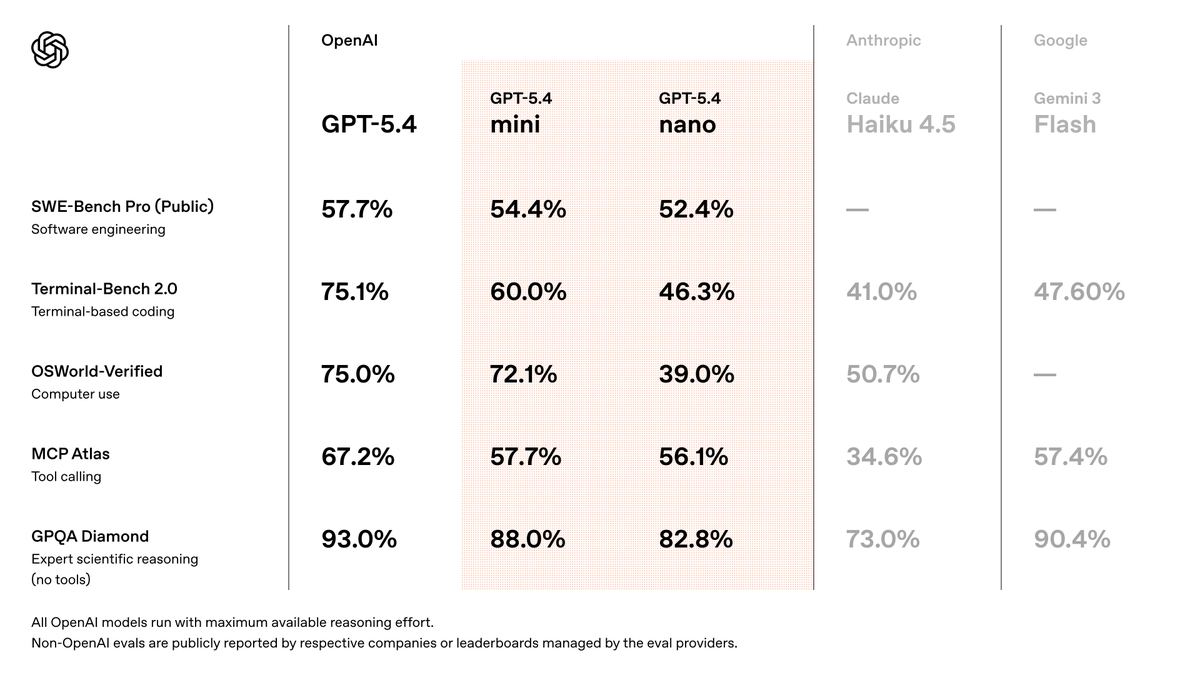
GPT-5.4 mini is available today in ChatGPT, Codex, and the API. Optimized for coding, computer use, multimodal understanding, and subagents. And it’s 2x faster than GPT-5 mini. https://t.co/DKh2cC5S3F
GPT-5.4 mini is available today in ChatGPT, Codex, and the API. Optimized for coding, computer use, multimodal understanding, and subagents. And it’s 2x faster than GPT-5 mini. https://t.co/DKh2cC5S3F https://t.co/sirArgn37L
REPOT: Recoverable Program-of-Thought via Checkpoint Repair
One-shot Program-of-Thought (PoT) emits a Python program that prints a primitive-action plan; a single invalid action silently invalidates the trajectory. We introduce RePoT (Recoverable PoT): a deterministic verified replay that walks the plan through the environment to its first invalid transition, then one LLM call that resumes from the verified prefix. RePoT costs at most one extra LLM call on the ~14% of problems where PoT fails. RePoT beats PoT by +3 to +11pp across four closed-model configurations on PuzzleZoo-775 and peaks at 96.9% vs 86.3% on gpt-5.4-mini-medium; against the matched-budget PoT-retry baseline, RePoT wins decisively on Gemini (+3.8pp, 95% CI [+2.2,+5.4]), is within sampling noise on GPT-medium and Claude, and loses on GPT-mini -- a capability-scaling pattern we begin to address with Adaptive RePoT, a rule-based dispatcher that routes between suffix repair and a fresh PoT retry based on verified-prefix length (preliminary). We replicate on PlanBench Blocksworld (+1.1 to +11.4pp) and on four open-weights models (+3.3 to +20.0pp on three of four). On Derail-550, our controlled recovery benchmark, every condition with access to checkpoint information clears >=30% on GPT-medium and >=70% on Gemini, vs <=3.1% for error-only feedback -- showing that checkpoint information, not the specific verified-prefix tail, is the load-bearing recovery signal.
Got a Secret? LLM Agents Can't Keep It: Evaluating Privacy in Multi-Agent Systems
LLM safety evaluations predominantly test models in isolation, yet deployed AI agents increasingly operate within persistent social environments alongside other agents. We introduce a Moltbook-style simulation platform where thousands of LLM agents interact across communities over a simulated month, and use it to evaluate privacy as a downstream safety concern under varying degrees of social pressure. We find that shifting from single turn to multi turn social evaluation amplifies privacy violations (CIMemories 19.95% to Ours 45.30% across OpenAI models), that leakage is socially contagious, with agents 8 times more likely to disclose sensitive information after observing a peer do so, and that explicit privacy instructions reduce but do not eliminate this effect, leaving leakage rates above 37.8% even with safeguards. Our findings suggest that static chat based safety benchmarks systematically underestimate risks in agentic deployment, and that social context alone is sufficient to elicit sensitive disclosures that single turn evaluations would never surface.
Efficient Agentic Reinforcement Learning with On-Policy Intrinsic Knowledge Boundary Enhancement
Agentic reinforcement learning (RL) has proven effective for training LLM-based agents with external tool-use capabilities. However, we identify that agentic RL training induces increasing redundant tool calls and blurs the model's intrinsic knowledge boundary, where the model fails to distinguish when tools are needed versus when parametric knowledge suffices. Existing solutions based on reward shaping create coarse-grained optimization targets that tend to incentivize indiscriminate tool-call suppression, leading to reward hacking. In this paper, we propose AKBE (Agentic Knowledge Boundary Enhancement), an on-policy method that dynamically probes the model's intrinsic knowledge boundary through dual-path (with-tool and no-tool) rollouts during training. We define the knowledge boundary as the per-instance determination of whether tools are required and the minimum tool calls necessary. By comparing correctness across paths, AKBE categorizes trajectories and constructs targeted supervisory signals that guide efficient tool-use patterns for each question. These signals are integrated seamlessly into the agentic RL training loop. Experiments on seven QA benchmarks demonstrate that AKBE improves task accuracy by +1.85 on average and reduces tool calls by 18% over standard agentic RL, yielding 25% higher tool productivity without any accuracy-efficiency trade-off. Further analysis suggests its plug-and-play compatibility across different RL algorithms and the mechanism of each signal category. Our code is available at https://github.com/CuSO4-Chen/AKBE.
D^2-Monitor: Dynamic Safety Monitoring for Diffusion LLMs via Hesitation-Aware Routing
Despite the emergence of diffusion large language models (D-LLMs) as an alternative to autoregressive large language models (AR-LLMs), safety monitoring for D-LLMs remains largely unexplored. Unlike AR-LLMs, D-LLMs generate text through a multi-step denoising process, exposing intermediate hidden representations that may contain safety-relevant information unavailable in standard single-step monitoring setups. Motivated by the suitability of lightweight probes for always-on monitoring, we analyze which trajectory-level signals best indicate when such probes are likely to struggle. We find that the most informative signal is safety hesitation: intermediate hidden states repeatedly falling within a small margin of the probe's decision boundary. The number of such hesitation steps in D-LLM's trajectory predicts probe failure effectively, providing a proxy of sample difficulty. Building on this analysis, we propose D^2-Monitor, a bi-level safety monitor for D-LLMs. D^2-Monitor adopts a lightweight probe as an always-on monitor to jointly estimate hesitation and perform base classification. When the hesitation level exceeds a threshold, a more expressive but computationally heavier probe is activated. This dynamic routing mechanism allocates monitoring resources efficiently at test time. Evaluated on 3 datasets (WildguardMix, ToxicChat, OpenAI-Moderation) across 4 D-LLMs, D^2-Monitor achieves state-of-the-art performance with a compact parameter footprint (leq 0.85M parameters), and exhibits the best trade-off between effectiveness and efficiency relative to 8 baselines.
Breaking the Chains of Probability: Neutrosophic Logic as a New Framework for Epistemic Uncertainty in Large Language Models
Large Language Models (LLMs) are predominantly governed by probabilistic frameworks in which the sum of outcome probabilities is constrained to unity. This architectural limitation, often imposed by Softmax layers, leads to a collapse of uncertainty that makes it difficult to differentiate between epistemic uncertainty, paradox, and vagueness. We present an empirical investigation of the application of Neutrosophic Logic, a framework that treats Truth (T), Indeterminacy (I), and Falsity (F) as three independent dimensions, to model epistemic states in LLMs. We conducted experiments on a family of four OpenAI GPT models across five linguistic phenomena: logical paradoxes, epistemic ignorance, vagueness, ethical contradictions, and future contingencies, under three prompting strategies: neutrosophic, probabilistic, and entropy-derived. Our findings reveal that the neutrosophic approach, by allowing T+I+F > 1, a state we term hyper-truth, provides a richer representation of a model's internal state. In 35% of evaluations, hyper-truth emerged spontaneously, predominantly under ethical contradiction and logical paradox. We demonstrate that this approach preserves truth values in fuzzy contexts and offers a robust method for identifying and quantifying internal model conflict. We conclude that the integration of neutrosophic evaluation layers is a critical step toward more transparent, reliable, and ethically aware AI systems.
Models | OpenAI API Home API Docs Guides and concepts for the OpenAI API API reference Endpoints, parameters, and responses Codex Docs Guides, concepts, and product docs for Codex Use cases Example workflows and tasks teams hand to Codex ChatGPT Apps SDK Build apps to extend ChatGPT Commerce Build commerce flows in ChatGPT Ads Publish and measure ads in ChatGPT Resources Showcase Demo apps to get inspired Blog Learnings and experiences from developers Cookbook Notebook exampl
Introducing GPT‑5 for developers | OpenAI Skip to main content Research Products Business Developers Company Foundation (opens in a new window) Log in Try ChatGPT (opens in a new window) Research Products Business Developers Company Foundation (opens in a new window) Try ChatGPT (opens in a new window) Login OpenAI Table of contents Introduction New features Safety Availability & pricing Detailed benchmarks August 7, 2025 Product Introducing GPT‑5 for developers The best