Mage-VL is a codec-native, proactive-streaming multimodal foundation model for image and video understanding, whose visual encoder is trained entirely from scratch at a compact 4B scale.
Running this yourself: consumer gpu should be enough.
Model updates refreshed3w agoAug 21, 2026news + changelog
Live access is not confirmed for this model. No current purchase price is advertised.
Related provider subscriptions
No current subscription pricing is tracked for this model.
Confirm this specific model, usage limits, and billing terms with the provider. A subscription does not automatically include API credits.
No login needed to compare. Prices are in USD; provider charges are separate from AI Market Cap plans. Context length, caching, tools, taxes, and regional terms can change the final cost. Open weights do not mean free hosting.
56.9
Quality Score
---
Arena ELO
5B
Parameters
131K
Context
Evidence profile
How complete is this record?
This measures the amount of verifiable public evidence we have, not how capable the model is. A missing field means it has not been verified yet, not that its value is zero.
Recent launch, pricing, benchmark, and API signals linked to this model or its provider.
LaunchesMicrosoft2mo ago
Thrilled to announce by popular demand MAI-Code-1-Flash is now generally available for GitHub Copilot Business and GitHub Copilot Enterprise - fast, efficient, and custom designed to help you build mo
Thrilled to announce by popular demand MAI-Code-1-Flash is now generally available for GitHub Copilot Business and GitHub Copilot Enterprise - fast, efficient, and custom designed to help you build more for less on @github
MAI-Image keeps climbing! Now #3 on @arena's image editing leaderboard. Our latest MAI-Image model is available in Private Preview on Microsoft Foundry. https://t.co/ib8IBXNbXA
The Muon optimizer incurs a significant overhead cost due to its cubic-time Newton-Schulz orthogonalization step. When weights are sharded, communication overhead compounds this computational cost, eroding the benefits of Muon in many settings. We present Dion3, a revision of Muon that targets this overhead at every level of the stack. Our Gram Newton-Schulz algorithm reduces the FLOP cost of orthogonalization, our CuteDSL kernels accelerate it by exploiting symmetry, and our megabatching strategy reduces communication overhead. Moreover, we propose a simple change to the update rule that cuts costs even further: selecting only a fraction of the momentum matrix's rows to orthogonalize at each step. This update rule improves on Dion (another "compressed" version of Muon), in both speed and performance. Overall, Dion3 matches or improves on the loss achieved by Muon but reduces optimizer step time by up to 6x. Dion3 is available via the dion package (https://github.com/microsoft/dion) as a drop-in replacement for Muon.
Bring your mood board to life with MAI-Image-2.6. Our latest image model can modify color, style, and visual details while maintaining consistency across iterations. https://t.co/HyHOy8Nt4s
MAI-Image keeps climbing! Now #3 on @arena's image editing leaderboard. Our latest MAI-Image model is available in Private Preview on Microsoft Foundry. https://t.co/ib8IBXNbXA
X/Twitter@MicrosoftAIMicrosoftannouncementgeneral2mo ago
Say how you feel. Get a poem that meets you there. Ode connects you with a poem for your moment. Guided by William Sieghart. Powered by Microsoft AI models. Try it out here: https://t.co/egu88NTf9C ht
Say how you feel. Get a poem that meets you there. Ode connects you with a poem for your moment. Guided by William Sieghart. Powered by Microsoft AI models. Try it out here: https://t.co/egu88NTf9C https://t.co/jQ3qm9sKnz
Thrilled to announce by popular demand MAI-Code-1-Flash is now generally available for GitHub Copilot Business and GitHub Copilot Enterprise - fast, efficient, and custom designed to help you build mo
Thrilled to announce by popular demand MAI-Code-1-Flash is now generally available for GitHub Copilot Business and GitHub Copilot Enterprise - fast, efficient, and custom designed to help you build more for less on @github
X/Twitter@MicrosoftAIMicrosoftannouncementgeneral2mo ago
We shipped a new coding model built for your everyday dev work. MAI-Code-1-Flash is fast, token-efficient, and trained inside real GitHub Copilot environments. It plans, builds, runs, and tests. All f
We shipped a new coding model built for your everyday dev work. MAI-Code-1-Flash is fast, token-efficient, and trained inside real GitHub Copilot environments. It plans, builds, runs, and tests. All from Copilot Chat in VS Code. Watch it go from a single frost banner to a full
X/Twitter@MicrosoftAIMicrosoftannouncementgeneral2mo ago
MAI-Image-2.5 ranked #2 for text-to-image and #3 for image editing on @ArtificialAnlys - showing strong performance across both generation and precise image edits. From rainy-window blur to a clear, u
MAI-Image-2.5 ranked #2 for text-to-image and #3 for image editing on @ArtificialAnlys - showing strong performance across both generation and precise image edits. From rainy-window blur to a clear, usable street scene, while preserving object consistency, lighting, https://t.co/q8MFDrr8uB
X/Twitter@MicrosoftAIMicrosoftannouncementgeneral3mo ago
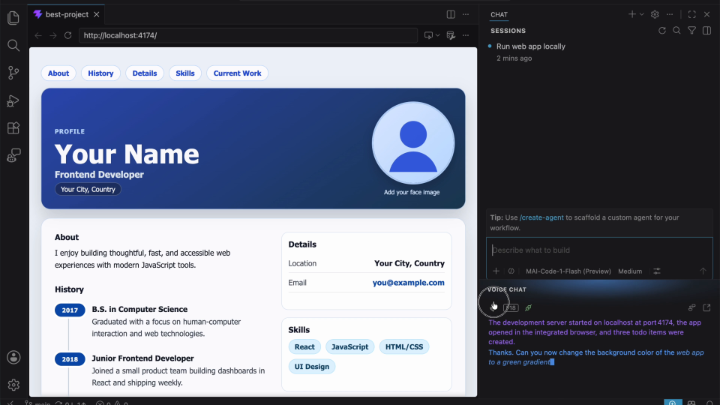
What happens when speech, transcription, and coding models work together? This prototype demo, built using a VS Code fork, showcases how MAI-Transcribe, MAI-Voice, and MAI-Code-1-Flash can work togeth
What happens when speech, transcription, and coding models work together? This prototype demo, built using a VS Code fork, showcases how MAI-Transcribe, MAI-Voice, and MAI-Code-1-Flash can work together in a unified workflow to transform spoken instructions into working code. https://t.co/z35l4fV2xQ
X/Twitter@MicrosoftAIMicrosoftannouncementgeneral3mo ago
Behind every model is a team dedicated to solving difficult challenges, exploring new ideas, and continuously pushing technology forward. Meet some of the people behind Microsoft AI. Watch the full vi
Behind every model is a team dedicated to solving difficult challenges, exploring new ideas, and continuously pushing technology forward. Meet some of the people behind Microsoft AI. Watch the full video here: https://t.co/oNxtle7FtO https://t.co/8fsVY6DnFQ
The Muon optimizer incurs a significant overhead cost due to its cubic-time Newton-Schulz orthogonalization step. When weights are sharded, communication overhead compounds this computational cost, eroding the benefits of Muon in many settings. We present Dion3, a revision of Muon that targets this overhead at every level of the stack. Our Gram Newton-Schulz algorithm reduces the FLOP cost of orthogonalization, our CuteDSL kernels accelerate it by exploiting symmetry, and our megabatching strategy reduces communication overhead. Moreover, we propose a simple change to the update rule that cuts costs even further: selecting only a fraction of the momentum matrix's rows to orthogonalize at each step. This update rule improves on Dion (another "compressed" version of Muon), in both speed and performance. Overall, Dion3 matches or improves on the loss achieved by Muon but reduces optimizer step time by up to 6x. Dion3 is available via the dion package (https://github.com/microsoft/dion) as a drop-in replacement for Muon.
Mage-VL: An Efficient Codec-Native Streaming Multimodal Foundation Model
Standard vision-language models (VLMs) suffer from Moravec's paradox: they excel at complex offline visual reasoning but struggle with simple streaming perception tasks and process them inefficiently. We present Mage-VL, an efficient codec-native streaming foundation model for real-time multimodal understanding and interaction. At its core, our custom tokenizer, Mage-ViT, replaces uniform frame sampling by selectively encoding dynamic, entropy-rich regions using motion vectors and residual energy across sparse anchor (I) and predicted (P) frames. Operating at a 16 x 16 patch level, this reduces visual token consumption by over 75% while preserving spatiotemporal context. Trained from scratch on approximately 560M unlabeled images and 100M unlabeled video frames, Mage-ViT matches or outperforms flagship encoders trained on billions of image-text pairs. We establish AI4AI data pipelines encompassing prompt-code joint optimization for multimodal captioning and AI-driven performance diagnosis to guide training recipes. Furthermore, through a bio-inspired dual-system architecture - a lightweight System 1 event gate and a causal System 2 decoder - Mage-VL enables proactive streaming perception. Extensive evaluations show that Mage-VL-4B matches Qwen3-VL-4B on static tasks while achieving strong gains in video understanding and 2D/3D spatial reasoning, with up to a 3.5x wall-clock inference speedup, and comprehensively surpasses the 15B Phi-4-reasoning-vision baseline. Beyond model artifacts, we deliver seven key empirical findings covering pre-training data efficiency, variable-resolution scaling, codec system acceleration, VideoQA SFT redundancy, motion-spatial synergy, AI4AI data pipelines, and Zero-Vision SFT for multimodal RL.
Object-Centric Residual RL for Zero-Shot Sim-to-Real VLA Enhancement
Vision-Language-Action (VLA) models can generalize across diverse manipulation tasks, but their imitation-learning-based policies remain brittle in precise physical interactions due to compounding execution errors; Can a reinforcement learning policy trained purely in simulation improve the robustness of real-world VLAs zero-shot? Residual RL, which learns a corrective policy on top of a frozen VLA, offers a natural framework, but existing approaches face a fundamental sim-to-real dilemma: privileged-state methods require lossy distillation for deployment; image-based methods suffer from the visual domain gap; and real-world RL is costly and unsafe. We propose an object-centric residual RL framework that refines VLA actions using object poses, enabling a compact observation space that transfers consistently between simulation and reality. To align the two domains, we additionally replay the same teleoperation demonstrations in simulation to train a sim counterpart of the real-world VLA. The residual RL policy is trained only in simulation with pose noise injection and dropout, and transfers zero-shot to the real robot. Across five manipulation tasks on a real Franka Research 3 (FR3) robot, our method improves the success rate from 42% to 76% zero-shot, and the improved rollouts can be further reused to retrain the base VLA for self-improvement without additional teleoperation. Project page: https://www.microsoft.com/en-us/research/articles/object-centric-residual-rl/