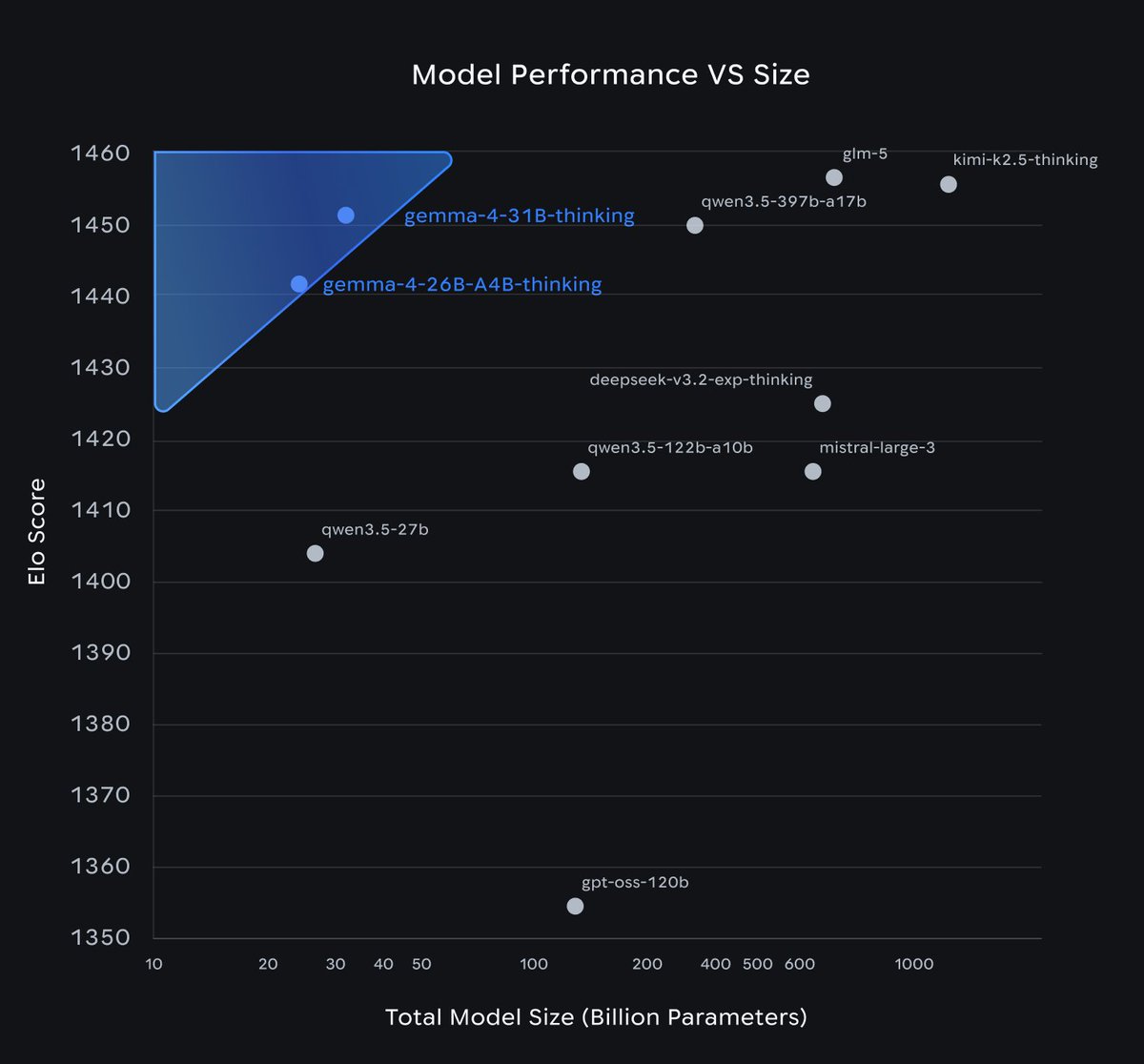
Google's fourth-generation open-weight multimodal model family, released under Apache 2.0 for private deployment on your own hardware, cloud GPUs, and edge devices.
Running this yourself: can likely run on your own machine.
Model updates refreshed3h agoOct 8, 2026news + changelog
Current rates are not verified. Missing pricing does not mean free usage.
Related provider subscriptions
No current subscription pricing is tracked for this model.
Confirm this specific model, usage limits, and billing terms with the provider. A subscription does not automatically include API credits.
No login needed to compare. Prices are in USD; provider charges are separate from AI Market Cap plans. Context length, caching, tools, taxes, and regional terms can change the final cost. Open weights do not mean free hosting.
50.9
Quality Score
1242
Arena ELO
Unknown
Parameters
128K
Context
Evidence profile
How complete is this record?
This measures the amount of verifiable public evidence we have, not how capable the model is. A missing field means it has not been verified yet, not that its value is zero.
Recent launch, pricing, benchmark, and API signals linked to this model or its provider.
LaunchesGoogle4w ago
Our @GoogleResearch Connectomics team, in collaboration with @HHMIJanelia, has released the complete wiring diagram of a male fruit fly’s brain and central nervous system — the largest brain map by nu
Our @GoogleResearch Connectomics team, in collaboration with @HHMIJanelia, has released the complete wiring diagram of a male fruit fly’s brain and central nervous system — the largest brain map by number of proofread neurons to date. So, why do we care so much about a tiny
We love seeing what you’ve built with Gemma 4, the open model family that we released last week. Here are a few fun examples, described by the builders in their own words (🧵):
Here’s everything we launched this week (we promise not a single one of these is a joke): — Gemma 4, bringing our most intelligent open models and breakthrough reasoning to your personal hardware and
Here’s everything we launched this week (we promise not a single one of these is a joke): — Gemma 4, bringing our most intelligent open models and breakthrough reasoning to your personal hardware and devices while outcompeting models 20x its size — Veo 3.1 Lite, our latest
Today, we’re launching Gemma 4, our most intelligent open models to date. Built with the same breakthrough technology as Gemini 3, Gemma 4 brings advanced reasoning to your personal hardware and devic
Today, we’re launching Gemma 4, our most intelligent open models to date. Built with the same breakthrough technology as Gemini 3, Gemma 4 brings advanced reasoning to your personal hardware and devices. Here’s what Gemma 4 unlocks for developers: — Intelligence-per-parameter: https://t.co/JgwRZvQHgF
Meet Gemma 4: our new family of open models you can run on your own hardware. Built for advanced reasoning and agentic workflows, we’re releasing them under an Apache 2.0 license. Here’s what’s new 🧵
Meet Gemma 4: our new family of open models you can run on your own hardware. Built for advanced reasoning and agentic workflows, we’re releasing them under an Apache 2.0 license. Here’s what’s new 🧵 https://t.co/u19GbEIoLJ
Check out this week's updates and releases: — Gemini 3.8 Flash TTS and Gemini 3.8 Flash-Lite TTS, two of our most expressive audio generation models yet — Gemini 3.8 Live with Live Avatar, bringing ne
Check out this week's updates and releases: — Gemini 3.8 Flash TTS and Gemini 3.8 Flash-Lite TTS, two of our most expressive audio generation models yet — Gemini 3.8 Live with Live Avatar, bringing near real-time visual presence to Gemini’s conversational AI — @Gemini_Notebook
X/Twitter@GoogleDeepMindGoogleannouncementgeneral3w ago
How can we reconstruct a memory that was never filmed? Our team paired restored archival photos with pose control models to capture the mannerisms and micro-expressions of Burt and Ethelle. This helpe
How can we reconstruct a memory that was never filmed? Our team paired restored archival photos with pose control models to capture the mannerisms and micro-expressions of Burt and Ethelle. This helped bring the day they first met to life for Love, Rendered, a new documentary https://t.co/2mMxcmRyva
Our @GoogleResearch Connectomics team, in collaboration with @HHMIJanelia, has released the complete wiring diagram of a male fruit fly’s brain and central nervous system — the largest brain map by nu
Our @GoogleResearch Connectomics team, in collaboration with @HHMIJanelia, has released the complete wiring diagram of a male fruit fly’s brain and central nervous system — the largest brain map by number of proofread neurons to date. So, why do we care so much about a tiny
We love seeing what you’ve built with Gemma 4, the open model family that we released last week. Here are a few fun examples, described by the builders in their own words (🧵):
X/Twitter@GoogleDeepMindGoogleopen_sourceopen source6mo ago
Gemma 4 punches above its weight, outperforming models 10x its size without the need for massive compute. With 10M+ downloads in its first week and 500M+ for the Gemma family overall, we’re excited to
Gemma 4 punches above its weight, outperforming models 10x its size without the need for massive compute. With 10M+ downloads in its first week and 500M+ for the Gemma family overall, we’re excited to see this level of engagement within the open research community. https://t.co/8s9ek1VR8k
Here’s everything we launched this week (we promise not a single one of these is a joke): — Gemma 4, bringing our most intelligent open models and breakthrough reasoning to your personal hardware and
Here’s everything we launched this week (we promise not a single one of these is a joke): — Gemma 4, bringing our most intelligent open models and breakthrough reasoning to your personal hardware and devices while outcompeting models 20x its size — Veo 3.1 Lite, our latest
Today, we’re launching Gemma 4, our most intelligent open models to date. Built with the same breakthrough technology as Gemini 3, Gemma 4 brings advanced reasoning to your personal hardware and devic
Today, we’re launching Gemma 4, our most intelligent open models to date. Built with the same breakthrough technology as Gemini 3, Gemma 4 brings advanced reasoning to your personal hardware and devices. Here’s what Gemma 4 unlocks for developers: — Intelligence-per-parameter: https://t.co/JgwRZvQHgF
Meet Gemma 4: our new family of open models you can run on your own hardware. Built for advanced reasoning and agentic workflows, we’re releasing them under an Apache 2.0 license. Here’s what’s new 🧵
Meet Gemma 4: our new family of open models you can run on your own hardware. Built for advanced reasoning and agentic workflows, we’re releasing them under an Apache 2.0 license. Here’s what’s new 🧵 https://t.co/u19GbEIoLJ
Persistence Forcing: Exploiting Feature Specialization in Pixel-Space Diffusion
Pixel-space diffusion Transformers (DiTs) directly operate on high-dimensional visual data, yet their hidden representations typically undergo uniform refinement across depth. Natural images, however, are inherently organized at different levels of granularity. Global structure can often be represented compactly, whereas local textures and fine details require richer representations. Motivated by this, we introduce heterogeneous refinement in pixel-space DiTs, assigning different feature groups distinct refinement budgets across depth. Consequently, an ordered feature specialization emerges: sparsely refined features predominantly encode global visual structure, whereas more frequently refined features increasingly specialize toward localized, high-frequency details. We refer to these two groups as persistent and active features, respectively. Building on this emergent specialization, we introduce Persistence Forcing (PerF), which explicitly exploits this persistent--active feature organization for pixel-space image generation. This enables persistent features to continuously condition actively refined features, allowing stable global information to guide the ongoing refinement of finer visual details. During generative sampling, this interaction further induces a meaningful guidance direction that promotes coherent global structure and naturally complements classifier-free guidance. On ImageNet 256times256, PerF-L achieves FID of 1.91, approaching 1.86 of JiT-H with only half the parameters, while PerF-H further achieves FID of 1.63 and 1.76 on ImageNet 256times256 and 512times512, respectively.
StableVQ: Practical Guidelines for Stable Vector-Quantized Tokenizer Training
Vector Quantization (VQ) is fundamental to discrete visual tokenizers that power modern autoregressive and masked image generation models. While recent shared-projection codebook methods have substantially advanced codebook utilization, training stability remains a critical and underexplored challenge. We argue that the root cause lies in the entanglement of the Encoder--Decoder and Codebook training: because neither module can reliably fulfill its own responsibility in isolation, the system can only function when the two subsystems happen to cooperate---a fragile condition that breaks down precisely when training is most stressed. We propose StableVQ, which revisits the proper learning objective of each module and resolves the problems that arise when each is trained to fulfill its own role independently. Concretely, (1) Dynamic STE corrects the instability in the Encoder's learning objective, enabling it to robustly optimize the reconstruction space under discrete regularization even when codebook utilization is low. (2) Region VQ Loss reconceives the Codebook's learning objective so that it can independently guarantee full tracking of the encoder output distribution, without relying on encoder oscillations to drive activation. (3) Decoupled Schedule recognizes that the distinct responsibilities of the Encoder--Decoder and the Codebook demand distinct optimization dynamics, and assigns each an independent learning rate schedule to ensure robust system-level behavior. Built on top of shared-projection codebooks, StableVQ is lightweight and introduces no learnable parameters. Experiments on ImageNet demonstrate consistent improvements in training stability, codebook utilization, and reconstruction quality across diverse codebook sizes and initialization settings.
RRSI: Regularized Recursive Self-Improvement of Agent Harnesses
An LLM agent's capability is largely magnified by its harness, namely the prompts, control flow, tooling, memory, and context management surrounding the frozen backbone model. Recent methods increasingly automate this process by iteratively proposing and selecting component-wise edits of an agent harness, practically establishing a form of recursive self-improvement (RSI) at the agent-system level. However, such recursive evolution may overfit by memorizing the training tasks, showing large in-distribution gains that shrink or even vanish on out-of-distribution benchmarks. We introduce Regularized Recursive Self-Improvement of Agent Harnesses (RRSI), which incorporates the principles of regularizations into harness self-improvement by constraining the evolution candidate proposal and selection. The proposer operates with a temporally annealed budget, limiting how many edits a candidate can bundle, and it encourages unexplored trajectories based on evolution history. The selector is equipped with a critic and a pruner: the critic screens benchmark-specific proposals, while the pruner, removes changes that are too small, too expensive, or no longer useful. Together these constraints favor reusable agent mechanisms over benchmark-specific ones or even noises. Across eight benchmarks spanning coding, agentic workspace and engineering design tasks, RRSI gains up to 14.1 points on the split it evolves against and up to 4.7 points on the five out-of-distribution benchmarks, while producing a harness that runs on 30% fewer policy tokens than the unregularized evolution. Code is available at https://github.com/google-research/rrsi and project page is https://regularized-rsi.com/.
When EOS Tokens Disagree: Understanding Length Inflation in On-Policy Distillation
We study length inflation in on-policy distillation (OPD), where student responses can become excessively long and even exhaust the generation budget. We identify termination-token mismatch between base students and post-trained teachers as an important source of this behavior. Across Qwen3, Llama, and Gemma, the two models can place their stopping probability on different EOS tokens, even when their declared stopping sets are identical. This mismatch can suppress the student's preferred termination action without reliably transferring the teacher-preferred alternative. We show that aligning the decoding stopping set alone is insufficient, while treating functionally equivalent EOS tokens as a shared semantic stopping action substantially mitigates mismatch-induced length inflation across all three model families. To further understand how termination behavior evolves over training, we study OPD across different K2-Horizon training stages. This stage-wise analysis shows that termination preferences can shift substantially during training, while also revealing a distinct length inflation late in the OPD run that persists beyond termination alignment. Together, these results identify termination mismatch as an important, but not exhaustive, source of OPD length dynamics. We release an implementation incorporating the proposed termination-handling corrections.
Training-Adaptive Convolutional Sparse Coding via Information Bottleneck for Robust Visual Representation
Visual signals require compact yet sufficient representations for robust downstream prediction. Convolutional sparse coding (CSC) provides an explicit mechanism for suppressing redundant components while preserving signal content, but its sparsity coefficient is typically fixed and manually selected. We propose a training-adaptive convolutional sparse coding framework for robust visual signal representation. Specifically, we unfold the CSC optimization with the Fast Iterative Shrinkage-Thresholding Algorithm (FISTA) and treat the sparsity coefficient as a differentiable variable jointly learned with the network parameters. From the information bottleneck perspective, this coefficient controls the trade-off between information retention and compression: the sparsity term promotes compact representations, while the reconstruction term together with task loss preserves task-relevant signal content. We further introduce a label-free post-training strategy that adjusts the compression strength for corrupted inputs with the main network parameters fixed. Experiments on CIFAR and ImageNet demonstrate competitive clean-data recognition and greatly improved robustness under different input perturbations.
VākQA: A Benchmark and Evaluation Study for Telugu Spoken Factoid Question Answering
Question answering has advanced rapidly with large language models, but predominantly for high-resource languages, in both text and spoken settings. Spoken question answering (SQA) benchmark for Telugu remains unexplored, and the reliability of automatic evaluation in this setting remains unquantified. We introduce VākQA, a Telugu SQA benchmark of 2,001 factoid question-answer pairs across six domains, with 2.53 hours of speech audio, bilingual transcriptions, and human-verified reference answers. We first validate evaluation methods against human judgements: Gemini-as-a-judge best approximates human ratings but is non-uniformly strict, while open-weight judges systematically penalize correct Telugu answers that differ in surface form from the reference. Using this validated setup, we benchmark proprietary and open-weight models across input modality, language, and domain. We observe that Telugu phrasing retains cultural specificity that is lost in translation, speech input introduces phonetic confusions that alter question meaning, and cascaded ASR-MT errors compound progressively. VākQA is publicly released.
ModaLens: Measuring Image Sensitivity in Report-Conditioned Medical VLMs
A radiology report can already answer a clinical question, so it is hard to tell whether a vision-language model also uses the image. ModaLens, a paired image-swap audit, measures how report availability changes image sensitivity: MedGemma-27B on 3,199 paired MIMIC-CXR cases from 293 patients, all 14 questions per case (13 finding-specific and one composite), each image replaced by one from another study, usually of the same patient, with question and report fixed. Under an explicit answer instruction, the model's generated answer changes on 4.26 percent of trials with the report and 20.94 percent without it, a paired increase of 16.7 points (patient-clustered 95 percent CI 15.6 to 17.7), so report availability reduces image-swap sensitivity under this protocol; the original prompt with a lowercase first-token readout gives 4.70 percent against 17.07 percent, and substitutions also move continuous answer scores where the binary prediction does not change. The labels are derived from reports, which limits conclusions about visual correctness; the direction replicates in two further model lineages. Code, the exact prompts and a run record for every number are at https://github.com/criticaldata/MODALENS.
SimpleOPD: Simple Tokenizer-Agnostic On-Policy Distillation for Long-Context Reasoning
On-policy distillation (OPD) offers a promising way to transfer reasoning capabilities from stronger teacher models, but applying it to long-context reasoning teachers and short-context students introduces practical challenges, including tokenizer mismatch, teacher-student distribution mismatch, response length explosion, and training instability. In this work, we study this setting by transferring proof-reasoning capabilities from the long-context reasoning model SU-01 to short-context student models. To handle tokenizer differences, we perform OPD in a shared text space and align only tokens that occupy identical text spans under the student and teacher tokenizers. To mitigate the problem of excessive generation length and frequent truncation, we introduce a student reference KL loss and mask the advantages of special termination tokens such as </think> and <|im_end|>. This strategy constrains the student from drifting excessively from its initial policy, thereby mitigating the teacher-student distribution mismatch problem and fostering steady length growth. Experiments on both same-family and different-family student models, including Qwen3, Qwen3.5, Intern-S2, GLM-4.7, Gemma-4, show consistent gains in mathematical reasoning, especially natural-language math proving. Notably, Intern-S2-Preview improves by 21.2 points on ProofBench, reaching 55.2 and surpassing Gemini-2.5-Pro. It also improves on science benchmarks such as HLE and HiPhO, suggesting that OPD transfers reasoning capabilities that generalize beyond the mathematical training domain.
DFM Mimir v1: An Open HRM Delivering Frontier Performance at 1B Parameters Using Only Permissible Post-Training Data
Current large language model development relies on massive, often non-permissible datasets, creating a high barrier for researchers committed to open-source and ethically sourced data. We introduce Mimir v1, a 1-billion-parameter language model based on the Hierarchical Reasoning Model (HRM) architecture, that is trained from scratch and delivers highly competitive performance for English and sets a new state of the art for Danish using only permissible post-training data. Trained on a mixture of 161 datasets, Mimir v1 outperforms the original HRM-Text 1B and competes with larger frontier models like Qwen 3.5 4B and Gemma 4 E2B, tested across 20 benchmarks for English, Math & Code and Danish. The model is available on the Hugging Face Hub: https://huggingface.co/danish-foundation-models/DFM-Mimir
We introduce DiffusionGemma, an experimental open-weight language model that uses discrete diffusion to generate text at exceptionally high speed. Rather than decoding one token at a time, DiffusionGemma iteratively refines blocks of 256 tokens in parallel, avoiding the sequential decoding bottleneck of conventional autoregressive (AR) large language models. Instead of training from scratch, we obtain DiffusionGemma by fine-tuning the mixture-of-experts Gemma 4 model with 3.8B activated and 25.2B total parameters. Our compute-efficient two-stage training pipeline uses fewer than 10% of the starting AR model's total training token budget. The first stage uses supervised fine-tuning to teach bidirectional denoising, while the second stage combines reinforcement learning with sampler distillation to jointly improve generation quality and inference efficiency. DiffusionGemma establishes a new Pareto frontier for the trade-off between generation speed and model capability. Averaged across our full evaluation suite, it generates around 20 tokens per forward pass and achieves roughly 1,500 output tokens per second on a single NVIDIA H100 GPU, which is substantially faster than AR models even with state-of-the-art speculative decoding. DiffusionGemma also retains the starting model's support for thinking mode, multimodal inputs, and long contexts. Despite diffusion fine-tuning, it remains capable of AR generation with only minor performance degradation, suggesting a path toward hybrid diffusion-AR decoding.
Agon: Competitive Cross-Model RL with Implicit Rival Grading of Reasoning
Reinforcement learning from verifiable rewards (e.g. GRPO) is the engine behind today's reasoning models, yet it grades only the final answer. On hard problems this trains models to write more rather than to think better, since the trace itself is never graded and no label for good thinking exists. We introduce Agon, which makes two competing models each other's graders. Both attempt the same problem; in alternating roles, one drafts a solution and the other reads it while solving, and each is rewarded for out-solving the other. To win, a model must out-reason a rival that has seen its work, so reasoning is judged implicitly during training, with no process labels and no reward model. Because both models are optimized, each faces a progressively stronger rival, which single-model RL cannot provide. The two need only be comparably strong and behaviorally different. At inference the pair deploys as it trains, a two-stage cascade in which one model drafts and the other answers after reading the draft. On the hard split of DeepMath with Qwen3, this doubles GRPO's pass@1, roughly eight times the gain of an untrained Mixture-of-Agents pass over the same base. The ordering replicates on competitive-programming code and across model families (Qwen3.5, Gemma 4). For now the models talk in text; the next step is to let them reason together in latent space.
We introduce Gemma 4, a new generation of open-weight, natively multimodal language models in the Gemma model family. Designed to advance compute efficiency and reasoning, the Gemma 4 model suite features dense and Mixture-of-Experts architectures, ranging from 2.3B to 31B parameters. Alongside improved vision and audio encoders for all model sizes, we propose a unified, encoder-free architecture for our 12B model, which ingests raw audio and image patches. Furthermore, we integrate a thinking mode, enabling Gemma models to generate reasoning traces prior to responding. We improve inference speed, memory, and compute efficiency, as well as long-context abilities through critical design choices. Gemma 4 establishes a leap in performance across STEM, multimodal, and long-context benchmarks, and rivals larger, frontier open models in human-rated tasks.
Discrete Diffusion Language Models for Interactive Radiology Report Drafting
Diffusion language models, which generate text by denoising a token canvas bidirectionally instead of emitting tokens left to right, have become competitive with autoregressive (AR) generation. Medical foundation models, however, remain almost entirely autoregressive. We adapt a mixture-of-experts diffusion language model, DiffusionGemma-26B, and benchmark it against its same-size AR sibling Gemma-4-26B under an identical LoRA recipe on medical visual question answering datasets, scored by a verbosity-robust LLM judge. Diffusion matches or exceeds AR on all of them, and the finetuned model (3.8B active) is competitive with frontier vision-language models; its decoding is also 3.5-4.4x faster. Beyond this parity, the diffusion model offers a drafting capability AR lacks: any-order infill. Because the canvas is denoised bidirectionally, a radiologist can fix report fragments and have the model fill the text between them, an operation inherent to diffusion but not to autoregression, which is subpar at it. This suits real reports, which are often terse or inconsistent across clinicians and institutions.
Gemma 4 is now available through local Ollama runtime and Ollama Cloud. 128K context window listed. Gemma 4 models are designed to deliver frontier-level performance at each size. They are well-suited for reasoning, agentic workflows, coding, and multimodal understanding.
Gemma — Google DeepMind Skip to main content Explore our next generation AI systems Explore models Gemini Gemini Build intelligent agents Gemini Omni Create anything from anything Nano Banana Create and edit detailed images Gemini Audio Talk, create and control audio Specialized models Veo Generate cinematic video with audio Lyria Generate high fidelity music and audio Genie 3 Generate and explore interactive worlds Gemini Robotics Perceive, reason, use tools and interact Ope
Gemma — Google DeepMind Skip to main content Explore our next generation AI systems Explore models Gemini Gemini Build intelligent agents Gemini Omni Create anything from anything Nano Banana Create and edit detailed images Gemini Audio Talk, create and control audio Specialized models Veo Generate cinematic video with audio Lyria Generate high fidelity music and audio Genie 3 Generate and explore interactive worlds Gemini Robotics Perceive, reason, use tools and interact Ope