Current rates are not verified. Missing pricing does not mean free usage.
Related provider subscriptions
No current subscription pricing is tracked for this model.
Confirm this specific model, usage limits, and billing terms with the provider. A subscription does not automatically include API credits.
No login needed to compare. Prices are in USD; provider charges are separate from AI Market Cap plans. Context length, caching, tools, taxes, and regional terms can change the final cost. Open weights do not mean free hosting.
---
Quality Score
---
Arena ELO
Undisclosed
Parameters
---
Context
Evidence profile
How complete is this record?
This measures the amount of verifiable public evidence we have, not how capable the model is. A missing field means it has not been verified yet, not that its value is zero.
Recent launch, pricing, benchmark, and API signals linked to this model or its provider.
LaunchesGoogleToday
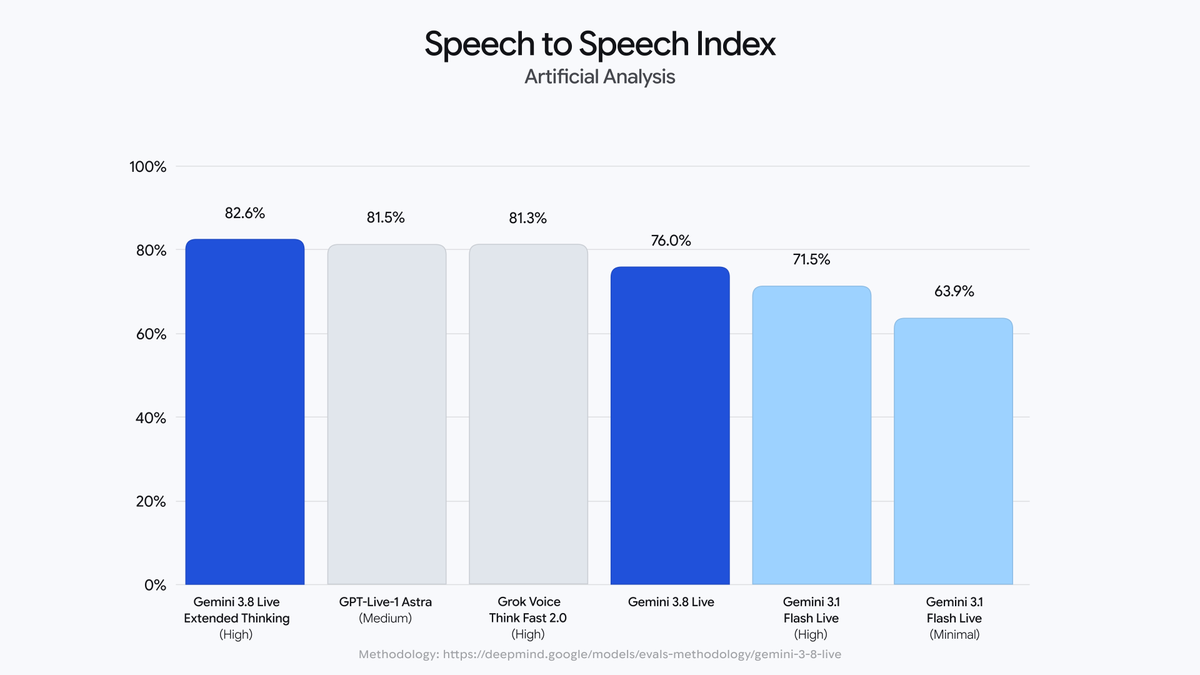
Introducing our most advanced Gemini Audio models yet 🗣 Gemini 3.8 Live and 3.8 Live Extended Thinking let you speak, collaborate, and execute tasks seamlessly, meaning conversing with AI just got a
Introducing our most advanced Gemini Audio models yet 🗣 Gemini 3.8 Live and 3.8 Live Extended Thinking let you speak, collaborate, and execute tasks seamlessly, meaning conversing with AI just got a lot more natural. So, what’s the difference between these two models? Let’s https://t.co/Dfy7j4zxOh
We’re introducing Gemini 3.8 Live and 3.8 Live Extended Thinking – our best conversational AI. The models talk, think, and handle tasks in the background without breaking your flow. 🧵 https://t.co/ni
We’re introducing Gemini 3.8 Live and 3.8 Live Extended Thinking – our best conversational AI. The models talk, think, and handle tasks in the background without breaking your flow. 🧵 https://t.co/nifcYx1C6L
Our @GoogleResearch Connectomics team, in collaboration with @HHMIJanelia, has released the complete wiring diagram of a male fruit fly’s brain and central nervous system — the largest brain map by nu
Our @GoogleResearch Connectomics team, in collaboration with @HHMIJanelia, has released the complete wiring diagram of a male fruit fly’s brain and central nervous system — the largest brain map by number of proofread neurons to date. So, why do we care so much about a tiny
We’re launching AlphaGenome Atlas: an AI-powered searchable database mapping the predicted impact of all 9 billion possible single-letter DNA changes. Here’s how it could help researchers better under
We’re launching AlphaGenome Atlas: an AI-powered searchable database mapping the predicted impact of all 9 billion possible single-letter DNA changes. Here’s how it could help researchers better understand our biology 🧵 https://t.co/SABFZW5SiR
Introducing WeatherNext 3️⃣— our most advanced global weather AI model yet from @GoogleDeepmind and @GoogleResearch With prediction capabilities that are up to 5x sharper than WeatherNext 2, the model
Introducing WeatherNext 3️⃣— our most advanced global weather AI model yet from @GoogleDeepmind and @GoogleResearch With prediction capabilities that are up to 5x sharper than WeatherNext 2, the model generates a forecast with high spatial resolution in order to catch https://t.co/XNDjd7eoHw
Introducing our most advanced Gemini Audio models yet 🗣 Gemini 3.8 Live and 3.8 Live Extended Thinking let you speak, collaborate, and execute tasks seamlessly, meaning conversing with AI just got a
Introducing our most advanced Gemini Audio models yet 🗣 Gemini 3.8 Live and 3.8 Live Extended Thinking let you speak, collaborate, and execute tasks seamlessly, meaning conversing with AI just got a lot more natural. So, what’s the difference between these two models? Let’s https://t.co/Dfy7j4zxOh
We’re introducing Gemini 3.8 Live and 3.8 Live Extended Thinking – our best conversational AI. The models talk, think, and handle tasks in the background without breaking your flow. 🧵 https://t.co/ni
We’re introducing Gemini 3.8 Live and 3.8 Live Extended Thinking – our best conversational AI. The models talk, think, and handle tasks in the background without breaking your flow. 🧵 https://t.co/nifcYx1C6L
X/Twitter@GoogleDeepMindGoogleannouncementgeneral4d ago
How can we reconstruct a memory that was never filmed? Our team paired restored archival photos with pose control models to capture the mannerisms and micro-expressions of Burt and Ethelle. This helpe
How can we reconstruct a memory that was never filmed? Our team paired restored archival photos with pose control models to capture the mannerisms and micro-expressions of Burt and Ethelle. This helped bring the day they first met to life for Love, Rendered, a new documentary https://t.co/2mMxcmRyva
X/Twitter@GoogleDeepMindGoogleannouncementgeneral6d ago
From tracking hurricanes to optimizing renewable energy grids, @PeterWBattaglia and @fryrsquared explore how WeatherNext 3 is shaping how we model forecasts and prepare in a fast-changing climate. Pod
From tracking hurricanes to optimizing renewable energy grids, @PeterWBattaglia and @fryrsquared explore how WeatherNext 3 is shaping how we model forecasts and prepare in a fast-changing climate. Podcast timecodes: 00:00 Introduction 00:38 Hurricane Melissa 11:50 Why weather https://t.co/JmuAm6NdtE
Our @GoogleResearch Connectomics team, in collaboration with @HHMIJanelia, has released the complete wiring diagram of a male fruit fly’s brain and central nervous system — the largest brain map by nu
Our @GoogleResearch Connectomics team, in collaboration with @HHMIJanelia, has released the complete wiring diagram of a male fruit fly’s brain and central nervous system — the largest brain map by number of proofread neurons to date. So, why do we care so much about a tiny
We’re launching AlphaGenome Atlas: an AI-powered searchable database mapping the predicted impact of all 9 billion possible single-letter DNA changes. Here’s how it could help researchers better under
We’re launching AlphaGenome Atlas: an AI-powered searchable database mapping the predicted impact of all 9 billion possible single-letter DNA changes. Here’s how it could help researchers better understand our biology 🧵 https://t.co/SABFZW5SiR
Introducing WeatherNext 3️⃣— our most advanced global weather AI model yet from @GoogleDeepmind and @GoogleResearch With prediction capabilities that are up to 5x sharper than WeatherNext 2, the model
Introducing WeatherNext 3️⃣— our most advanced global weather AI model yet from @GoogleDeepmind and @GoogleResearch With prediction capabilities that are up to 5x sharper than WeatherNext 2, the model generates a forecast with high spatial resolution in order to catch https://t.co/XNDjd7eoHw
X/Twitter@GoogleDeepMindGoogleannouncementgeneral1w ago
WeatherNext 3 is a major breakthrough in how we forecast global weather. ⛅ Developed with @GoogleResearch, the model learns directly from real-world, real-time observations to give more localized high
WeatherNext 3 is a major breakthrough in how we forecast global weather. ⛅ Developed with @GoogleResearch, the model learns directly from real-world, real-time observations to give more localized highly accurate predictions faster. 🧵 https://t.co/iI8c6uEN4n
X/Twitter@GoogleDeepMindGoogleannouncementgeneral1w ago
Two new Gemini models are here to help scale your AI agents and secure code: 🔘 3.8 Flash: our most intelligent model yet with significant gains from 3.7 Flash across software engineering, agentic tas
Two new Gemini models are here to help scale your AI agents and secure code: 🔘 3.8 Flash: our most intelligent model yet with significant gains from 3.7 Flash across software engineering, agentic tasks, and multi-step reasoning. 🔘 3.8 Flash Cyber: our most capable https://t.co/EEJDIMhRwp
X/Twitter@GoogleDeepMindGoogleannouncementgeneral2w ago
We’re bringing agentic video understanding to our latest Gemini models. They can now analyze videos with better accuracy while using up to 88% fewer tokens. 🧵 https://t.co/ZTjlaLk7tX
ModaLens: Measuring Image Sensitivity in Report-Conditioned Medical VLMs
A radiology report can already answer a clinical question, so it is hard to tell whether a vision-language model also uses the image. ModaLens, a paired image-swap audit, measures how report availability changes image sensitivity: MedGemma-27B on 3,199 paired MIMIC-CXR cases from 293 patients, all 14 questions per case (13 finding-specific and one composite), each image replaced by one from another study, usually of the same patient, with question and report fixed. Under an explicit answer instruction, the model's generated answer changes on 4.26 percent of trials with the report and 20.94 percent without it, a paired increase of 16.7 points (patient-clustered 95 percent CI 15.6 to 17.7), so report availability reduces image-swap sensitivity under this protocol; the original prompt with a lowercase first-token readout gives 4.70 percent against 17.07 percent, and substitutions also move continuous answer scores where the binary prediction does not change. The labels are derived from reports, which limits conclusions about visual correctness; the direction replicates in two further model lineages. Code, the exact prompts and a run record for every number are at https://github.com/criticaldata/MODALENS.
Let Confidence Change, Not the Prediction: Prediction-Preserving Repair for Post-hoc Calibration
Post-hoc calibration corrects reported confidence, yet a multiclass calibrator can also change the associated top-1 prediction. Accuracy captures only the net effect of these changes on correctness, not how often predictions change; the Top-1 Prediction Change Rate (TPCR) instead measures this frequency. We propose Calibrator-Output Repair for Top-1 Decision Preservation (CORD), the first post-fit adapter to impose exact prediction preservation by repairing the full calibrated probability vector. From the original and calibrated outputs alone, CORD determines the mass assigned to the original top-1. The calibrated conditional distribution allocates the remaining mass over the other classes, yielding a repaired vector whose own argmax recovers the original prediction. On the calibration split, CORD coordinates the repaired masses to retain the calibrated outputs' mean mass on original predictions whenever attainable. The adapter alters neither the fitted calibrator nor its direct output, fits no additional supervised map, and requires no user- or validation-tuned hyperparameter. Across CIFAR-10/100 and ImageNet-1K, CORD attains zero TPCR by construction and lowers mean ECE, NLL, and Brier relative to the corresponding direct outputs in every dataset; paired gains persist under distribution shift and across calibration-set sizes. CORD thus removes the preservation constraint from calibrator fitting and assigns exact recovery of the original decision to subsequent output repair. Our code is available at https://github.com/labhai/CORD.