Confirm this specific model, usage limits, and billing terms with the provider. A subscription does not automatically include API credits.
No login needed to compare. Prices are in USD; provider charges are separate from AI Market Cap plans. Context length, caching, tools, taxes, and regional terms can change the final cost. Open weights do not mean free hosting.
62.3
Quality Score
1284
Arena ELO
Undisclosed
Parameters
1M
Context
Evidence profile
How complete is this record?
This measures the amount of verifiable public evidence we have, not how capable the model is. A missing field means it has not been verified yet, not that its value is zero.
Epoch AI, Data on AI Models. Used under CC BY with attribution.
Launches
3
high
Benchmarks
2
high
API
1
medium
Safety
1
medium
Research
9
low
General
4
low
What Changed Recently
Recent launch, pricing, benchmark, and API signals linked to this model or its provider.
LaunchesGoogle2w ago
It’s Friday 🎉 Here’s a look at this week’s announcements: — https://t.co/a9bSlm0Yxk is now available globally in English, allowing anyone to use our detector portal to easily verify if images, video,
It’s Friday 🎉 Here’s a look at this week’s announcements: — https://t.co/a9bSlm0Yxk is now available globally in English, allowing anyone to use our detector portal to easily verify if images, video, or audio files were AI-generated by Google or industry partners — Nano Banana
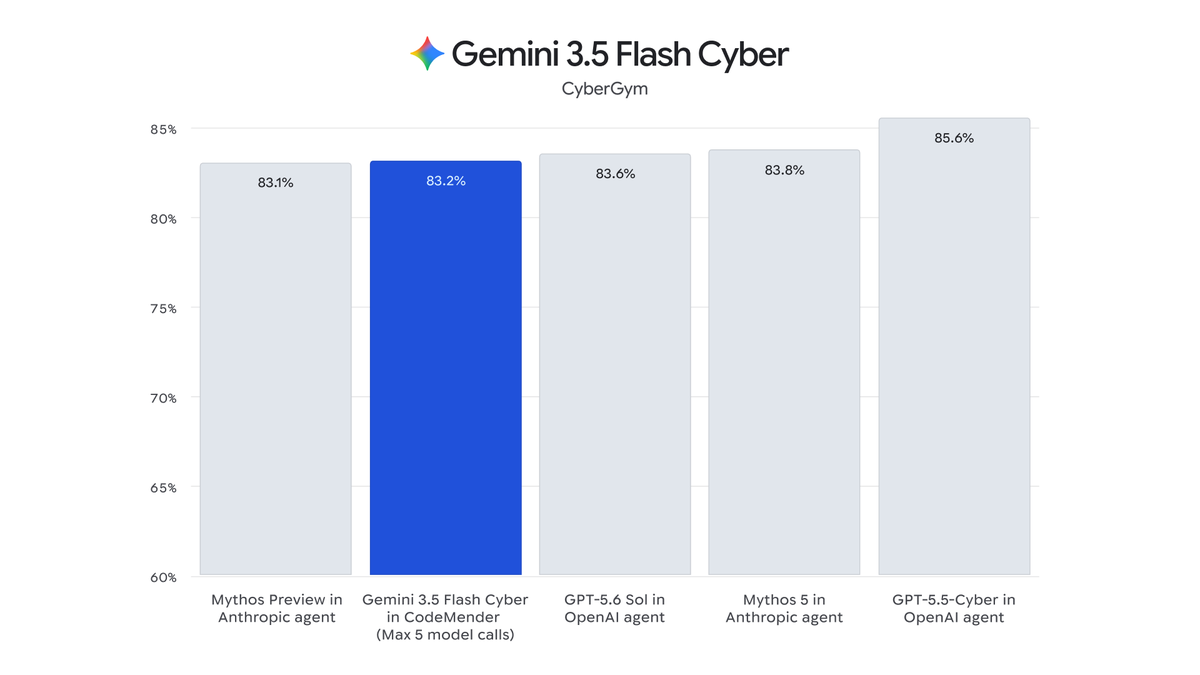
As AI models are now finding vulnerabilities faster than we can fix them, our approach to securing software must be built on highly efficient and capable models. Which brings us to our third (!) model
As AI models are now finding vulnerabilities faster than we can fix them, our approach to securing software must be built on highly efficient and capable models. Which brings us to our third (!) model launch of the day: Gemini 3.5 Flash Cyber ⚡🛡️ Built on top of 3.5 Flash, in https://t.co/8N63Ws6laR
Today, we're introducing not one but TWO new models, striking the balance between efficiency and quality to enable you to build production AI agents. — Gemini 3.6 Flash: Addresses efficiency feedback
Today, we're introducing not one but TWO new models, striking the balance between efficiency and quality to enable you to build production AI agents. — Gemini 3.6 Flash: Addresses efficiency feedback we received from Gemini 3.5 Flash with upgrades in coding, knowledge work, and https://t.co/QGAkaMFm2T
Over half of reported crimes in Singapore use sophisticated social engineering. With @GovTechSG, we’re building on-device fraud detection using our open model Gemma. By fine-tuning it on local scam ta
Over half of reported crimes in Singapore use sophisticated social engineering. With @GovTechSG, we’re building on-device fraud detection using our open model Gemma. By fine-tuning it on local scam tactics, it identifies threats in real time without compromising personal https://t.co/pkAulZoJng
It’s Friday 🎉 Here’s a look at this week’s announcements: — https://t.co/a9bSlm0Yxk is now available globally in English, allowing anyone to use our detector portal to easily verify if images, video,
It’s Friday 🎉 Here’s a look at this week’s announcements: — https://t.co/a9bSlm0Yxk is now available globally in English, allowing anyone to use our detector portal to easily verify if images, video, or audio files were AI-generated by Google or industry partners — Nano Banana
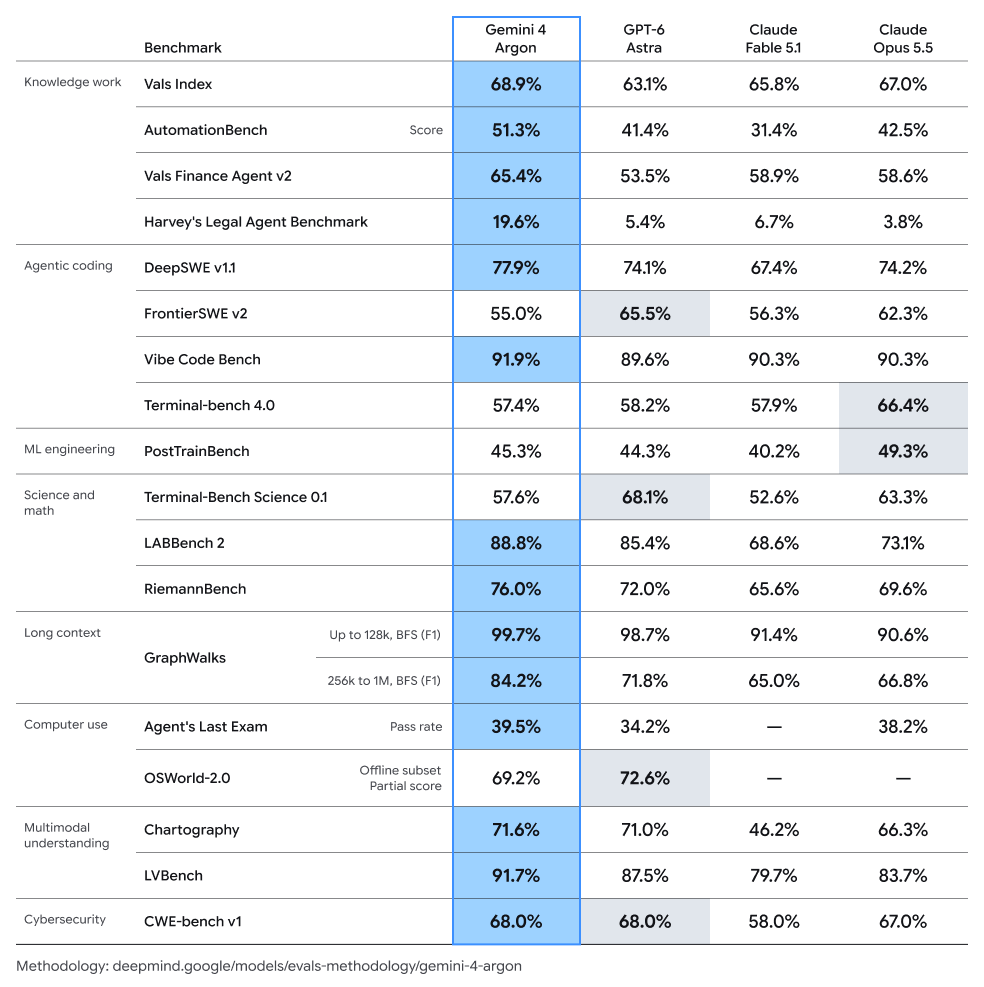
Announcing Gemini 4 Argon, our new frontier model. Argon is built to sustain deep reasoning across complex, long-horizon workflows and delivers frontier performance in complex workflows across real-wo
Announcing Gemini 4 Argon, our new frontier model. Argon is built to sustain deep reasoning across complex, long-horizon workflows and delivers frontier performance in complex workflows across real-world software engineering, enterprise knowledge work like legal and finance, and https://t.co/IpYt2KAaaq
Gemini 3.5 Flash Cyber is our specialized, lightweight model built to help security teams spot and patch vulnerabilities before they can be exploited. 🧵 https://t.co/XpiKcvwjeI
As AI models are now finding vulnerabilities faster than we can fix them, our approach to securing software must be built on highly efficient and capable models. Which brings us to our third (!) model
As AI models are now finding vulnerabilities faster than we can fix them, our approach to securing software must be built on highly efficient and capable models. Which brings us to our third (!) model launch of the day: Gemini 3.5 Flash Cyber ⚡🛡️ Built on top of 3.5 Flash, in https://t.co/8N63Ws6laR
Today, we're introducing not one but TWO new models, striking the balance between efficiency and quality to enable you to build production AI agents. — Gemini 3.6 Flash: Addresses efficiency feedback
Today, we're introducing not one but TWO new models, striking the balance between efficiency and quality to enable you to build production AI agents. — Gemini 3.6 Flash: Addresses efficiency feedback we received from Gemini 3.5 Flash with upgrades in coding, knowledge work, and https://t.co/QGAkaMFm2T
Gemini 3.5 Flash now supports native computer use. This built-in tool lets developers build custom agents that can see and take action across browser, mobile, and desktop interfaces. Find out more → h
Gemini 3.5 Flash now supports native computer use. This built-in tool lets developers build custom agents that can see and take action across browser, mobile, and desktop interfaces. Find out more → https://t.co/DZyfe7aIHd https://t.co/z4xAKAtcah
EvaOmni: An Evidence-Grounded Benchmark for Audio-Visual Reasoning
Omni LLMs can naturally locate key audio and visual evidence and integrate information across modalities for audiovisual reasoning. Existing audio-visual reasoning benchmarks that mainly rely on multiple-choice questions usually score models solely based on answer correctness, making it difficult to assess whether a model truly forms a reasoning chain from evidence to the correct answer. In addition, textual or unimodal shortcuts may allow models to answer correctly without analyzing the necessary audio-visual evidence, further weakening the reliability of evaluation benchmarks. To address these issues, we introduce EvaOmni, an evidence-grounded benchmark containing 392 videos and 1,027 purely human-annotated question-answer pairs, covering 15 capabilities and three levels: retrieval and localization, basic understanding, and complex reasoning. We design a series of rigorous annotation procedures in which experts annotate audio and visual evidence and construct video-based distractors; humans review whether questions meet strict inspection criteria, and finally models filter textual and unimodal shortcuts. Beyond high-quality question-answer pairs, we require models to simultaneously return the answer and supporting evidence intervals in order to evaluate the complete reasoning chain. We propose the Coverage Grounded Score (C.G.) to measure how much annotated evidence a model identifies, and the Bottleneck Grounded Score (B.G.) to penalize poor temporal localization in either modality; both are incorporated into answer correctness. Across 7 open-weight and 17 proprietary Omni LLMs, Gemini3.7-Flash achieved the highest overall accuracy (79.4%), C.G. (70.8%), and B.G. (35.1%). At Level 3, it reached 79.1% accuracy, but its B.G. was only 12.3%. These results show that even the most advanced models still have room for development in grounded audio-visual reasoning.
Diffusion Language Models Change Speed Across Tasks and Languages
Diffusion language models can write several tokens in one forward pass, and they decide during generation how many passes to spend. Two outputs of the same token length can therefore vary a lot in cost. To understand the underlying factors of this cost variation, we analyze two diffusion models across 10 tasks. We find that the number of forward passes per token depends heavily on the task. Text copied or lightly edited from the input is cheap, while open-ended writing is costly. In DiffusionGemma, generating a token for story writing requires more than three times as many forward passes as for grammar correction. Two output properties explain much of this gap: how much of it is new relative to the input, and how rare its words are within the task. The same holds within a single response when thinking is involved. The final answer is cheap when it repeats the model's reasoning trace and costly when it adds something new. In multilingual generation, we find that highly tokenized languages also require more passes per token, adding to the cost they already pay with more tokens. Finally, cost tracks correctness: on the same math problem, wrong answers take more passes per token than correct ones, and weighting candidate answers by decoding speed beats majority voting by up to 4.2 points at no extra cost. Taken together, our results show that diffusion's computational advantage depends on how much of the output is already determined, while its decoding effort offers a practical signal for making inference more efficient and reliable.
From Failures to Learnable Worlds: Policy-Conditioned Environment Generation for Navigation Agents
Simulated environments enable scalable training data generation for embodied agents, but more data does not necessarily provide what a particular agent needs to learn. Existing environment-generation pipelines largely optimize generic properties such as realism, diversity, or task coverage, while different pretrained policies can fail for different environmental reasons. We therefore introduce WEDGE, a framework for weakness-guided navigation learning in which the failure modes of a pretrained agent guide the generation of training environments at each adaptation round. Given a pretrained policy, WEDGE uses an LLM to propose executable weakness features from contrasting successful and failed rollouts, automatically validates them on the diagnostic set, and selects the strongest validated weakness based on its success-rate gap. The validated weaknesses are then mapped to the environmental factors that control them. WEDGE varies these factors to construct environments in the difficulty regimes where the policy struggles, producing targeted training experience for adaptation. Across three navigation agents with different adaptation mechanisms, we find that policies exhibit distinct weakness profiles and benefit from different training environments. Weakness-conditioned adaptation consistently outperforms matched random and hard-example alternatives on ProcTHOR, while the resulting gains for Uni-NaVid and Gemini also extend to HM3D after ProcTHOR adaptation. Iterative re-diagnosis further shows that dominant weaknesses can persist or shift as the policy improves, providing updated guidance for subsequent environment construction. Together, these results show that policy failures are not only diagnostic signals, but actionable guidance for constructing training environments that target a policy's current weaknesses.
APEX: Asynchronous Prefix Denoising for Extreme Compression
Fewer latent tokens promise cheaper diffusion. Yet aggressive latent compression creates a reconstruction-generation dilemma: adding channels improves reconstruction but makes generation harder. We introduce APEX, short for Asynchronous Prefix denoising for EXtreme compression, which pairs a hierarchical latent space with asynchronous denoising over channel groups. Our autoencoder orders channel prefixes from structure to detail, while one shared denoiser generates them at staggered local times without adding tokens. On ImageNet-512, APEX outperforms existing methods at every evaluated channel count under 64x and 128x compression. At matched training and guided sampling compute, it also outperforms a 256-token model at every evaluated budget, with larger gains at lower compute. Code is available at https://daviddinkevich.github.io/APEX.
DataVista: Diagnosing Multimodal LLMs on Data Video Understanding
Data video is a media form that integrates data visualization with video narrative, widely adopted in news reporting and business analysis. Compared with general video understanding, data video understanding places greater emphasis on accurately reading data from animated charts, integrating evidence across charts and time, and understanding how narrative organization and visual design communicate information. Yet existing benchmarks target either general videos or static charts, and data video understanding has not been systematically evaluated. We present DataVista, the first benchmark for data video understanding, containing 961 real-world data videos and 6,775 evaluation questions organized under a three-level progressive capability framework (data perception, temporal reasoning, narrative understanding) with 10 fine-grained question types across five topic domains. Systematic evaluation of 19 mainstream MLLMs shows that the best-performing model, Gemini-3.1-Pro, achieves 70.0% overall accuracy, still far below human expert performance, with models performing worst on Causal Reasoning and Narrative Structure. Increasing frame counts and adding subtitles mainly benefit data perception and temporal reasoning, with limited gains in narrative understanding. Further analysis of model responses identifies typical failure modes in chart reading, evidence judgment, and instruction understanding. The benchmark is available at https://github.com/HKUSTDial/DataVista.
Flow matching has emerged as a scalable paradigm for training high-quality generative models, but sampling from the learned probability flow requires many network evaluations. Distillation can reduce this cost to one or a few evaluations; however, one-step generation often sacrifices quality, making few-step generation the practical operating regime. Existing few-step methods perform their iterative computation along the probability flow and therefore require a fixed, manually chosen timestep discretization. This discretization is often chosen heuristically and is expensive to tune; it may also be restrictive when refinement difficulty differs across samples or spatial locations. We introduce data-space iteration, a few-step generation framework that removes flow discretization altogether. Starting from noise, a shared generator directly refines its prediction in data space, with every iteration trained to produce the best sample permitted by its capacity. Our formulation integrates with distribution matching distillation (DMD) with minimal changes, enabling a controlled comparison between iteration methods under matched training settings. On class-conditional ImageNet 256x256, data-space iteration outperforms standard discretization baselines and matches or improves upon variants selected through schedule search, without requiring schedule-specific training. These results show that data-space iteration provides a simple and effective alternative to discretized flow-space iteration for fast generation.
Dynamic Harness Search: Building Multi-Agent Systems Per-Query via Prediction
Agent harnesses specify the roles, instructions, tools, and communication structure used to solve a task, and the right harness depends on the query. Because the value of each design choice is observable only through execution, tailoring a harness to each query has required either executing alternatives at inference time or costly manual design. We introduce SHIFT, which moves execution out of the per-query search loop. A local LLM architect learns a policy over harness-building actions from search, and a value function that predicts, from measured executions, a utility balancing accuracy against execution cost. For each query, Monte Carlo tree search uses these predictions to construct a harness. Across 9,193 tasks in six benchmarks, from math to document and general-assistant tasks, with a Gemini 3.5 Flash executor, SHIFT attains the highest mean accuracy, about 80%, outperforming 17 baselines that span prompting, prompt optimization, and workflow search, and exceeding the strongest baseline by 7.2 percentage points. A cheaper mode of SHIFT also attains a higher mean accuracy than every baseline while using 32% fewer execution tokens than the strongest baseline. We further show that choosing structure, instructions, and tools jointly beats choosing only instructions or only tools by up to 9.1 percentage points, and that learned value selection identifies more accurate harnesses with lower execution cost from candidate pools.
VeriHarness: Scaling Agentic Verification for Long-Horizon Tasks
As LLM agents undertake increasingly complex, long-horizon tasks, verifying their outputs becomes increasingly challenging. We study how verification capability can be strengthened with a fixed base model, without access to reference answers or grading rubrics at test time. Repeated sampling yields multiple rollouts that can contain complementary correct claims, but we need a reliable verification mechanism to determine which claims to trust. We first find that disagreement often exposes correct alternatives, while consensus can conceal errors. These observations motivate VeriHarness, which turns the underlying LLM a generator uses into an agentic verifier by giving it a workspace, evidence tools, and reusable verification skills. A disagreement resolver checks competing claims against environmental evidence, while a consensus challenger tests shared claims and searches for omitted requirements. Their findings guide the selection and revision of the final artifact. Across five long-horizon workspace benchmarks and two frontier models, VeriHarness achieves the highest selection scores among the evaluated baselines. Evidence-backed revision further improves average performance, bringing gains over a single rollout to 6.2 points with Gemini 3.5 Flash and 6.4 points with Claude Opus 4.8. We further show that verification skills can self-improve from failure feedback, demonstrating VeriHarness as a novel and critical approach for scaling long-horizon agentic verification. We release the full pool of approximately 26,000 rollouts across all five benchmarks and both models, produced at a cost of over $100,000, to support future research on agentic verification.
SAGE: Salient Factor Discovery and Generation with Visual Foundation Representations
Given a target dataset, such as faces with eyeglasses, and a background dataset, such as faces without, contrastive analysis separates salient factors specific to the target from common content shared by both. We aim for salient representations that capture target-specific detail in each image, such as the shape, color, and position of the glasses, so that they reveal subtypes without subtype labels and guide the generation of new examples of a discovered subtype, even one with no name or text description. We introduce SAGE, which learns both factors directly in the high-dimensional spatial latent of a frozen representation autoencoder and conditions a diffusion transformer on the learned salient representation of a reference image. On Digits-ImageNet and FFHQ eyeglasses, SAGE combines high-fidelity reconstruction (rFID below 2) with unsupervised subtype discovery, recovering the digits better than baselines (probe accuracy 0.950 vs.\ at most 0.281) and revealing eyewear types, finer sunglasses styles, and mislabeled images; salient-conditioned generation raises Digits-ImageNet subtype accuracy over the unfactorized latent (90.5% vs.\ 27.7%) and diversity on both datasets. On retinal OCT, SAGE's salient space separates three diseases using only normal/disease labels.