Live access is not confirmed for this model. No current purchase price is advertised.
Related provider subscriptions
No current subscription pricing is tracked for this model.
Confirm this specific model, usage limits, and billing terms with the provider. A subscription does not automatically include API credits.
No login needed to compare. Prices are in USD; provider charges are separate from AI Market Cap plans. Context length, caching, tools, taxes, and regional terms can change the final cost. Open weights do not mean free hosting.
Preview
This model is still tracked for research and discovery, but it is excluded from default public rankings until it returns to active status.
61.7
Quality Score
1278
Arena ELO
Undisclosed
Parameters
1M
Context
Evidence profile
How complete is this record?
This measures the amount of verifiable public evidence we have, not how capable the model is. A missing field means it has not been verified yet, not that its value is zero.
Epoch AI, Data on AI Models. Used under CC BY with attribution.
Launches
1
high
Benchmarks
5
high
Research
22
low
General
2
low
What Changed Recently
Recent launch, pricing, benchmark, and API signals linked to this model or its provider.
LaunchesGoogle1w ago
It’s Friday 🎉 Here’s a look at this week’s announcements: — https://t.co/a9bSlm0Yxk is now available globally in English, allowing anyone to use our detector portal to easily verify if images, video,
It’s Friday 🎉 Here’s a look at this week’s announcements: — https://t.co/a9bSlm0Yxk is now available globally in English, allowing anyone to use our detector portal to easily verify if images, video, or audio files were AI-generated by Google or industry partners — Nano Banana
Over half of reported crimes in Singapore use sophisticated social engineering. With @GovTechSG, we’re building on-device fraud detection using our open model Gemma. By fine-tuning it on local scam ta
Over half of reported crimes in Singapore use sophisticated social engineering. With @GovTechSG, we’re building on-device fraud detection using our open model Gemma. By fine-tuning it on local scam tactics, it identifies threats in real time without compromising personal https://t.co/pkAulZoJng
It’s Friday 🎉 Here’s a look at this week’s announcements: — https://t.co/a9bSlm0Yxk is now available globally in English, allowing anyone to use our detector portal to easily verify if images, video,
It’s Friday 🎉 Here’s a look at this week’s announcements: — https://t.co/a9bSlm0Yxk is now available globally in English, allowing anyone to use our detector portal to easily verify if images, video, or audio files were AI-generated by Google or industry partners — Nano Banana
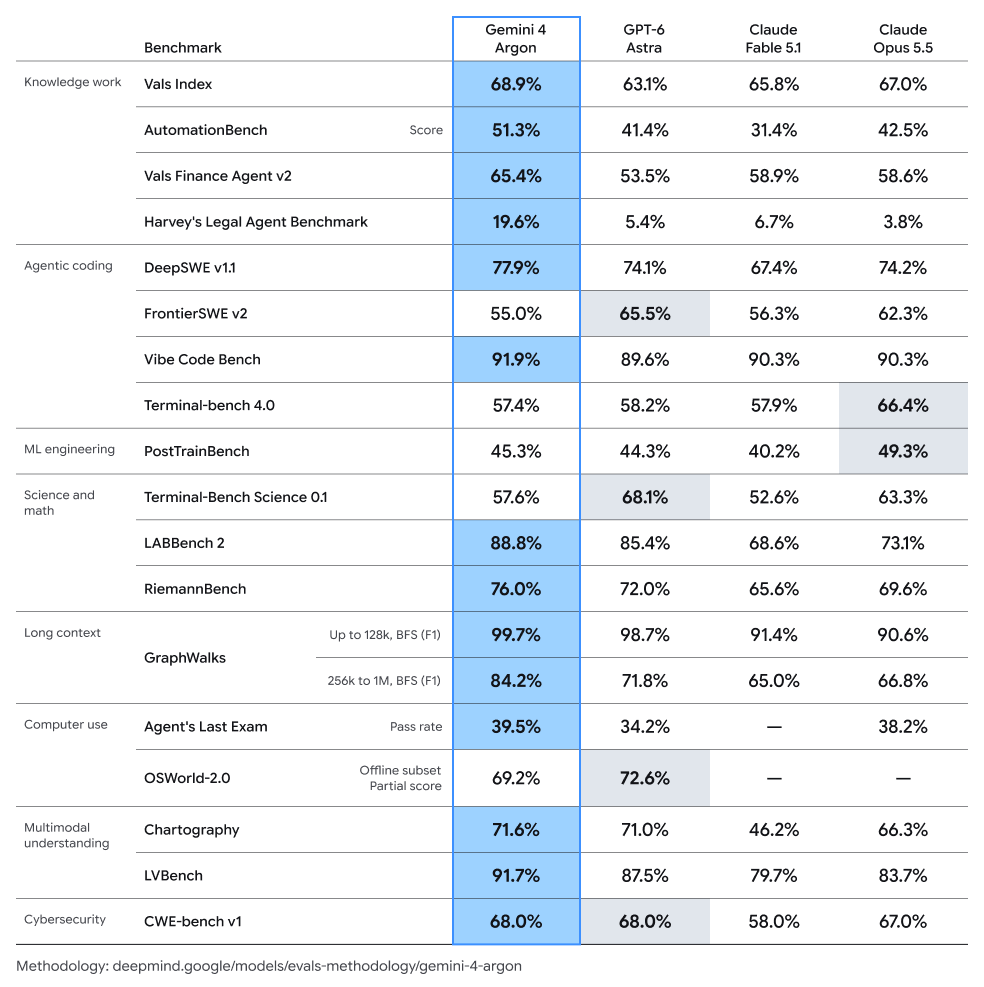
Announcing Gemini 4 Argon, our new frontier model. Argon is built to sustain deep reasoning across complex, long-horizon workflows and delivers frontier performance in complex workflows across real-wo
Announcing Gemini 4 Argon, our new frontier model. Argon is built to sustain deep reasoning across complex, long-horizon workflows and delivers frontier performance in complex workflows across real-world software engineering, enterprise knowledge work like legal and finance, and https://t.co/IpYt2KAaaq
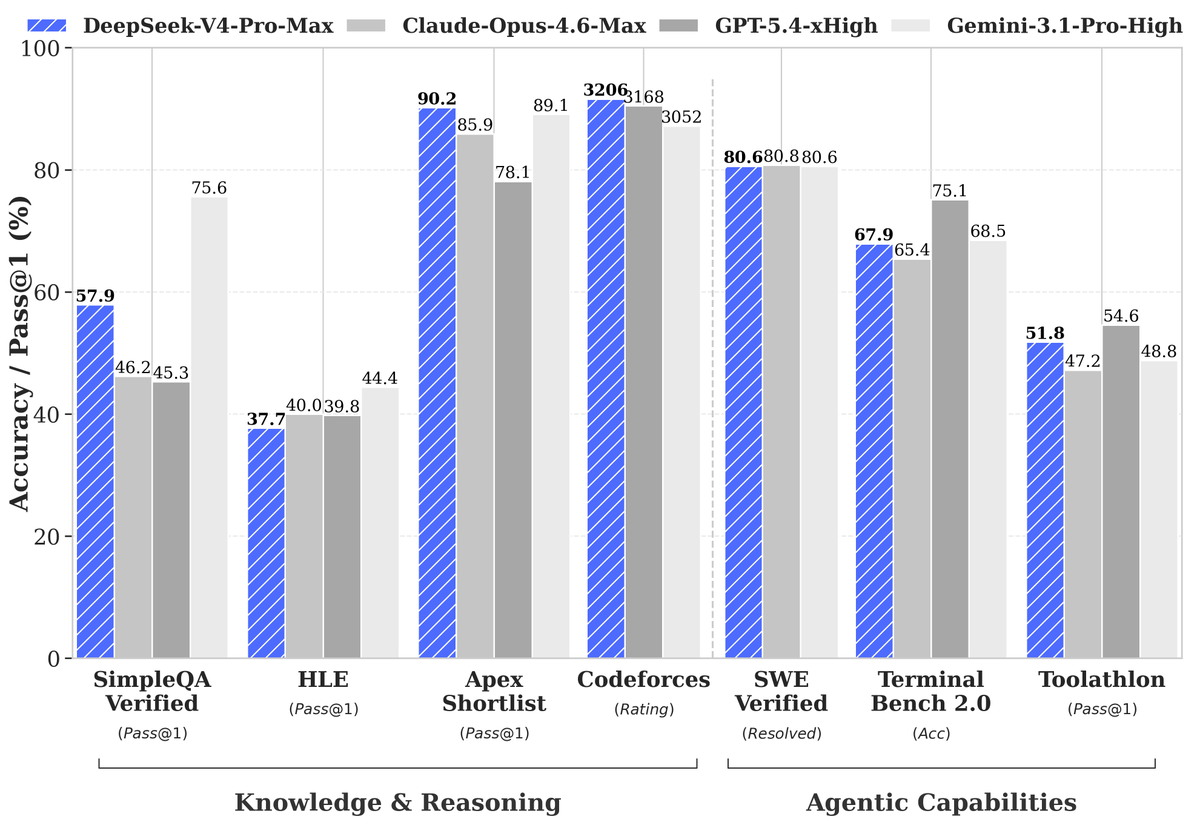
DeepSeek-V4-Pro 🔹 Enhanced Agentic Capabilities: Open-source SOTA in Agentic Coding benchmarks. 🔹 Rich World Knowledge: Leads all current open models, trailing only Gemini-3.1-Pro. 🔹 World-Class Re
DeepSeek-V4-Pro 🔹 Enhanced Agentic Capabilities: Open-source SOTA in Agentic Coding benchmarks. 🔹 Rich World Knowledge: Leads all current open models, trailing only Gemini-3.1-Pro. 🔹 World-Class Reasoning: Beats all current open models in Math/STEM/Coding, rivaling top https://t.co/D04x5RjE3L
X/Twitter@GoogleDeepMindGoogleresearchresearch6mo ago
Deep Research and Deep Research Max are our latest autonomous research agents powered by Gemini 3.1 Pro. They can safely navigate both the web and your custom data, like internal docs and specialized
Deep Research and Deep Research Max are our latest autonomous research agents powered by Gemini 3.1 Pro. They can safely navigate both the web and your custom data, like internal docs and specialized financial information, to create professional-grade, fully cited reports. 🧵 https://t.co/Tt3zmjYLWJ
EvaOmni: An Evidence-Grounded Benchmark for Audio-Visual Reasoning
Omni LLMs can naturally locate key audio and visual evidence and integrate information across modalities for audiovisual reasoning. Existing audio-visual reasoning benchmarks that mainly rely on multiple-choice questions usually score models solely based on answer correctness, making it difficult to assess whether a model truly forms a reasoning chain from evidence to the correct answer. In addition, textual or unimodal shortcuts may allow models to answer correctly without analyzing the necessary audio-visual evidence, further weakening the reliability of evaluation benchmarks. To address these issues, we introduce EvaOmni, an evidence-grounded benchmark containing 392 videos and 1,027 purely human-annotated question-answer pairs, covering 15 capabilities and three levels: retrieval and localization, basic understanding, and complex reasoning. We design a series of rigorous annotation procedures in which experts annotate audio and visual evidence and construct video-based distractors; humans review whether questions meet strict inspection criteria, and finally models filter textual and unimodal shortcuts. Beyond high-quality question-answer pairs, we require models to simultaneously return the answer and supporting evidence intervals in order to evaluate the complete reasoning chain. We propose the Coverage Grounded Score (C.G.) to measure how much annotated evidence a model identifies, and the Bottleneck Grounded Score (B.G.) to penalize poor temporal localization in either modality; both are incorporated into answer correctness. Across 7 open-weight and 17 proprietary Omni LLMs, Gemini3.7-Flash achieved the highest overall accuracy (79.4%), C.G. (70.8%), and B.G. (35.1%). At Level 3, it reached 79.1% accuracy, but its B.G. was only 12.3%. These results show that even the most advanced models still have room for development in grounded audio-visual reasoning.
From Failures to Learnable Worlds: Policy-Conditioned Environment Generation for Navigation Agents
Simulated environments enable scalable training data generation for embodied agents, but more data does not necessarily provide what a particular agent needs to learn. Existing environment-generation pipelines largely optimize generic properties such as realism, diversity, or task coverage, while different pretrained policies can fail for different environmental reasons. We therefore introduce WEDGE, a framework for weakness-guided navigation learning in which the failure modes of a pretrained agent guide the generation of training environments at each adaptation round. Given a pretrained policy, WEDGE uses an LLM to propose executable weakness features from contrasting successful and failed rollouts, automatically validates them on the diagnostic set, and selects the strongest validated weakness based on its success-rate gap. The validated weaknesses are then mapped to the environmental factors that control them. WEDGE varies these factors to construct environments in the difficulty regimes where the policy struggles, producing targeted training experience for adaptation. Across three navigation agents with different adaptation mechanisms, we find that policies exhibit distinct weakness profiles and benefit from different training environments. Weakness-conditioned adaptation consistently outperforms matched random and hard-example alternatives on ProcTHOR, while the resulting gains for Uni-NaVid and Gemini also extend to HM3D after ProcTHOR adaptation. Iterative re-diagnosis further shows that dominant weaknesses can persist or shift as the policy improves, providing updated guidance for subsequent environment construction. Together, these results show that policy failures are not only diagnostic signals, but actionable guidance for constructing training environments that target a policy's current weaknesses.
APEX: Asynchronous Prefix Denoising for Extreme Compression
Fewer latent tokens promise cheaper diffusion. Yet aggressive latent compression creates a reconstruction-generation dilemma: adding channels improves reconstruction but makes generation harder. We introduce APEX, short for Asynchronous Prefix denoising for EXtreme compression, which pairs a hierarchical latent space with asynchronous denoising over channel groups. Our autoencoder orders channel prefixes from structure to detail, while one shared denoiser generates them at staggered local times without adding tokens. On ImageNet-512, APEX outperforms existing methods at every evaluated channel count under 64x and 128x compression. At matched training and guided sampling compute, it also outperforms a 256-token model at every evaluated budget, with larger gains at lower compute. Code is available at https://daviddinkevich.github.io/APEX.
DataVista: Diagnosing Multimodal LLMs on Data Video Understanding
Data video is a media form that integrates data visualization with video narrative, widely adopted in news reporting and business analysis. Compared with general video understanding, data video understanding places greater emphasis on accurately reading data from animated charts, integrating evidence across charts and time, and understanding how narrative organization and visual design communicate information. Yet existing benchmarks target either general videos or static charts, and data video understanding has not been systematically evaluated. We present DataVista, the first benchmark for data video understanding, containing 961 real-world data videos and 6,775 evaluation questions organized under a three-level progressive capability framework (data perception, temporal reasoning, narrative understanding) with 10 fine-grained question types across five topic domains. Systematic evaluation of 19 mainstream MLLMs shows that the best-performing model, Gemini-3.1-Pro, achieves 70.0% overall accuracy, still far below human expert performance, with models performing worst on Causal Reasoning and Narrative Structure. Increasing frame counts and adding subtitles mainly benefit data perception and temporal reasoning, with limited gains in narrative understanding. Further analysis of model responses identifies typical failure modes in chart reading, evidence judgment, and instruction understanding. The benchmark is available at https://github.com/HKUSTDial/DataVista.
Flow matching has emerged as a scalable paradigm for training high-quality generative models, but sampling from the learned probability flow requires many network evaluations. Distillation can reduce this cost to one or a few evaluations; however, one-step generation often sacrifices quality, making few-step generation the practical operating regime. Existing few-step methods perform their iterative computation along the probability flow and therefore require a fixed, manually chosen timestep discretization. This discretization is often chosen heuristically and is expensive to tune; it may also be restrictive when refinement difficulty differs across samples or spatial locations. We introduce data-space iteration, a few-step generation framework that removes flow discretization altogether. Starting from noise, a shared generator directly refines its prediction in data space, with every iteration trained to produce the best sample permitted by its capacity. Our formulation integrates with distribution matching distillation (DMD) with minimal changes, enabling a controlled comparison between iteration methods under matched training settings. On class-conditional ImageNet 256x256, data-space iteration outperforms standard discretization baselines and matches or improves upon variants selected through schedule search, without requiring schedule-specific training. These results show that data-space iteration provides a simple and effective alternative to discretized flow-space iteration for fast generation.
SAGE: Salient Factor Discovery and Generation with Visual Foundation Representations
Given a target dataset, such as faces with eyeglasses, and a background dataset, such as faces without, contrastive analysis separates salient factors specific to the target from common content shared by both. We aim for salient representations that capture target-specific detail in each image, such as the shape, color, and position of the glasses, so that they reveal subtypes without subtype labels and guide the generation of new examples of a discovered subtype, even one with no name or text description. We introduce SAGE, which learns both factors directly in the high-dimensional spatial latent of a frozen representation autoencoder and conditions a diffusion transformer on the learned salient representation of a reference image. On Digits-ImageNet and FFHQ eyeglasses, SAGE combines high-fidelity reconstruction (rFID below 2) with unsupervised subtype discovery, recovering the digits better than baselines (probe accuracy 0.950 vs.\ at most 0.281) and revealing eyewear types, finer sunglasses styles, and mislabeled images; salient-conditioned generation raises Digits-ImageNet subtype accuracy over the unfactorized latent (90.5% vs.\ 27.7%) and diversity on both datasets. On retinal OCT, SAGE's salient space separates three diseases using only normal/disease labels.
Persistence Forcing: Exploiting Feature Specialization in Pixel-Space Diffusion
Pixel-space diffusion Transformers (DiTs) directly operate on high-dimensional visual data, yet their hidden representations typically undergo uniform refinement across depth. Natural images, however, are inherently organized at different levels of granularity. Global structure can often be represented compactly, whereas local textures and fine details require richer representations. Motivated by this, we introduce heterogeneous refinement in pixel-space DiTs, assigning different feature groups distinct refinement budgets across depth. Consequently, an ordered feature specialization emerges: sparsely refined features predominantly encode global visual structure, whereas more frequently refined features increasingly specialize toward localized, high-frequency details. We refer to these two groups as persistent and active features, respectively. Building on this emergent specialization, we introduce Persistence Forcing (PerF), which explicitly exploits this persistent--active feature organization for pixel-space image generation. This enables persistent features to continuously condition actively refined features, allowing stable global information to guide the ongoing refinement of finer visual details. During generative sampling, this interaction further induces a meaningful guidance direction that promotes coherent global structure and naturally complements classifier-free guidance. On ImageNet 256times256, PerF-L achieves FID of 1.91, approaching 1.86 of JiT-H with only half the parameters, while PerF-H further achieves FID of 1.63 and 1.76 on ImageNet 256times256 and 512times512, respectively.
AutoMem: Automated Learning of Memory as a Cognitive Skill
Memory expertise is a learned skill: knowing what to encode, when to retrieve, and how to organize knowledge--a capacity known in cognitive science as metamemory. We bring this perspective to LLMs by treating memory management as a trainable skill. We promote file-system operations to first-class memory actions alongside task actions, letting the model itself decide how to manage its memory. This memory skill improves along two axes: the structure that supports it (prompts, file schemas, action vocabulary), and the proficiency of the model exercising it. Both axes resist manual optimization: episodes in long-horizon tasks run for thousands of steps, and a single memory mistake can hide long before it surfaces, making human review of full trajectories impractical. We introduce AutoMem, a framework that automates both axes. In the first loop, a strong LLM reviews complete agent trajectories and iteratively revises the memory structure that shapes how the agent interacts with its memory files. In the second loop, the agent's own good memory decisions are identified from many episodes and used as training signal to sharpen the model's memory proficiency directly. Across three procedurally generated long-horizon games (Crafter, MiniHack, and NetHack), optimizing memory alone--without modifying the model's task-action behavior--improved the base agent's performance ~2x-4x, bringing a 32B open-weight model competitive with frontier systems such as Claude Opus 4.5 and Gemini 3.1 Pro Thinking. Our results show that memory management is an independently learnable skill, and a high-leverage objective yielding large gains on long-horizon tasks.
LoSoNA: A Benchmark for Local Social Norm Adaptation in Group Conversations
Online group chats are social spaces with local conversational norms that are rarely stated explicitly. The ability and willingness of LLM-based agents to recognize and adapt to these norms remains mostly unexplored. We introduce LoSoNA, a benchmark for local social norm adaptation in multi-party chat. Each scenario gives a subject model a curated group-chat transcript in which non-subject participants demonstrate a hidden local norm, followed by a final elicitor turn that forces a response revealing whether the subject has inferred that norm. We evaluate eight frontier and open-weight models under four prompting conditions that vary how explicitly the model is told to treat the prior conversation as evidence for how it should answer. Naive prompting remains limited for most models; explicit norm-aware prompting helps unevenly, with Gemini 3.1 Pro reaching 84.2% and Claude Fable 5 reaching 81.6%, while several other models show small gains or regressions. LoSoNA contributes to recent calls for evaluating LLM social capabilities by testing whether models can infer local conversational norms from precedent and use them in a one-turn group-chat response.
Hardening Agent Benchmarks with Adversarial Hacker-Fixer Loops
Agent benchmarks score submissions with outcome verifiers that are typically hand-written and brittle, leaving them open to reward hacking. We audit 1,968 tasks across five terminal-agent benchmarks and find 323 (16%) hackable by frontier models given only the task description. This corrupts both leaderboard rankings and RL training signal, yet the standard response is manual and reactive.
We introduce the hacker-fixer loop, a method for building exploit-resistant verifiers without per-task manual patching. The loop alternates three LLM agents: a hacker tries to pass the verifier without solving the task, a fixer patches the verifier to reject each discovered exploit, and a solver confirms the patched verifier still admits legitimate solutions. The loop iterates: each patch reshapes what the verifier rewards, surfacing the next exploit. We further add verifier access, and let patches transfer across tasks, to broaden the exploits the loop discovers.
On KernelBench, the loop drives the attack success rate from 62% to 0% on a held-out corpus of publicly reported exploits. We also find that weaker agents in the loop can defend against much stronger hackers: Gemini 3 Flash's loop drives the stronger Gemini 3.1 Pro and Claude Opus 4.7's attack success rate from 76% and 61% to 0% on KernelBench, and Gemini 3.1 Pro's from 39% to 17% on Terminal Bench across 77 tasks. We release Terminal Wrench (323 hackable environments, 3,632 hack trajectories) as a snapshot of the current attack surface, our patched verifiers, the exploits the loop discovered, and our implementation as a basis for future work.
OVO-S-Bench: A Hierarchical Benchmark for Streaming Spatial Intelligence in Multimodal LLMs
Multimodal agents in robotics, AR, and autonomous driving must reason about places and layouts from continuous egocentric streams, often using evidence outside the current view. Existing benchmarks either evaluate offline over full videos or target events rather than spatial structure. We introduce OVO-S-Bench, a fully human-annotated benchmark for streaming spatial intelligence, comprising 1,680 questions over 348 source videos. Annotation involves 12 trained annotators, each also serving as a blind cross-reviewer, across roughly 804 person-hours of multi-round quality assurance. Each question carries a query timestamp and an evidence interval, and at evaluation, the model sees only the prefix preceding the query. Questions span four levels of increasing abstraction: instantaneous egocentric perception, spatiotemporal context tracking, spatial simulation and reasoning, and allocentric mapping. Across 38 proprietary and open-source MLLMs, Gemini-3.1-Pro trails human experts by 27 points, 59.2 vs. 86.6, with allocentric mapping as the dominant bottleneck. Notably, streaming and spatially fine-tuned MLLMs underperform their own backbones. We further find that chain-of-thought reasoning amplifies spatial errors when ungrounded in the stream. By exposing these limitations, OVO-S-Bench establishes a demanding testbed for next-generation streaming spatial MLLMs.
ChartArena: Benchmarking Chart Parsing across Languages, Scenarios, and Formats
Charts are a primary medium for conveying quantitative and relational information, yet systematically evaluating chart parsing models remains difficult. Existing benchmarks focus on narrow chart types and leave diagrammatic structures such as flowcharts and mind maps largely unaddressed, while models produce outputs in incompatible formats, and datasets rarely include the printed or hand-drawn images encountered in practice. To address these issues, we introduce ChartArena, a comprehensive bilingual benchmark covering eight chart families spanning both numeric charts and diagrammatic structures, each evaluated across three visual scenarios: digital renderings, printed photos, and hand-drawn photos. The dataset is built via a human-agent collaborative annotation pipeline with multi-stage human verification to ensure annotation reliability. To enable fair cross-model comparison, we further design a format-agnostic evaluation protocol that maps heterogeneous outputs into two canonical semantic spaces, a normalized triple view and a directed graph view, and scores them with structure-aware metrics. Through extensive evaluation of 26 leading MLLMs, we observe three consistent findings: (i) frontier proprietary models such as Gemini 3.1 Pro lead overall, yet the strongest open-source systems are rapidly closing the gap; (ii) document parsing models handle numeric charts reasonably but fall sharply behind on diagrammatic structures; and (iii) expert chart parsers remain limited to narrow chart families. Across all models, radar charts and hand-drawn scenarios stay especially challenging. These findings show that ChartArena exposes clear capability gaps and provides a unified foundation for future progress. ChartArena is publicly available at https://github.com/pspdada/ChartArena.
Verus-SpecGym: An Agentic Environment for Evaluating Specification Autoformalization
AI coding agents are increasingly used to write real-world software, but ensuring that their outputs are correct remains a fundamental challenge. Formal verification offers a promising path: an agent generates code together with a machine-checked proof, guaranteeing that the code satisfies a formal specification. However, there is no guarantee that the formal spec itself matches the user's intent. In this work, we study specification autoformalization: whether LLM agents can translate informal programming problems into faithful formal specifications. We introduce Verus-SpecBench, a benchmark of 581 spec-writing tasks derived from Codeforces problems targeting Verus, a verifier for Rust, and Verus-SpecGym, an agentic environment in which models interact with Verus, bash, & the filesystem to develop these specs. The central challenge is evaluation: expert-written reference specs are expensive to write, & LLM judges can miss subtle mistakes. We address this by (a) extending Verus's exec_spec mechanism so that generated specs can be executed as Rust code, & (b) testing them against official Codeforces tests & adversarial cases extracted from Codeforces "hacks", which are edge cases written by competitors to break incorrect solutions. On Verus-SpecBench, the strongest model, Gemini 3.1 Pro, solves 77.8% of tasks, other frontier models solve 51.1--57.8% & OSS models reach only 21.5--25.5%. Our analysis of failure modes shows that model-generated specs can omit important input assumptions, accept incorrect outputs, & reject valid ones. We also find that LLM-as-a-judge evaluation misses 26% of the failures our evaluator catches. Overall, our results suggest that spec autoformalization is within reach for frontier agents but remains brittle even on problems where they can already generate correct code. The code, data, & logs can be found at https://github.com/formal-verif-is-cool/verus-spec-gym
CurveBench: A Benchmark for Exact Topological Reasoning over Nested Jordan Curves
We introduce CurveBench, a benchmark for hierarchical topological reasoning from visual input. CurveBench consists of 756 images of pairwise non-intersecting Jordan curves across easy, polygonal, topographic-inspired, maze-like, and dense counting configurations. Each image is annotated with a rooted tree encoding the containment relations between planar regions. We formulate the task as structured prediction: given an image, a model must recover the full rooted containment tree induced by the curves. Despite the visual simplicity of the task, the strongest evaluated model, Gemini 3.1 Pro, achieves only 71.1\% tree-generation accuracy on CurveBench-Easy and 19.1\% on CurveBench-Hard. We further demonstrate benchmark utility through RLVR-style fine-tuning of open-weight vision-language models. Our trained Qwen3-VL-8B model improves over Qwen-3-VL-8B-Thinking from 2.8\% to 33.3\% tree-generation accuracy on CurveBench-Easy, exceeding GPT-5.4 and Claude Opus 4.5 under our evaluation protocol. The remaining gap, especially on CurveBench-Hard, shows that exact topology-aware visual reasoning remains far from solved.
Metal-Sci: A Scientific Compute Benchmark for Evolutionary LLM Kernel Search on Apple Silicon
We present Metal-Sci, a 10-task benchmark of scientific Apple Silicon Metal compute kernels spanning six optimization regimes (stencils, all-pairs in n-body problems, multi-field Boltzmann, neighbor-list molecular dynamics, multi-kernel PDE, FFT). Each task ships a CPU reference, a roofline-anchored fitness function, and a held-out generalization size. We pair the benchmark with a lightweight harness for automatic kernel search that runtime-compiles each candidate, scores it against the roofline across multiple sizes, and feeds structured compile and per-size correctness diagnostics back to a frozen LLM driving a (1{+}1) evolutionary loop. We report matched single-model sweeps of Claude Opus 4.7, Gemini 3.1 Pro, and GPT 5.5 on M1 Pro: in-distribution self-speedups span 1.00times to 10.7times. Beyond raw speedup, our central methodological claim is structural: the held-out gate scoring function Φ_T (evaluated once at end-of-run on a configuration the agent never sees during search) functions as a cheap mechanical oversight primitive on this automatic search loop, catching e.g. an Opus template <uint D> HMC win that returns wrong samples at unseen dimensions, and a GPT FFT3D best that wins in-distribution at 2.95times speedup but collapses to 0.23times on a 256^3 held-out cube, a silent regression that the in-distribution score alone cannot see. Code at https://github.com/vicgalle/metal-sci-kernels
IntentGrasp: A Comprehensive Benchmark for Intent Understanding
Accurately understanding the intent behind speech, conversation, and writing is crucial to the development of helpful Large Language Model (LLM) assistants. This paper introduces IntentGrasp, a comprehensive benchmark for evaluating the intent understanding capability of LLMs. Derived from 49 high-quality, open-licensed corpora spanning 12 diverse domains, IntentGrasp is constructed through source datasets curation, intent label contextualization, and task format unification. IntentGrasp contains a large-scale training set of 262,759 instances and two evaluation sets: an All Set of 12,909 test cases and a more balanced and challenging Gem Set of 470 cases. Extensive evaluations on 20 LLMs across 7 families (including frontier models such as GPT-5.4, Gemini-3.1-Pro, and Claude-Opus-4.7) demonstrate unsatisfactory performance, with scores below 60% on All Set and below 25% on Gem set. Notably, 17 out of 20 tested models perform worse than a random-guess baseline (15.2%) on Gem Set, while the estimated human performance is ~81.1%, showing substantial room for improvement. To enhance such ability, this paper proposes Intentional Fine-Tuning (IFT), which fine-tunes the models on the training set in IntentGrasp, yielding significant gains of 30+ F1 points on All Set and 20+ points on Gem Set. Tellingly, the leave-one-domain-out (Lodo) experiments further demonstrate the strong cross-domain generalizability of IFT, verifying that it is a promising approach to substantially enhancing the intent understanding of LLMs. Overall, by benchmarking and boosting intent understanding ability, this study sheds light on a promising path towards more intentional, capable, and safe AI assistants for human benefits and social good.
FlashRT: Towards Computationally and Memory Efficient Red-Teaming for Prompt Injection and Knowledge Corruption
Long-context large language models (LLMs)-for example, Gemini-3.1-Pro and Qwen-3.5-are widely used to empower many real-world applications, such as retrieval-augmented generation, autonomous agents, and AI assistants. However, security remains a major concern for their widespread deployment, with threats such as prompt injection and knowledge corruption. To quantify the security risks faced by LLMs under these threats, the research community has developed heuristic-based and optimization-based red-teaming methods. Optimization-based methods generally produce stronger attacks than heuristic attacks and thus provide a more rigorous assessment of LLM security risks. However, they are often resource-intensive, requiring significant computation and GPU memory, especially for long context scenarios. The resource-intensive nature poses a major obstacle for the community (especially academic researchers) to systematically evaluate the security risks of long-context LLMs and assess the effectiveness of defense strategies at scale. In this work, we propose FlashRT, the first framework to improve the efficiency (in terms of both computation and memory) for optimization-based prompt injection and knowledge corruption attacks under long-context LLMs. Through extensive evaluations, we find that FlashRT consistently delivers a 2x-7x speedup (e.g., reducing runtime from one hour to less than ten minutes) and a 2x-4x reduction in GPU memory consumption (e.g., reducing from 264.1 GB to 65.7 GB GPU memory for a 32K token context) compared to state-of-the-art baseline nanoGCG. FlashRT can be broadly applied to black-box optimization methods, such as TAP and AutoDAN. We hope FlashRT can serve as a red-teaming tool to enable systematic evaluation of long-context LLM security. The code is available at: https://github.com/Wang-Yanting/FlashRT
VLAA-GUI: Knowing When to Stop, Recover, and Search, A Modular Framework for GUI Automation
Autonomous GUI agents face two fundamental challenges: early stopping, where agents prematurely declare success without verifiable evidence, and repetitive loops, where agents cycle through the same failing actions without recovery. We present VLAA-GUI, a modular GUI agentic framework built around three integrated components that guide the system on when to Stop, Recover, and Search. First, a mandatory Completeness Verifier enforces UI-observable success criteria and verification at every finish step -- with an agent-level verifier that cross-examines completion claims with decision rules, rejecting those lacking direct visual evidence. Second, a mandatory Loop Breaker provides multi-tier filtering: switching interaction mode after repeated failures, forcing strategy changes after persistent screen-state recurrence, and binding reflection signals to strategy shifts. Third, an on-demand Search Agent searches online for unfamiliar workflows by directly querying a capable LLM with search ability, returning results as plain text. We additionally integrate a Coding Agent for code-intensive actions and a Grounding Agent for precise action grounding, both invoked on demand when required. We evaluate VLAA-GUI across five top-tier backbones, including Opus 4.5, 4.6 and Gemini 3.1 Pro, on two benchmarks with Linux and Windows tasks, achieving top performance on both (77.5% on OSWorld and 61.0% on WindowsAgentArena). Notably, three of the five backbones surpass human performance (72.4%) on OSWorld in a single pass. Ablation studies show that all three proposed components consistently improve a strong backbone, while a weaker backbone benefits more from these tools when the step budget is sufficient. Further analysis also shows that the Loop Breaker nearly halves wasted steps for loop-prone models.
Building a Precise Video Language with Human-AI Oversight
Video-language models (VLMs) learn to reason about the dynamic visual world through natural language. We introduce a suite of open datasets, benchmarks, and recipes for scalable oversight that enable precise video captioning. First, we define a structured specification for describing subjects, scenes, motion, spatial, and camera dynamics, grounded by hundreds of carefully defined visual primitives developed with professional video creators such as filmmakers. Next, to curate high-quality captions, we introduce CHAI (Critique-based Human-AI Oversight), a framework where trained experts critique and revise model-generated pre-captions into improved post-captions. This division of labor improves annotation accuracy and efficiency by offloading text generation to models, allowing humans to better focus on verification. Additionally, these critiques and preferences between pre- and post-captions provide rich supervision for improving open-source models (Qwen3-VL) on caption generation, reward modeling, and critique generation through SFT, DPO, and inference-time scaling. Our ablations show that critique quality in precision, recall, and constructiveness, ensured by our oversight framework, directly governs downstream performance. With modest expert supervision, the resulting model outperforms closed-source models such as Gemini-3.1-Pro. Finally, we apply our approach to re-caption large-scale professional videos (e.g., films, commercials, games) and fine-tune video generation models such as Wan to better follow detailed prompts of up to 400 words, achieving finer control over cinematography including camera motion, angle, lens, focus, point of view, and framing. Our results show that precise specification and human-AI oversight are key to professional-level video understanding and generation. Data and code are available on our project page: https://linzhiqiu.github.io/papers/chai/
MathNet: a Global Multimodal Benchmark for Mathematical Reasoning and Retrieval
Mathematical problem solving remains a challenging test of reasoning for large language and multimodal models, yet existing benchmarks are limited in size, language coverage, and task diversity. We introduce MathNet, a high-quality, large-scale, multimodal, and multilingual dataset of Olympiad-level math problems together with a benchmark for evaluating mathematical reasoning in generative models and mathematical retrieval in embedding-based systems. MathNet spans 47 countries, 17 languages, and two decades of competitions, comprising 30,676 expert-authored problems with solutions across diverse domains. In addition to the core dataset, we construct a retrieval benchmark consisting of mathematically equivalent and structurally similar problem pairs curated by human experts.
MathNet supports three tasks: (i) Problem Solving, (ii) Math-Aware Retrieval, and (iii) Retrieval-Augmented Problem Solving. Experimental results show that even state-of-the-art reasoning models (78.4% for Gemini-3.1-Pro and 69.3% for GPT-5) remain challenged, while embedding models struggle to retrieve equivalent problems. We further show that retrieval-augmented generation performance is highly sensitive to retrieval quality; for example, DeepSeek-V3.2-Speciale achieves gains of up to 12%, obtaining the highest scores on the benchmark. MathNet provides the largest high-quality Olympiad dataset together with the first benchmark for evaluating mathematical problem retrieval, and we publicly release both the dataset and benchmark at https://mathnet.mit.edu.
Terminal Wrench: A Dataset of 331 Reward-Hackable Environments and 3,632 Exploit Trajectories
We release Terminal Wrench, a subset of 331 terminal-agent benchmark environments, copied from the popular open benchmarks that are demonstrably reward-hackable. The data set includes 3,632 hack trajectories and 2,352 legitimate baseline trajectories across three frontier models (Claude Opus 4.6, Gemini 3.1 Pro, GPT-5.4). Each entry preserves the original task definition alongside full attack trajectories that show how the verifier was bypassed. It also includes cases where the task was not solved as intended. The tasks span system administration, machine learning, software engineering, and security challenges; the exploits range from simple output spoofing to stack-frame introspection, standard-library patching, and rootkit-style binary hijacking. Crucially, these exploits are specific to each task, rather than the evaluation harness, making them harder to patch. We also present a monitorability study in which hack trajectories are sanitized or stripped of reasoning traces and then scored by an LLM judge, showing that detection degrades meaningfully when chain-of-thought is removed (AUC drops from 0.97 to 0.92). The data set is publicly available at https://github.com/few-sh/terminal-wrench.