Previous Opus-tier flagship retained for compatibility after newer Claude Opus releases. Still strong on deep reasoning, extended thinking, and advanced coding, but superseded by Claude Opus 5 for Anthropic's latest Opus-tier performance.
Model updates refreshed4h agoOct 11, 2026news + changelog
Confirm this specific model, usage limits, and billing terms with the provider. A subscription does not automatically include API credits.
No login needed to compare. Prices are in USD; provider charges are separate from AI Market Cap plans. Context length, caching, tools, taxes, and regional terms can change the final cost. Open weights do not mean free hosting.
---
Quality Score
---
Arena ELO
Undisclosed
Parameters
200K
Context
Evidence profile
How complete is this record?
This measures the amount of verifiable public evidence we have, not how capable the model is. A missing field means it has not been verified yet, not that its value is zero.
Expanding the Cyber Verification Program Announcements Oct 6, 2026 We’re launching a new, expanded version of our Cyber Verification Program, which makes advanced cyber capabilities and reduced blocking classifiers available to qualifying security professionals.
We’re beginning a process of publishing more frequent reports on model behavior, beyond what appears in our system cards and regular risk reports. Today’s report describes four types of behaviors we’v
We’re beginning a process of publishing more frequent reports on model behavior, beyond what appears in our system cards and regular risk reports. Today’s report describes four types of behaviors we’ve identified during evaluations and internal use. In each, Claude acted on real
X/Twitter@claudeaiAnthropicannouncementgeneral3d ago
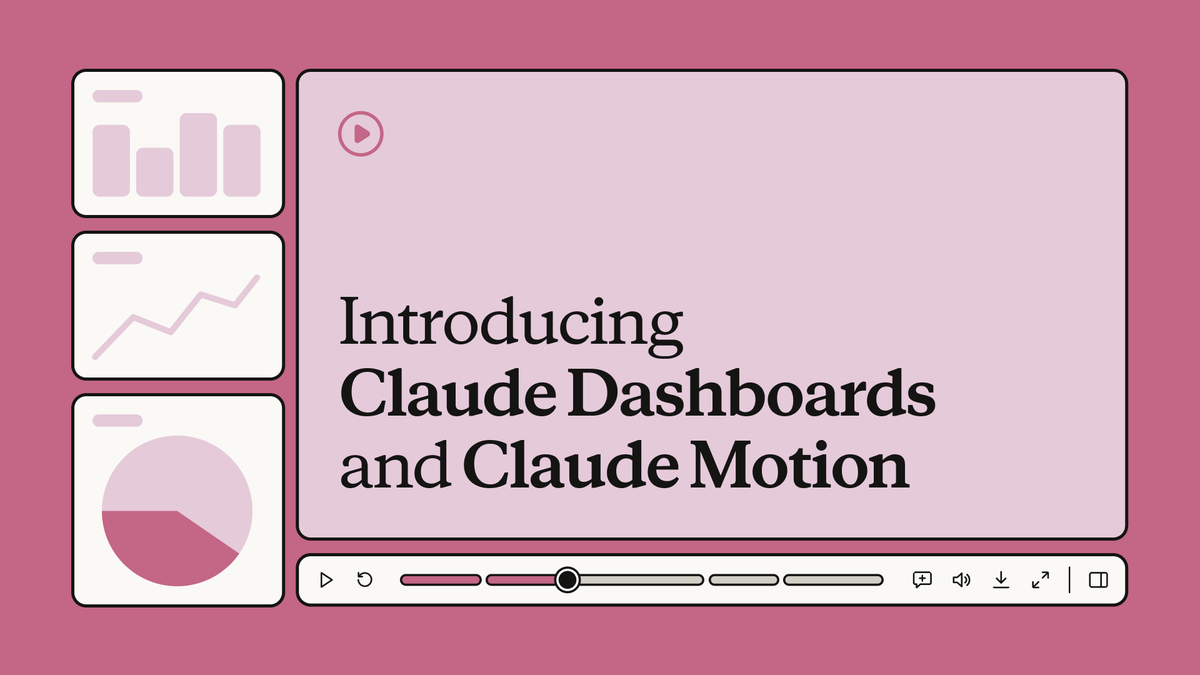
Claude Dashboards and Claude Motion are in beta today. Ask Claude to turn your data into live dashboards and your ideas into animated explainers. https://t.co/V3fU4lMnzp
X/Twitter@claudeaiAnthropicannouncementgeneral5d ago
Claude now works inside Google Docs, Sheets, and Slides, and those files also open inside Claude. In Google Workspace, Claude sits in a sidebar next to your file, reads what you have open, and edits i
Claude now works inside Google Docs, Sheets, and Slides, and those files also open inside Claude. In Google Workspace, Claude sits in a sidebar next to your file, reads what you have open, and edits it in place. You can approve each edit before it lands. https://t.co/se9wIS7vK1
Expanding the Cyber Verification Program Announcements Oct 6, 2026 We’re launching a new, expanded version of our Cyber Verification Program, which makes advanced cyber capabilities and reduced blocking classifiers available to qualifying security professionals.
AutoMem: Automated Learning of Memory as a Cognitive Skill
Memory expertise is a learned skill: knowing what to encode, when to retrieve, and how to organize knowledge--a capacity known in cognitive science as metamemory. We bring this perspective to LLMs by treating memory management as a trainable skill. We promote file-system operations to first-class memory actions alongside task actions, letting the model itself decide how to manage its memory. This memory skill improves along two axes: the structure that supports it (prompts, file schemas, action vocabulary), and the proficiency of the model exercising it. Both axes resist manual optimization: episodes in long-horizon tasks run for thousands of steps, and a single memory mistake can hide long before it surfaces, making human review of full trajectories impractical. We introduce AutoMem, a framework that automates both axes. In the first loop, a strong LLM reviews complete agent trajectories and iteratively revises the memory structure that shapes how the agent interacts with its memory files. In the second loop, the agent's own good memory decisions are identified from many episodes and used as training signal to sharpen the model's memory proficiency directly. Across three procedurally generated long-horizon games (Crafter, MiniHack, and NetHack), optimizing memory alone--without modifying the model's task-action behavior--improved the base agent's performance ~2x-4x, bringing a 32B open-weight model competitive with frontier systems such as Claude Opus 4.5 and Gemini 3.1 Pro Thinking. Our results show that memory management is an independently learnable skill, and a high-leverage objective yielding large gains on long-horizon tasks.
CurveBench: A Benchmark for Exact Topological Reasoning over Nested Jordan Curves
We introduce CurveBench, a benchmark for hierarchical topological reasoning from visual input. CurveBench consists of 756 images of pairwise non-intersecting Jordan curves across easy, polygonal, topographic-inspired, maze-like, and dense counting configurations. Each image is annotated with a rooted tree encoding the containment relations between planar regions. We formulate the task as structured prediction: given an image, a model must recover the full rooted containment tree induced by the curves. Despite the visual simplicity of the task, the strongest evaluated model, Gemini 3.1 Pro, achieves only 71.1\% tree-generation accuracy on CurveBench-Easy and 19.1\% on CurveBench-Hard. We further demonstrate benchmark utility through RLVR-style fine-tuning of open-weight vision-language models. Our trained Qwen3-VL-8B model improves over Qwen-3-VL-8B-Thinking from 2.8\% to 33.3\% tree-generation accuracy on CurveBench-Easy, exceeding GPT-5.4 and Claude Opus 4.5 under our evaluation protocol. The remaining gap, especially on CurveBench-Hard, shows that exact topology-aware visual reasoning remains far from solved.
Soohak: A Mathematician-Curated Benchmark for Evaluating Research-level Math Capabilities of LLMs
Following the recent achievement of gold-medal performance on the IMO by frontier LLMs, the community is searching for the next meaningful and challenging target for measuring LLM reasoning. Whereas olympiad-style problems measure step-by-step reasoning alone, research-level problems use such reasoning to advance the frontier of mathematical knowledge itself, emerging as a compelling alternative. Yet research-level math benchmarks remain scarce because such problems are difficult to source (e.g., Riemann Bench and FrontierMath-Tier 4 contain 25 and 50 problems, respectively). To support reliable evaluation of next-generation frontier models, we introduce Soohak, a 439-problem benchmark newly authored from scratch by 64 mathematicians. Soohak comprises two subsets. On the Challenge subset, frontier models including Gemini-3-Pro, GPT-5, and Claude-Opus-4.5 reach 30.4%, 26.4%, and 10.4% respectively, leaving substantial headroom, while leading open-weight models such as Qwen3-235B, GPT-OSS-120B, and Kimi-2.5 remain below 15%. Notably, beyond standard problem solving, Soohak introduces a refusal subset that probes a capability intrinsic to research mathematics: recognizing ill-posed problems and pausing rather than producing confident but unjustified answers. On this subset, no model exceeds 50%, identifying refusal as a new optimization target that current models do not directly address. To prevent contamination, the dataset will be publicly released in late 2026, with model evaluations available upon request in the interim.