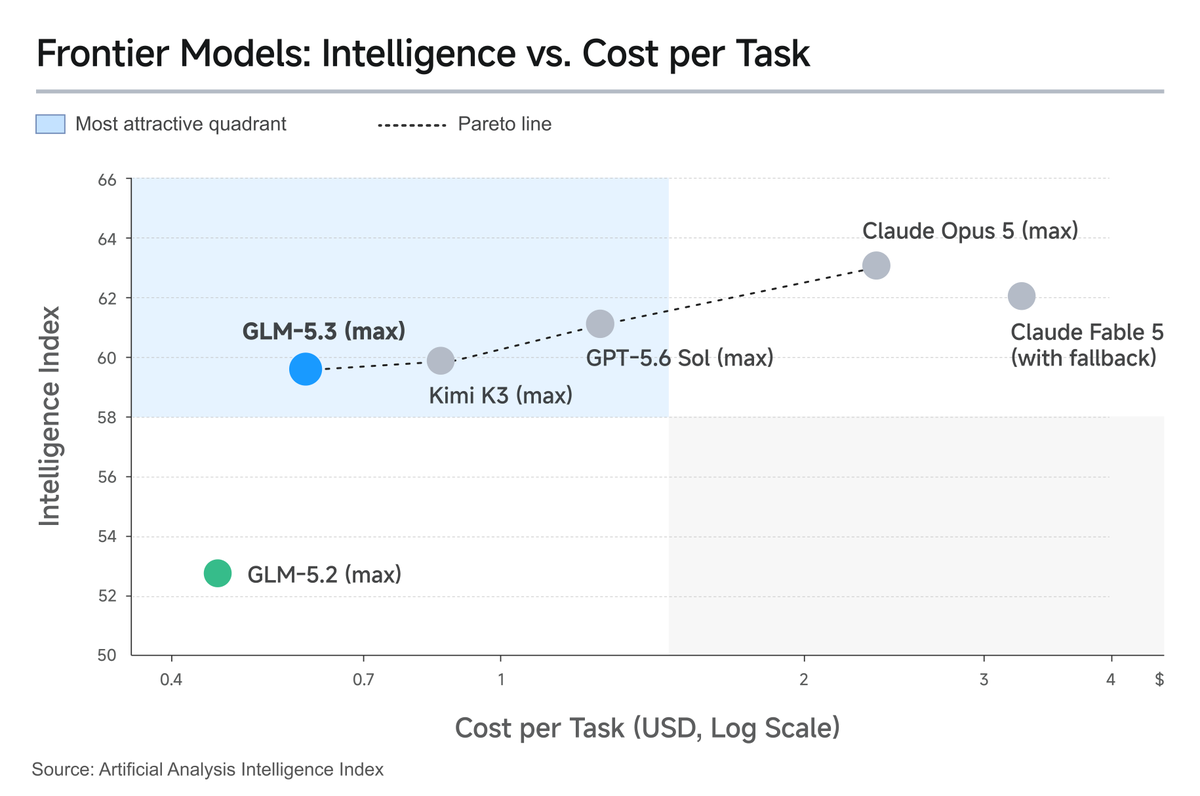
GLM 5.2 is a large-scale reasoning model from Z.ai. It supports text input and output with a 1M-token context window, and is suited for long-horizon agent workflows, project-level software engineering,...
Model updates refreshed6d agoAug 18, 2026news + changelog
This measures the amount of verifiable public evidence we have, not how capable the model is. A missing field means it has not been verified yet, not that its value is zero.
Recent launch, pricing, benchmark, and API signals linked to this model or its provider.
LaunchesZ.ai2w ago
ZCode now has 1 million users. As a thank-you to our community, we’ve reset usage limits for all GLM Coding Plan users. We’re also rolling out an update that helps turn long-horizon capabilities into
ZCode now has 1 million users. As a thank-you to our community, we’ve reset usage limits for all GLM Coding Plan users. We’re also rolling out an update that helps turn long-horizon capabilities into completed work: - More intelligence in real engineering workflows - 98% cache https://t.co/QT03v4lJVm
Navigation Language Models GLM-5.3 Guides API Reference Coding Plan Released Notes Terms and Policy Help Center Get Started Quick Start Overview Pricing Core Parameters SDKs Guide Migrate to GLM-5.3 Language Models GLM-5.3 New GLM-5.2 GLM-5.1 GLM-5 GLM-5-Turbo GLM-4.7 GLM-4.6 GLM-4.5 GLM-4-32B-0414-128K Vision Language Models GLM-5V-Turbo GLM-4.6V GLM-OCR AutoGLM-Phone-Multilingual GLM-4.5V Image Generation Models GLM-Image CogView-4 Video Generation Models CogVideoX-3 Vidu Q
Introducing ZCode, the official development environment for GLM-5.2 - GLM Coding Plan subscribers: now 1.5x usage quota in ZCode - BYOK supported: works with your existing subscriptions and APIs - Ava
Introducing ZCode, the official development environment for GLM-5.2 - GLM Coding Plan subscribers: now 1.5x usage quota in ZCode - BYOK supported: works with your existing subscriptions and APIs - Available on macOS, Windows, and Linux Download now: https://t.co/XM9RRZGS6L
Introducing GLM-5.2: Frontier Intelligence, Open Weights - Significant improvements in coding and agentic tasks - Strong long-horizon capabilities with a 1M context window - Two levels of reasoning ef
Introducing GLM-5.2: Frontier Intelligence, Open Weights - Significant improvements in coding and agentic tasks - Strong long-horizon capabilities with a 1M context window - Two levels of reasoning effort: GLM-5.2 (max) pushes the limits, while GLM-5.2 (high) strikes a strong https://t.co/SjGPSVhePJ
Navigation Language Models GLM-5.3 Guides API Reference Coding Plan Released Notes Terms and Policy Help Center Get Started Quick Start Overview Pricing Core Parameters SDKs Guide Migrate to GLM-5.3 Language Models GLM-5.3 New GLM-5.2 GLM-5.1 GLM-5 GLM-5-Turbo GLM-4.7 GLM-4.6 GLM-4.5 GLM-4-32B-0414-128K Vision Language Models GLM-5V-Turbo GLM-4.6V GLM-OCR AutoGLM-Phone-Multilingual GLM-4.5V Image Generation Models GLM-Image CogView-4 Video Generation Models CogVideoX-3 Vidu Q
GLM-5.3 API is now live. - Built for coding, defensive cybersecurity, and long-horizon agentic tasks - Priced the same as GLM-5.2 - Available via the official API and partner model gateways Get starte
GLM-5.3 API is now live. - Built for coding, defensive cybersecurity, and long-horizon agentic tasks - Priced the same as GLM-5.2 - Available via the official API and partner model gateways Get started: https://t.co/3Dpy1tOdaM https://t.co/yBzgPwTFxL
ZCode now has 1 million users. As a thank-you to our community, we’ve reset usage limits for all GLM Coding Plan users. We’re also rolling out an update that helps turn long-horizon capabilities into
ZCode now has 1 million users. As a thank-you to our community, we’ve reset usage limits for all GLM Coding Plan users. We’re also rolling out an update that helps turn long-horizon capabilities into completed work: - More intelligence in real engineering workflows - 98% cache https://t.co/QT03v4lJVm
Introducing ZCode, the official development environment for GLM-5.2 - GLM Coding Plan subscribers: now 1.5x usage quota in ZCode - BYOK supported: works with your existing subscriptions and APIs - Ava
Introducing ZCode, the official development environment for GLM-5.2 - GLM Coding Plan subscribers: now 1.5x usage quota in ZCode - BYOK supported: works with your existing subscriptions and APIs - Available on macOS, Windows, and Linux Download now: https://t.co/XM9RRZGS6L
Introducing GLM-5.2: Frontier Intelligence, Open Weights - Significant improvements in coding and agentic tasks - Strong long-horizon capabilities with a 1M context window - Two levels of reasoning ef
Introducing GLM-5.2: Frontier Intelligence, Open Weights - Significant improvements in coding and agentic tasks - Strong long-horizon capabilities with a 1M context window - Two levels of reasoning effort: GLM-5.2 (max) pushes the limits, while GLM-5.2 (high) strikes a strong https://t.co/SjGPSVhePJ
As models, contexts, and workloads grow, hidden assumptions in inference infrastructure can surface as output anomalies. Reliability requires more than throughput, latency, and availability. It also r
As models, contexts, and workloads grow, hidden assumptions in inference infrastructure can surface as output anomalies. Reliability requires more than throughput, latency, and availability. It also requires preserving the correctness of model state behind every generation.
After fixing correctness issues, we turned to the next bottleneck: Prefill throughput and GPU memory pressure in long-context Coding Agent serving. To address this, we introduced LayerSplit, a layer-w
After fixing correctness issues, we turned to the next bottleneck: Prefill throughput and GPU memory pressure in long-context Coding Agent serving. To address this, we introduced LayerSplit, a layer-wise KV Cache storage scheme. Instead of duplicating all layers on every GPU, https://t.co/OGptVovbtf
FreeToken: Efficient Edge-Native MoE Serving with Bandwidth-Adaptive Execution
Frontier open-weight models are increasingly available, but serving them still largely assumes datacenter infrastructure. We present FreeToken, an edge-native MoE serving system that treats a personal machine not as a small GPU, but as a unified, elastic inference platform. FreeToken co-designs the full serving stack, including model layout and loading, expert residency, CPU--GPU execution, agentic state reuse, and runtime memory management, around two realities of local AI: agent workloads continuously change their execution pattern, and edge hardware exposes heterogeneous resources whose balance differs from machine to machine. Rather than committing to a fixed offloading strategy, FreeToken continuously maps computation and model state onto the resources actually available. FreeToken supports more than 20 MoE models and real coding and tool-using agents across hardware ranging from an 8GB laptop GPU to a single workstation GPU. More importantly, it changes what these machines can practically serve, from a 35B model on a laptop to a 284B model on a gaming desktop and the 753B GLM-5.2 on a single workstation GPU. FreeToken turns open weights into deployable local software, making the machines users already own a practical platform for frontier-scale intelligence. We release the system at flashml.ai.
Complex software systems develop over timescales that exceed the lifespan of any individual coding agent. Most agentic software systems preserve continuity through persistent sessions, memories, managers or shared context. We introduce EvoX Genesis (hereafter, Genesis), which instead makes the software project persistent while allowing local agents to remain finite-lived. Genesis represents software as a persistent recursive world: each local world is situated by an accepted version and a repository path, finite-lived agents propose local changes, recursive delegation moves work across paths, and only accepted consequences advance the persistent version history. We evaluate this organization across formation, continuation and redevelopment. Starting from a repository with no compiler implementation, Genesis used DeepSeek V4 Flash to build a Rust-based C compiler with about 250k tracked lines; the run lasted over 120 hours, archived over 1,000 agent episodes and incurred only US$44 in model-token charges. The compiler passed the complete c-testsuite and most LLVM and Csmith tests. In a separate compiler world generated with GLM 5.2, development continued after repeated agent replacement while retaining full test performance. Genesis also reimplemented 13 MESA modules with over 100k Fortran lines as a Rust workspace with nearly 90k Rust lines; across six numerical workloads, it achieved median speedups of 1.55--6.87x. These results show that long-horizon software development can be organized around a persistent project rather than a persistent agent.
Macaron-V1: Towards Open Continual Learning with Self-Improvement and Mixture-of-LoRA
Macaron-V1 is an open agent-model family for experiential intelligence: learning from experience in real environments and continuing to learn after deployment. It is organized around two system goals. Adaptation is pursued through recursive improvement of versioned model-harness pairs, where experience from one configuration is evaluated under an external contract and used to construct its successor. Collaboration is pursued via the Mixture-of-LoRA (MoL) architecture that freezes a base model, composes specialist LoRA adapters, and selects one LoRA per user turn. The flagship Macaron-V1-Venti combines a 744B GLM-5.2 base with four LoRAs for chat, agent, coding, and GenUI; the Qwen3.6-based Macaron-V1-Tall (50B) uses the same design for local deployment. This report presents Macaron-V1 as a co-designed system spanning architecture, algorithms, and infrastructure. The MoL architecture supports continual learning through extensible LoRA specialists. The algorithm combines Model-Harness Co-design and recursive self-improvement loop, including the UI4A component-native GenUI harness, a stateful action substrate, versioned HCP contract, and the agentic RL framework MindForge. The supporting infrastructure includes the post-training platform MinT, the long-context RL method LongStraw, and stability techniques for sparse MoE and DSA base models. We evaluate Macaron-V1 on Personal Intelligence, GenUI, and general capability benchmarks against frontier baselines. Our results validate the current system, while compounding gains from continual learning and collective intelligence remain open questions.
OneDayAgent: Towards a Long-Horizon Harness for Autonomous Agents
LLM agents are increasingly applied to open-ended everyday requests that span work, study, and life. These tasks are long-horizon, cross-environment, and multimodal, forcing the agent to preserve goals and constraints across many steps while navigating heterogeneous tools and attachments. While prior work has addressed individual failure modes such as goals drift, states loss, and context overflow, whether a single harness can manage them jointly and remain effective across backends has received less study. We present OneDayAgent, a long-horizon harness for autonomous agents. OneDayAgent turns an open-ended request into a managed execution process that decomposes tasks into bounded subtasks, maintains execution memory under context pressure, and verifies and repairs the final deliverable. We evaluate OneDayAgent on AgentIF-OneDay across 104 tasks. With the GLM-5.2 backend, OneDayAgent sets a new state of the art with an overall score of 0.821. The same harness runs across five backend LLMs from three model families, indicating the harness generalizes across backends without tuning, even as different models induce distinct execution styles under the same workflow.