BenchmarksDeepSeek3w ago
deepseek-ai/DeepSeek-V4-Pro · Hugging Face
DeepSeek published benchmark or leaderboard evidence for DeepSeek-V4-Pro.
View sourceunsloth
DeepSeek-V4-Pro is a open-weight unsloth llm model with a 1,048,576 token context window.
Running this yourself: can likely run on your own machine.
Live access is not confirmed for this model. No current purchase price is advertised.
No current subscription pricing is tracked for this model.
Confirm this specific model, usage limits, and billing terms with the provider. A subscription does not automatically include API credits.
No login needed to compare. Prices are in USD; provider charges are separate from AI Market Cap plans. Context length, caching, tools, taxes, and regional terms can change the final cost. Open weights do not mean free hosting.
---
Quality Score
---
Arena ELO
Unknown
Parameters
1M
Context
This measures the amount of verifiable public evidence we have, not how capable the model is. A missing field means it has not been verified yet, not that its value is zero.
14 of 22 public signals
Sign in to join the discussion
151
Downloads
60
Likes
Apr 2026
Released
3/5 signals
2/4 signals
4/5 signals
3/4 signals
2/4 signals
Gaps we are still tracking
Benchmarks
5
API
1
Research
3
Recent launch, pricing, benchmark, and API signals linked to this model or its provider.
DeepSeek published benchmark or leaderboard evidence for DeepSeek-V4-Pro.
View sourceGAIA score 27.6 from Test-deepseek
View source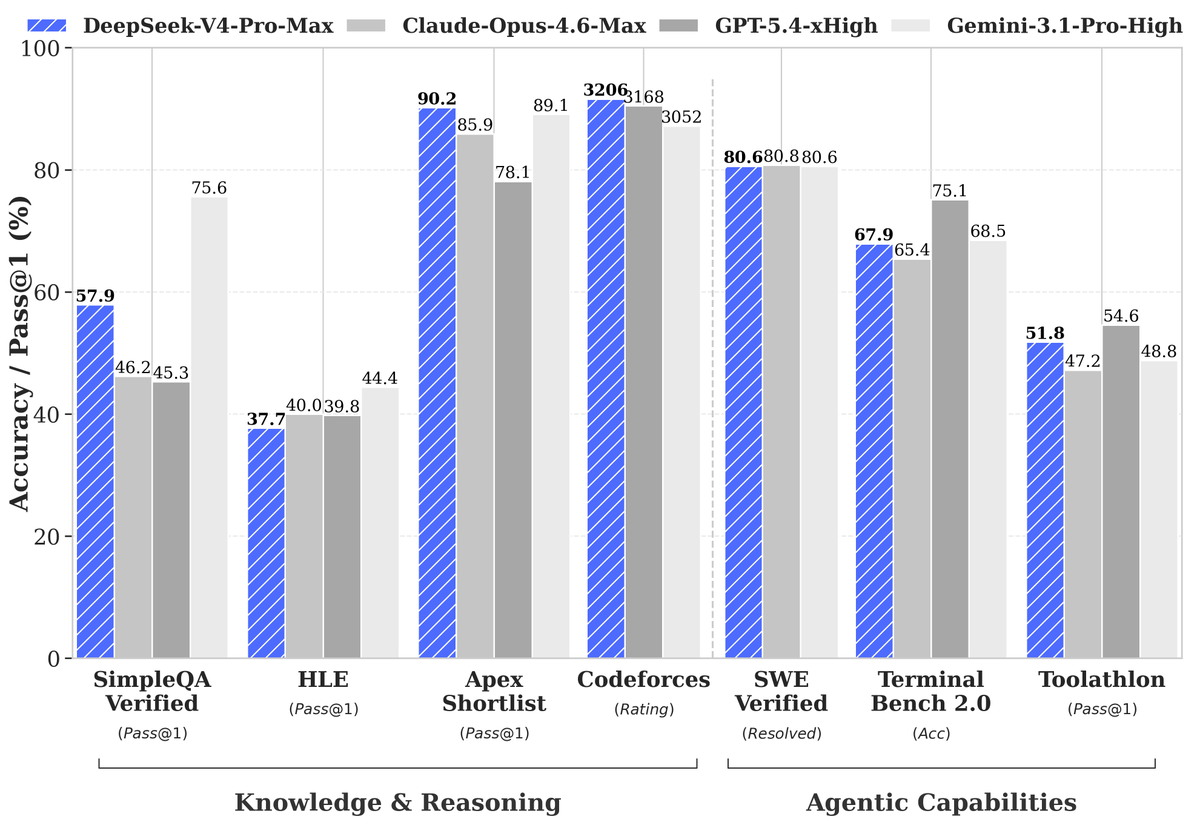
GAIA score 65.8 from XWork-MultiAgent
View sourceDeepSeek-V4-Pro 🔹 Enhanced Agentic Capabilities: Open-source SOTA in Agentic Coding benchmarks. 🔹 Rich World Knowledge: Leads all current open models, trailing only Gemini-3.1-Pro. 🔹 World-Class Reasoning: Beats all current open models in Math/STEM/Coding, rivaling top https://t.co/D04x5RjE3L
View sourceGAIA score 13.0 from deepseek
View sourceDeepSeek-V4-Pro 🔹 Enhanced Agentic Capabilities: Open-source SOTA in Agentic Coding benchmarks. 🔹 Rich World Knowledge: Leads all current open models, trailing only Gemini-3.1-Pro. 🔹 World-Class Reasoning: Beats all current open models in Math/STEM/Coding, rivaling top https://t.co/D04x5RjE3L
This paper studies autonomous software development, in which LLM-based coding agents transform high-level requirements into complete, functional, and usable software systems without human intervention. We introduce Harness-of-Harness (HoH), a framework that enables coding agents to continually improve software during autonomous development. HoH operates on existing coding-agent harnesses, and organizes their executions into iterative planning-coding-testing loops. To sustain improvement across loops, HoH balances repair with capability growth, scopes development into small and verifiable increments, separates implementation-time testing from independent evaluation, and constrains verifiable outputs rather than prescribing agent workflows. It progressively exposes deliverables, role-specific tools, and skills, encourages reuse rather than recreation, and maintains versioned project histories. On GameCraft-Bench, FrontierSWE, and ProgramBench, three harness-model pairs (Codex with GPT-5.5, OpenCode with DeepSeek-V4-Pro, and Pi with MiniMax-M3), HoH consistently outperforms the corresponding standalone harnesses, achieving an average relative gain of 52.25 percent and a maximum gain of 82.86 percent after three iterations. In a multi-day deployment with more than 70 iterations, HoH autonomously develops a first-person-shooter game, featuring a coherent storyline, fully implemented core mechanics, human-playable experience, polished visuals and integrated audio. Github: https://github.com/Flesymeb/HarnessOfHarness Project Page: https://flesymeb.github.io/HarnessOfHarness/
High-quality long-horizon training data for terminal agents is expensive to produce, often costing hundreds to thousands of dollars per task, because each task must keep the instruction, environment, reference solution, and verifier mutually consistent. Human authoring does not scale, and direct generation with large language models (LLMs) often breaks these dependencies. We present Recursive Synthetic Terminal Tasks (RST), a recursive verified synthesis framework for constructing long-horizon terminal-agent tasks at scale. Starting from verified seed tasks, RST extends the reference solution, realigns the verifier and instruction to the new workflow, validates the result in a fresh sandbox, and reuses accepted tasks as seeds for subsequent rounds. Across fifteen recursive rounds, RST produces 37,484 synthesized terminal-agent tasks at roughly \0.05 per task. Task difficulty increases substantially over rounds: the median reference solution grows from 67 to 374 lines, the median number of executed commands grows from 40 to 244, and DeepSeek-V4-Pro pass@4 drops from 90% at R_1 to 2.5% at R_{15}$. To demonstrate training utility, we collect rejection-sampled Qwen3.5 trajectories on the synthesized tasks and use them for supervised fine-tuning. Fine-tuning on these trajectories improves Qwen3.5-27B and Qwen3.5-122B-A10B by up to 10 points on Terminal-Bench~2, Terminal-Bench Hard, and Long-Horizon Terminal Bench, while agentic PPO lifts Qwen3.5-27B to 49.44\%, 32.00\%, and 22.07\% on the three benchmarks, corresponding to relative gains of 20.0\%, 41.2\%, and 21.9\% over the base model. Moreover, after 15 rounds, the recursion shows no ceiling: synthesis yield and validation rates remain stable as difficulty keeps climbing, indicating that the process can continue well beyond the scale reported here.
Frontier model evaluations are shifting from foundational capabilities (e.g., instruction following and reasoning) toward compositional, agentic ones, but Korean agentic benchmarks remain scarce. We introduce K-BrowseComp, a web-browsing agent benchmark grounded in Korean contexts, consisting of 400 problems. The 300-problem K-BrowseComp-Verified subset is manually constructed and validated by native Korean speakers. On this subset, frontier LLMs, including GPT-5.5, DeepSeek-V4-Pro, and GLM-5.1, reach only 30.00--45.67\%, a substantial drop from BrowseComp, while Korean LLMs released through Korea's Proprietary AI Foundation Model program obtain only 0.00--10.33\%. We further construct a 100-problem synthetic split using hard few-shot exemplars and failure-mode-targeted generation to exploit the asymmetry between solving and creating web browsing problems. On the adversarially filtered synthetic diagnostic split, the strongest model reaches only 26.00\%, and we report this split separately as a targeted stress test. We publicly release our data and code.
DeepSeek-V4-Pro is now available through Ollama Cloud. 1M context window listed. DeepSeek-V4-Pro is a frontier Mixture-of-Experts model with a large context window and three reasoning modes.
DeepSeek published benchmark or leaderboard evidence for DeepSeek-V4-Pro.
GAIA score 27.6 from Test-deepseek
GAIA score 65.8 from XWork-MultiAgent