Live access is not confirmed for this model. No current purchase price is advertised.
Related provider subscriptions
No current subscription pricing is tracked for this model.
Confirm this specific model, usage limits, and billing terms with the provider. A subscription does not automatically include API credits.
No login needed to compare. Prices are in USD; provider charges are separate from AI Market Cap plans. Context length, caching, tools, taxes, and regional terms can change the final cost. Open weights do not mean free hosting.
---
Quality Score
---
Arena ELO
Unknown
Parameters
1M
Context
Evidence profile
How complete is this record?
This measures the amount of verifiable public evidence we have, not how capable the model is. A missing field means it has not been verified yet, not that its value is zero.
Recent launch, pricing, benchmark, and API signals linked to this model or its provider.
PricingDeepSeek5mo ago
🚀 DeepSeek-V4 Preview is officially live & open-sourced! Welcome to the era of cost-effective 1M context length. 🔹 DeepSeek-V4-Pro: 1.6T total / 49B active params. Performance rivaling the world's t
🚀 DeepSeek-V4 Preview is officially live & open-sourced! Welcome to the era of cost-effective 1M context length. 🔹 DeepSeek-V4-Pro: 1.6T total / 49B active params. Performance rivaling the world's top closed-source models. 🔹 DeepSeek-V4-Flash: 284B total / 13B active params. https://t.co/n1AgwMIymu
Social & Blog Posts3
X/Twitter@deepseek_aiDeepSeek
Research Papers6
HF Papersunslothresearch5d ago
Other
ollama-libraryunslothapiapi1w ago
DeepSeek-V4-Flash is now available on Ollama Cloud
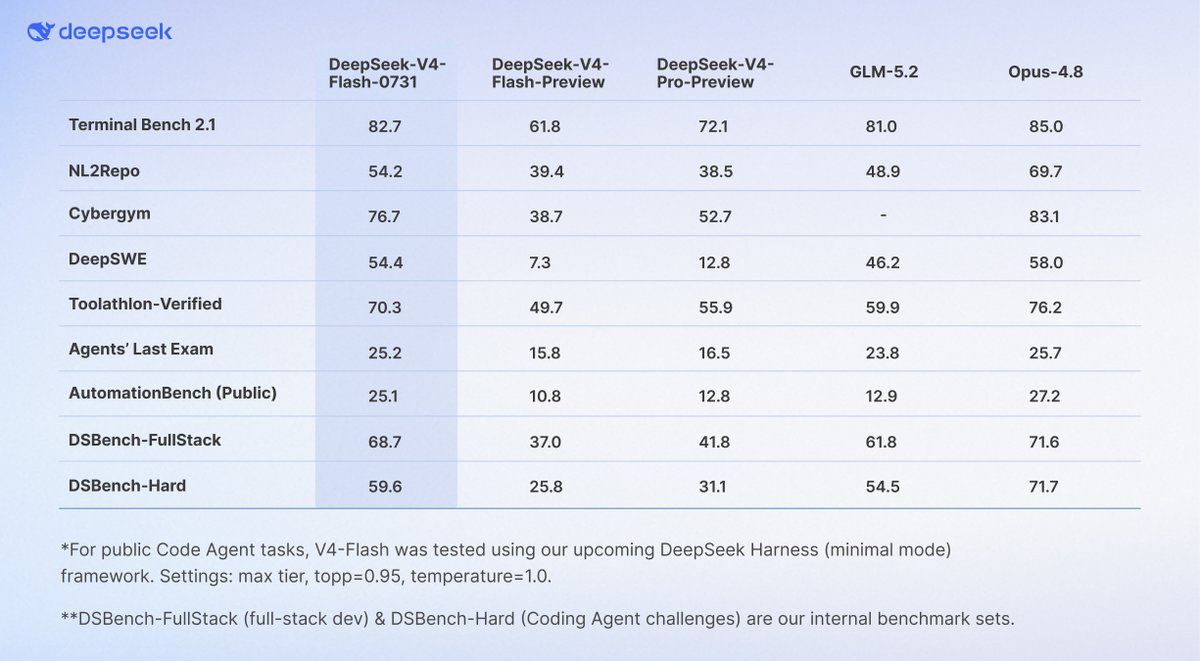
🚀 DeepSeek-V4-Flash Official API is now LIVE in public beta! 🔷 We’ve massively upgraded its Agent capabilities—benchmark scores are now far surpassing the V4-Pro-Preview. Check out the massive perfo
🚀 DeepSeek-V4-Flash Official API is now LIVE in public beta! 🔷 We’ve massively upgraded its Agent capabilities—benchmark scores are now far surpassing the V4-Pro-Preview. Check out the massive performance leap below! 👇 🔷 The official V4-Flash now natively supports the https://t.co/NUzOyxza2f
DeepSeek-V4-Flash-Vision-Exp is now live on the DeepSeek API Platform! 🚀 🔹 This experimental multimodal model matches DeepSeek-V4-Flash on text capabilities—including agents, reasoning, and world kn
DeepSeek-V4-Flash-Vision-Exp is now live on the DeepSeek API Platform! 🚀 🔹 This experimental multimodal model matches DeepSeek-V4-Flash on text capabilities—including agents, reasoning, and world knowledge. 🔹 On multimodal agent benchmarks, V4-Flash-Vision-Exp makes a major https://t.co/t2ELUZAagW
🚀 DeepSeek-V4-Flash Official API is now LIVE in public beta! 🔷 We’ve massively upgraded its Agent capabilities—benchmark scores are now far surpassing the V4-Pro-Preview. Check out the massive perfo
🚀 DeepSeek-V4-Flash Official API is now LIVE in public beta! 🔷 We’ve massively upgraded its Agent capabilities—benchmark scores are now far surpassing the V4-Pro-Preview. Check out the massive performance leap below! 👇 🔷 The official V4-Flash now natively supports the https://t.co/NUzOyxza2f
X/Twitter@deepseek_aiDeepSeekpricingpricing5mo ago
🚀 DeepSeek-V4 Preview is officially live & open-sourced! Welcome to the era of cost-effective 1M context length. 🔹 DeepSeek-V4-Pro: 1.6T total / 49B active params. Performance rivaling the world's t
🚀 DeepSeek-V4 Preview is officially live & open-sourced! Welcome to the era of cost-effective 1M context length. 🔹 DeepSeek-V4-Pro: 1.6T total / 49B active params. Performance rivaling the world's top closed-source models. 🔹 DeepSeek-V4-Flash: 284B total / 13B active params. https://t.co/n1AgwMIymu
Predictive Credit: Measuring What Scientific Explanations Add to Experimental Forecasts
Research agents explain planned experiments. We measure predictive credit with paired forecasts sharing an intervention, forecaster, and outcome while varying description, matched explanation, and donor context. Five checks track commitment, delivery, predictive gain, alignment, and known-signal uptake. Across 336 prospective states in controlled learning, 12 Tox21 endpoints, and 24 OpenML tasks, v5's frozen credit decision was inconclusive. Tox21's preregistered ROC AUC interval-score harm test was unmet (D-M=-.0026, 95 percent interval [-.0174, .0104]); OpenML's joint formation, point-equivalence, and repeatability rule was unmet. Matched point-accuracy gains over description remained unconfirmed, and Tox21/OpenML seed-donor intervals spanned zero. Under requested DeepSeek V4 Pro, matched and donor cards reduced secondary Tox21 drift by 64.5 and 59.1 percent. A DeepSeek V4 Flash replay raised matched point MAE from .01823 to .02020 and missed matched-donor interval-score equivalence. OpenML full-card assignment widened nominal 80 percent intervals by 21 percent, with 49.3 percent coverage versus 51.4 percent for description and content in 66/144 cards. Direct-text Flash delivered all 144 notes without detectable matched point-accuracy gain. A researcher-authored mechanism positive control lowered point MAE by 2.60 percentage points versus description. The protocol measures predictive credit for research-agent benchmarks and scientific forecasting; natural-explanation credit remained unconfirmed at the tested donor resolutions.
DeepSeek-V4.1-Flash: Pushing the Limits of KV Cache Compression
The widespread adoption of long-horizon agents has made model workloads increasingly input-heavy. Although prior work has substantially reduced the cost of long-context computation, prefill remains computationally expensive, and large KV caches continue to strain HBM and SSD capacity and data-transfer bandwidth. Together, these compute, storage, and bandwidth demands constitute the primary bottleneck to further lowering deployment costs. To address this challenge, we introduce DeepSeek-V4.1-Flash, a multimodal Mixture-of-Experts (MoE) model with 552B backbone parameters and support for contexts of up to one million tokens. With its Causal Encoder-Decoder (CED) architecture, the model activates 16B parameters per token during decode but only 8B parameters during prefill, substantially improving cost efficiency for agentic workloads. To push the limits of KV cache compression, DeepSeek-V4.1-Flash combines cross-layer KV cache reuse in Compressed Sparse Attention 2 (CSA2) with FP4 KV caching. These designs reduce its global KV cache footprint (always in HBM) to 890 bytes per token, roughly 1/4 of the corresponding footprint of DeepSeek-V4-Flash. Further, through a dedicated deployment optimization known as SWA Bounded Replay, DeepSeek-V4.1-Flash reduces its persistent KV cache footprint (always on SSD or in host memory) to roughly 1/8 of that of DeepSeek-V4-Flash. Despite its much smaller KV cache footprint, the model delivers substantially better performance than the baseline. In addition, we streamline the DeepSeek-V4 architecture and introduce several efficient architectural extensions. We pretrain DeepSeek-V4.1-Flash on a multimodal corpus comprising 45T tokens and conduct comprehensive post-training, yielding strong performance across diverse text-based and multimodal agentic scenarios. Model checkpoints are available at https://huggingface.co/deepseek-ai/DeepSeek-V4.1-Flash.
Learning to Evaluate Before Improving: Automatic Rubric Induction for Automatic Research Agents
Autonomous scientific research agents are increasingly applied to end-to-end scientific workflows, including literature review, data analysis, experimentation, and report generation. However, open-ended research tasks often do not clearly specify the analyses, methods, and success criteria required to complete the task. As a result, agents may miss important analyses, use inappropriate methods, or draw conclusions that are insufficiently supported by evidence. To address the problem, we present AutoSciRub, an evaluation-first framework that induces a task-specific executable rubric before research execution, and uses it to guide execution, criterion-level verification as well as iterative revision. AutoSciRub decomposes an underspecified instruction into atomic scientific goals, grounds them in relevant literature and task-visible data, and synthesizes specific, actionable, and verifiable criteria. The resulting rubric makes implicit experimental and evidential requirements explicit, providing guidance for experiments and analyses. During revision, rubric-guided verification identifies unmet criteria and enables targeted refinement of the research report and its supporting artifacts. On ResearchClawBench, AutoSciRub consistently improves all tested configurations, with an average gain of 2.08 points across three backbone LLMs under the fixed Codex harness and 2.95 points across three agent harnesses using a fixed DeepSeek-V4-Flash backbone. On a randomly sampled 20-task subset of AstaBench E2E Discovery, AutoSciRub further achieves an average improvement of 16.8 points across three agent harnesses, while maintaining or increasing the number of successfully completed tasks. These results demonstrate that evaluation-first guidance provides an effective and generalizable control mechanism for autonomous scientific research (Code: https://github.com/zjunlp/AutoSciRub).
JIT-Agent: Scaling Harness Intelligence via Just-in-Time Harness Evolution
Agent capability is not determined by the model alone. The agent harness, encompassing memory management, planning strategy, action protocol, and tool/skill orchestration, can dominate the contribution of the underlying foundation model. Yet harness design remains manual, task-specific, and fundamentally unscalable. We present JIT-Agent, a harness intelligence model trained to synthesize task-adaptive agent harnesses on the fly for arbitrary off-the-shelf agentic LLMs. We formalize the agent harness as a composable, machine-generatable artifact governed by a fixed four-module protocol, and train JIT-Agent to customize harnesses for a given task at hand, repair harnesses for stable and reliable execution, and self-evolve by distilling performance signals from an expanding archive of prior harness configurations. Equipped with JIT-Agent as a harness helper, DeepSeek-V4-Flash surpasses GPT-5.6 on DeepSearchQA (+9.1) and OdysseyBench (+4.3), while the already strong GLM-5.2 gains up to +20.2 points. Across controlled evaluations, JIT-Agent-generated harnesses are performance-competitive with mature agent runtimes such as OpenCode and Claude Code and consistently improve multi-scale model families of DeepSeek V4, Mimo-V2.5, and Qwen3.6. To our knowledge, JIT-Agent is the first model purpose-built for just-in-time harness generation, establishing harness intelligence as a trainable, transferable, and compounding dimension of agent capability orthogonal to model scaling.
Complex software systems develop over timescales that exceed the lifespan of any individual coding agent. Most agentic software systems preserve continuity through persistent sessions, memories, managers or shared context. We introduce EvoX Genesis (hereafter, Genesis), which instead makes the software project persistent while allowing local agents to remain finite-lived. Genesis represents software as a persistent recursive world: each local world is situated by an accepted version and a repository path, finite-lived agents propose local changes, recursive delegation moves work across paths, and only accepted consequences advance the persistent version history. We evaluate this organization across formation, continuation and redevelopment. Starting from a repository with no compiler implementation, Genesis used DeepSeek V4 Flash to build a Rust-based C compiler with about 250k tracked lines; the run lasted over 120 hours, archived over 1,000 agent episodes and incurred only US$44 in model-token charges. The compiler passed the complete c-testsuite and most LLVM and Csmith tests. In a separate compiler world generated with GLM 5.2, development continued after repeated agent replacement while retaining full test performance. Genesis also reimplemented 13 MESA modules with over 100k Fortran lines as a Rust workspace with nearly 90k Rust lines; across six numerical workloads, it achieved median speedups of 1.55--6.87x. These results show that long-horizon software development can be organized around a persistent project rather than a persistent agent.
Hierarchical Self-Improvement: A Framework for Task-Specific Evolvable Agent Harnesses
Modern LLM agents are often improved by modifying prompts, tools, or workflows manually, while the executable scaffold surrounding the model---the harness---is typically treated as a fixed artifact after deployment. This work studies an alternative where the harness is task-specific and continuously evolvable: each task family maintains its own harness, which is hot-swapped across iterations through a fixed task-injection seam and rewritten using environment feedback. We introduce Hierarchical Self-Improvement (HSI), a framework in which a single frozen LLM M operates across three hierarchical scopes: a task harness H that executes tasks, an evolver that rewrites H, and a meta-evolver that rewrites the evolver's strategy code under a frozen outer anchor. A thinking-on/off design isolates the contribution of harness evolution by disabling reasoning during task execution while enabling it during self-modification. HSI is bounded by two factors: a feedback-fidelity bound, since evolution requires informative reward signals to guide selection, and a backbone capability bound, since harness redesign cannot overcome limitations of the frozen model. On BALROG with DeepSeek-V4-Flash-Preview as the frozen backbone, HSI achieves consistent gains over the initial harness on moderate-difficulty tasks (+39.3 on BabyAI, +33.0 on Crafter, +25.0 on TextWorld, and +15.0 on MiniHack, all in raw \% Progress), while obtaining strong held-out generalization on BabaIsAI sub-suites (0.98 best-test on BreakStop and 1.00 on GoTo from a 20% unseen split). On tasks beyond the backbone's capability (NLE), harness evolution provides no improvement. These results demonstrate task-specific harness evolution as a viable axis for improving frozen LLM agents under clear empirical limits. Code is available at https://github.com/TailinZhou/hsi.
DeepSeek-V4-Flash is now available through Ollama Cloud. 1M context window listed. DeepSeek-V4-Flash is the official release of DeepSeek-V4-Flash, built for efficient reasoning across a 1M-token context window, outperforming DeepSeek-V4-Pro (Preview).