BenchmarksToday
gpt-5-mini-2025-08-07 - SWE-Bench Verified
SWE-Bench Verified resolved rate 59.8
View sourceOpenAI
Smaller GPT-5 family model tuned for lower-latency chat, coding, and multimodal assistant workloads.
OpenRouter
Price record: 2026-10-25. Source: openrouter.
Confirm this specific model, usage limits, and billing terms with the provider. A subscription does not automatically include API credits.
No login needed to compare. Prices are in USD; provider charges are separate from AI Market Cap plans. Context length, caching, tools, taxes, and regional terms can change the final cost. Open weights do not mean free hosting.
42.1
Quality Score
1183
Arena ELO
Undisclosed
Parameters
128K
Context
This measures the amount of verifiable public evidence we have, not how capable the model is. A missing field means it has not been verified yet, not that its value is zero.
17 of 22 public signals
Sign in to join the discussion
0
Downloads
0
Likes
Aug 2025
Released
4/5 signals
4/4 signals
5/5 signals
1/4 signals
3/4 signals
Parameters
—
Training compute
Not reported
Dataset scale
Not reported
Base model
Not reported
Source-reported access: API access · Unknown confidence
Gaps we are still tracking
Benchmarks
4
API
1
Research
3
General
8
Recent launch, pricing, benchmark, and API signals linked to this model or its provider.
SWE-Bench Verified resolved rate 59.8
View sourceSWE-Bench Verified resolved rate 59.8
Introducing GPT-5 for developers | OpenAI Skip to main content Research Products Business Developers Company Foundation (opens in a new window) Log in Try ChatGPT (opens in a new window) Research Products Business Developers Company Foundation (opens in a new window) Try ChatGPT (opens in a new window) Login OpenAI August 7, 2025 Product Introducing GPT‑5 for developers The best model for coding and agentic tasks. Loading… Share Introduction Introduction Coding Frontend engin
ChatGPT Start searching API Dashboard Try ChatGPT Home API Overview Get started with the OpenAI API Models Explore models and compare capabilities Agents Build persistent agents on hosted infrastructure Tools Connect models to tools and data Audio & voice Build speech and realtime voice experiences Production Deploy and scale your API integrations API reference Explore endpoints, parameters, and responses ChatGPT Plugins Extend ChatGPT and Codex Sign in with ChatGPT Apps
View sourceChatGPT Start searching API Dashboard Try ChatGPT Home API Overview Get started with the OpenAI API Models Explore models and compare capabilities Agents Build persistent agents on hosted infrastructure Tools Connect models to tools and data Audio & voice Build speech and realtime voice experiences Production Deploy and scale your API integrations API reference Explore endpoints, parameters, and responses ChatGPT Plugins Extend ChatGPT and Codex Sign in with ChatGPT Apps
View sourceGPT-5.4 mini is available today in ChatGPT, Codex, and the API. Optimized for coding, computer use, multimodal understanding, and subagents. And it’s 2x faster than GPT-5 mini. https://t.co/DKh2cC5S3F https://t.co/sirArgn37L
View sourceGPT-Rosalind surfaced a new lead for drug discovery: could restoring cholesterol transport protect neurons from degeneration? DCTN1 is a gene linked to Perry syndrome, a rare neurodegenerative disorder. In mouse-brain data, disrupting it increased expression of genes involved in

Our latest model advances bring stronger capabilities for building and migrating software in low-resource programming languages such as COBOL, Fortran, and Visual Basic. These languages power software that banks, governments, and businesses depend on. Progress here means https://t.co/Mulo5P3iCO
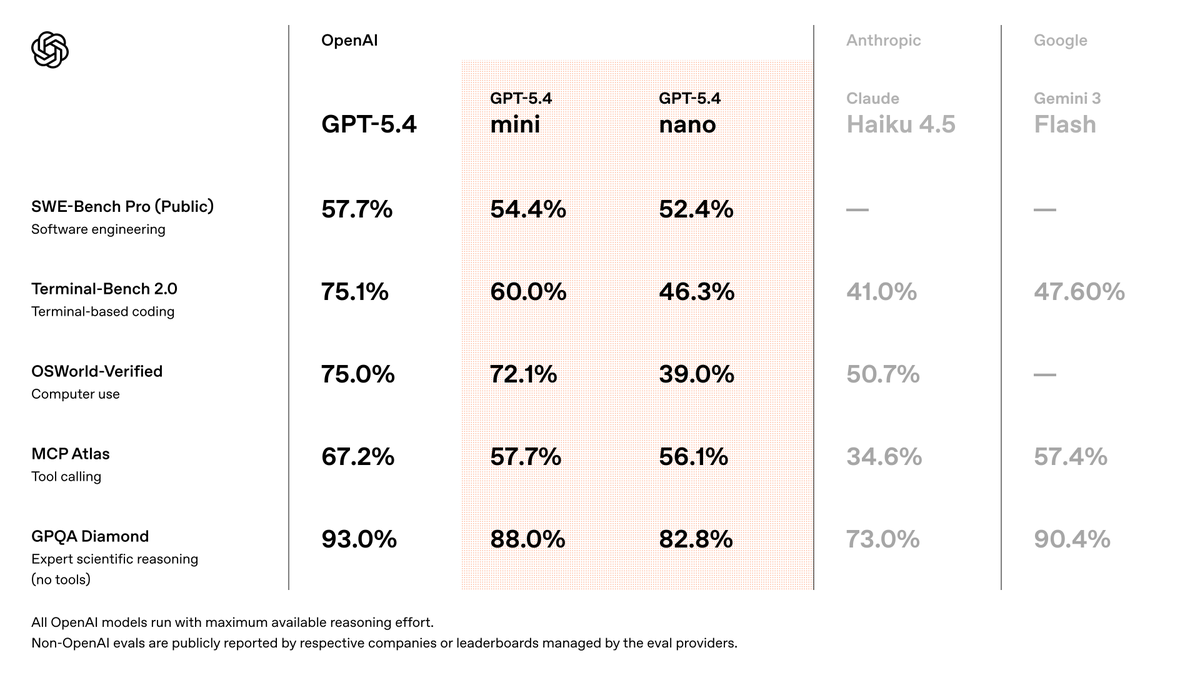
GPT-5.4 mini is available today in ChatGPT, Codex, and the API. Optimized for coding, computer use, multimodal understanding, and subagents. And it’s 2x faster than GPT-5 mini. https://t.co/DKh2cC5S3F https://t.co/sirArgn37L
General-purpose manipulation requires reliable behavior across embodiments, objects, and task demands. We introduce HandsOn, a composable simulation platform and benchmark for cross-embodiment dexterous manipulation. It supports five robotic arms, six dexterous hands, and approximately 200 rigid, articulated, and deformable assets in randomized scenes. The benchmark pairs 18,000 curated human demonstrations with 66 human-verified tasks: Core-50 supports demonstration-based learning and execution tests, while Transfer-16 evaluates asset and relation transfer, skill composition, and deformable manipulation without target-task training demonstrations. Qualitative real-robot rollouts illustrate sim-to-real transfer. Across diffusion, vision-language-action, world-action, and prompted VLM-based methods, the best trained multi-task policy achieves 29.1% Core-50 success. Without benchmark finetuning, GPT-6 using move_eef for palm-and-finger control achieves 5.2% on Core-50 and 1.9% on Transfer-16 over 660 trials. Trained-policy stage diagnostics expose failures in contact establishment, action coordination, and maintaining achieved goals, with additional sequencing errors in composed tasks. HandsOn provides a shared basis for investigating manipulation generalization and the limits of reliable physical interaction.
As recommender systems transition toward agentic, multi-turn conversational interfaces, evaluation paradigms have struggled to keep pace. Current benchmarks often rely on "LLM-as-a-judge" evaluations, which introduce subjectivity, high costs and inconsistency. We present τ-Rec, a benchmark for agentic recommender systems that replaces subjective evaluation with verifiable rewards and a reveal-tagged elicitation (RTE) mechanism that controls how task constraints surface during dialogue. By testing agents against structured catalog predicates and employing a pass^k reliability metric, τ-Rec provides a systematic test for consistent reasoning. Our evaluation of nine configurations across five model families -- GPT-5.4, Claude Sonnet 4.6, Gemini 2.5 Flash, DeepSeek V4 Flash, Qwen3-32B and GPT-5 mini -- reveals a steep reliability cliff, where even the best model achieves only ~57% at pass^1 and ~38% at pass^4, highlighting a critical gap in current conversational agent deployment. All code and data are publicly available at https://github.com/nbharaths/tau-rec.
Agentic search requires language model agents to explore many sources and answer complex information-seeking questions. Scaling test-time compute is a promising way to improve these agents, but current approaches can fail, because correct answers are often sparse and score-based selection depends on model calibration. We propose FineVerify, a fine-grained self-verification framework that decomposes each question into checkable sub-questions, verifies sampled candidates against each sub-question, and selects the candidate with the highest aggregated score. This per-check structure turns selection into simpler local judgments and produces scores under the same explicit criteria. Across four agentic search benchmarks and two models, FineVerify consistently outperforms standard scaling baselines. With only four sampled trajectories, it improves GPT-5-mini by 8.2 accuracy points and Gemini-3-flash by 5.6% on average. With 12 samples, FineVerify enables GPT-5-mini to surpass frontier GPT-5 on BrowseComp-Plus. Beyond accuracy, FineVerify produces interpretable verification traces that help audit benchmark errors, suggesting broader applications for inspecting agentic search systems. Code and data are available at https://github.com/XuZhao0/fineverify
Introducing GPT-5 for developers | OpenAI Skip to main content Research Products Business Developers Company Foundation (opens in a new window) Log in Try ChatGPT (opens in a new window) Research Products Business Developers Company Foundation (opens in a new window) Try ChatGPT (opens in a new window) Login OpenAI August 7, 2025 Product Introducing GPT‑5 for developers The best model for coding and agentic tasks. Loading… Share Introduction Introduction Coding Frontend engin
ChatGPT Start searching API Dashboard Try ChatGPT Home API Overview Get started with the OpenAI API Models Explore models and compare capabilities Agents Build persistent agents on hosted infrastructure Tools Connect models to tools and data Audio & voice Build speech and realtime voice experiences Production Deploy and scale your API integrations API reference Explore endpoints, parameters, and responses ChatGPT Plugins Extend ChatGPT and Codex Sign in with ChatGPT Apps
ChatGPT Start searching API Dashboard Try ChatGPT Home API Overview Get started with the OpenAI API Models Explore models and compare capabilities Agents Build persistent agents on hosted infrastructure Tools Connect models to tools and data Audio & voice Build speech and realtime voice experiences Production Deploy and scale your API integrations API reference Explore endpoints, parameters, and responses ChatGPT Plugins Extend ChatGPT and Codex Sign in with ChatGPT Apps