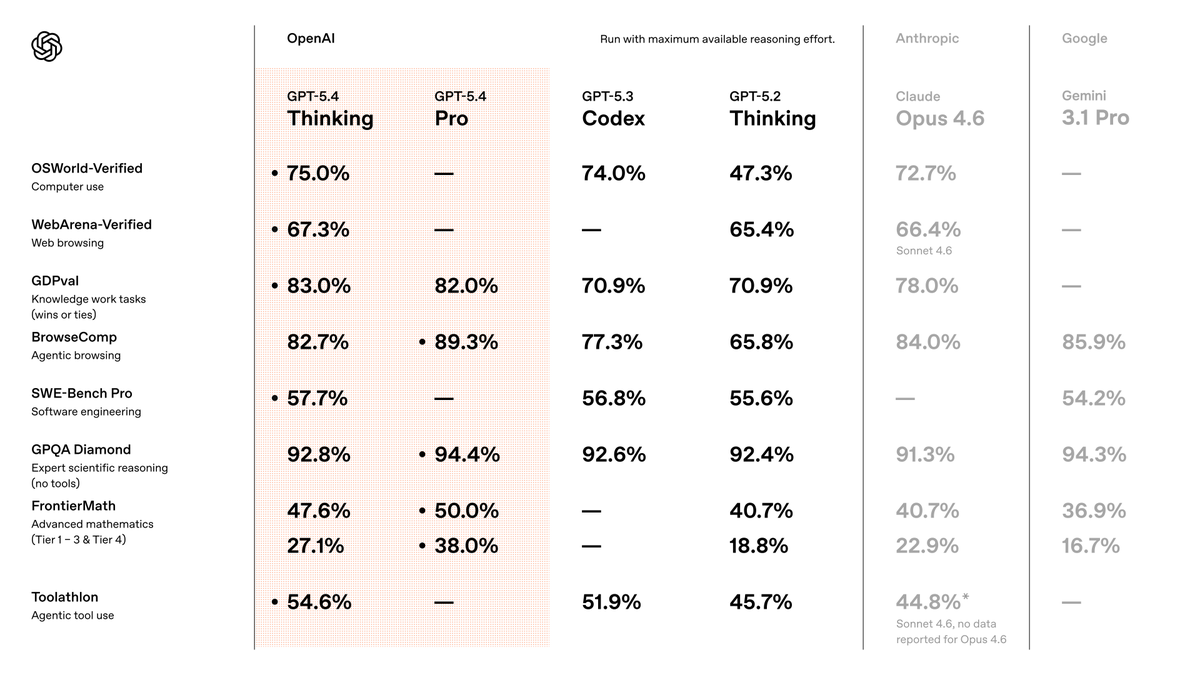
GPT-5.4 Pro is OpenAI's most advanced model, building on GPT-5.4's unified architecture with enhanced reasoning capabilities for complex, high-stakes tasks. It features a 1M+ token context window (922K input, 128K...
Model updates refreshed14h agoOct 2, 2026news + changelog
Confirm this specific model, usage limits, and billing terms with the provider. A subscription does not automatically include API credits.
No login needed to compare. Prices are in USD; provider charges are separate from AI Market Cap plans. Context length, caching, tools, taxes, and regional terms can change the final cost. Open weights do not mean free hosting.
---
Quality Score
1205
Arena ELO
1M
Parameters
1M
Context
Evidence profile
How complete is this record?
This measures the amount of verifiable public evidence we have, not how capable the model is. A missing field means it has not been verified yet, not that its value is zero.
Introducing GPT‑5 for developers | OpenAI Skip to main content Research Products Business Developers Company Foundation (opens in a new window) Log in Try ChatGPT (opens in a new window) Research Products Business Developers Company Foundation (opens in a new window) Try ChatGPT (opens in a new window) Login OpenAI August 7, 2025 Product Introducing GPT‑5 for developers The best model for coding and agentic tasks. Loading… Share Introduction Introduction Coding Frontend engin
GPT-5.4 Thinking and GPT-5.4 Pro are rolling out now in ChatGPT. GPT-5.4 is also now available in the API and Codex. GPT-5.4 brings our advances in reasoning, coding, and agentic workflows into one fr
GPT-5.4 Thinking and GPT-5.4 Pro are rolling out now in ChatGPT. GPT-5.4 is also now available in the API and Codex. GPT-5.4 brings our advances in reasoning, coding, and agentic workflows into one frontier model. https://t.co/1hy6xXLAmJ
Introducing GPT‑5 for developers | OpenAI Skip to main content Research Products Business Developers Company Foundation (opens in a new window) Log in Try ChatGPT (opens in a new window) Research Products Business Developers Company Foundation (opens in a new window) Try ChatGPT (opens in a new window) Login OpenAI August 7, 2025 Product Introducing GPT‑5 for developers The best model for coding and agentic tasks. Loading… Share Introduction Introduction Coding Frontend engin
ChatGPT Start searching API Dashboard Try ChatGPT Home API Overview Get started with the OpenAI API Models Explore models and compare capabilities Agents Build persistent agents on hosted infrastructure Tools Connect models to tools and data Audio & voice Build speech and realtime voice experiences Production Deploy and scale your API integrations API reference Explore endpoints, parameters, and responses ChatGPT Sign in with ChatGPT Apps powered by your user's ChatGP
This is Ultrafast. Our premium speed tier, Ultrafast offers up to 8x faster token generation (300 tokens per second) in Codex and up to 6x in the API. https://t.co/ekyzT1vFan
This is Ultrafast. Our premium speed tier, Ultrafast offers up to 8x faster token generation (300 tokens per second) in Codex and up to 6x in the API. https://t.co/ekyzT1vFan
Codex Security Cloud is getting a major upgrade, with access to cyber-capable models through Daybreak Blue included by default. It scans entire GitHub repos, continuously reviews new commits, investig
Codex Security Cloud is getting a major upgrade, with access to cyber-capable models through Daybreak Blue included by default. It scans entire GitHub repos, continuously reviews new commits, investigates and deduplicates findings, and prepares fixes for review – even when your https://t.co/up1hpkiCAK
We’ve shared details on how AI agents in our research environment sent training and evaluation data to third-party services when they shouldn’t have. Most of that data did not come from users. We have
We’ve shared details on how AI agents in our research environment sent training and evaluation data to third-party services when they shouldn’t have. Most of that data did not come from users. We have discovered 53 cases where images that people had uploaded were posted to
After the Hugging Face incident, we committed to conducting a much broader review of actions taken by our models during training and evaluation and to being transparent about our findings. This is an
After the Hugging Face incident, we committed to conducting a much broader review of actions taken by our models during training and evaluation and to being transparent about our findings. This is an extensive review that is ongoing. The vast majority of actions we’ve reviewed
GPT-5.4 Thinking and GPT-5.4 Pro are rolling out now in ChatGPT. GPT-5.4 is also now available in the API and Codex. GPT-5.4 brings our advances in reasoning, coding, and agentic workflows into one fr
GPT-5.4 Thinking and GPT-5.4 Pro are rolling out now in ChatGPT. GPT-5.4 is also now available in the API and Codex. GPT-5.4 brings our advances in reasoning, coding, and agentic workflows into one frontier model. https://t.co/1hy6xXLAmJ
SkillOpt-Lite: Better and Faster Agent Self-evolution via One Line of Vibe
While skill optimization for autonomous agents has gained traction, existing methods rely on complex pipelines. This leaves a fundamental question unaddressed: What constitutes a minimal viable pipeline for skill optimization, where every component is justified by theory or empirical necessity? We formalize skill optimization via Zeroth-Order (ZO) optimization, mapping classical counterparts (central difference, trust regions) to recent literature. Noting that unlike blind numerical perturbations in classical ZO, skill trajectories serve as interpretable debugging feedback. Grounded in Claude Code philosophy and PAC learning, we establish three principles for convergence and generalization: file-system-based trajectory exploration, consensus attribute mining, and independent validation gating. Eliminating redundancies, we propose SkillOpt-Lite. It accelerates convergence and outperforms full SkillOpt: improving LiveMath by +8.8 points on GPT-5.5 and +25.4 points on GPT-5.4-nano, allowing the nano model to surpass standard GPT-5.4 optimized by SkillOpt. Finally, we integrate our framework into production coding agents like VSCode Copilot, enabling developers to evolve agent skills via one line of vibe. Because our framework treats all agent components simply as standard editable code, this minimal pipeline naturally generalizes to full harness optimization (HarnessOpt). On SpreadsheetBench, HarnessOpt enables GPT-5.4-nano to achieve 0.7758 accuracy, outperforming the larger GPT-5.5 running standard pipelines (0.7620). Code is available at https://github.com/EvolvingLMMs-Lab/SkillOpt-Lite.
MultAttnAttrib: Training-Free Multimodal Attribution in Long Document Question Answering
As grounded QA systems are increasingly deployed in AI assistants, accurately attributing generated answers to evidence is critical for user trust and model safety. While unimodal attributions have been explored in depth, the multimodal setting remains relatively under-researched. As a result, we introduce MultAttnAttrib, a training-free attribution-generation method that leverages a model's prefill pass, selected attention heads, and calibrated thresholds to locate source evidence within a document. To establish baseline results for the method, we introduce MultAttrEval, a complementary benchmark dataset annotated with fine-grained, ground-truth attributions for answer components grounded in multimodal source documents. To our knowledge, this is the first evaluation dataset designed specifically for multimodal attribution in long-form documents. Experimental results show that MultAttnAttrib consistently outperforms a variety of attribution-generation methods, including several strong prompting-based approaches and matches the latest frontier models such as GPT 5.4. Our method not only substantially improves attribution accuracy for both unimodal and multimodal attribution types, but also produces attributions at up to one-seventh of the direct inference latency compared to prompting on the same base model.
PolicyGuard: A Dialogue-Grounded Sub-Agent Verifier for Policy Adherence in LLM Agents
LLM agents handle user requests on behalf of organizations through tool calls and must follow the company policies stated in their system prompts. Prior work approaches this as a safeguarding problem -- external checks that block non-compliant agent actions. We argue that policy adherence is a broader problem: real workflows unfold across many turns, require explicit user confirmation and prerequisite reads, and hinge on the content of the dialogue rather than on any single argument value. Meeting this bar requires (i) full conversation context, (ii) self-reasoning over the policy and the current dialogue, and (iii) conversation-specific remediation that guides the agent's next turn -- three capabilities that prior safeguard work has often underestimated. We introduce POLICYGUARD, a sub-agent verifier that shares the agent's view of the dialogue, reasons over the policy in context, and provides actionable feedback for the agent's next turn. On tau^2-BENCH airline across three vendors (GPT-5.4, Claude Sonnet 4.6, Gemini 2.5 Pro) with four trials per setting, POLICYGUARD improves PASS4 by +12.0 / +6.0 / +12.0 pp. Per-call analyses show POLICYGUARD achieves higher policy-violation recall while blocking roughly half as often as argument-level guards.
S-Agent: Spatial Tool-Use Elicits Reasoning for Spatial Intelligence
Real-world spatial intelligence requires reasoning over a continuous and evolving 3D world, yet existing VLMs and tool-augmented agents largely remain tied to static, stateless inference from isolated visual observations. We introduce \textsc{S-Agent}, a spatial tool-use agentic paradigm for understanding and reasoning over continuous multi-view images and videos. By formulating spatial reasoning as spatio-temporal evidence accumulation rather than isolated frame-level prediction, S-Agent reshapes spatial perception into scene-centric understanding beyond frame-centric recognition. Specifically, S-Agent casts the VLM as a semantic planner that decides what evidence is needed, while a hierarchy of spatial tools and experts grounds objects in 2D, lifts them into 3D geometric evidence, and aggregates this evidence into high-level spatial knowledge (e.g., counting, measurement, orientation, and relative position). Additionally, a temporal memory mechanism, including Scene Memory for maintaining the evolving scene state and Agent Memory for accumulating reasoning context, enables evidence integration across frames and reasoning steps. Comprehensive experiments on multi-view and video spatial reasoning benchmarks show that S-Agent consistently improves both open-source and closed-source VLMs in a training-free manner. Beyond inference-time augmentation, supervised fine-tuning (SFT) on S-Agent-generated spatial trajectories S-300K yields S-Agent-8B, a compact spatial agent that significantly surpasses similar-scale baselines (e.g., Qwen3-VL-8B) and performs comparably to advanced closed-source models (e.g., GPT-5.4 and Gemini 3).
Multi-agent reasoning systems adopt a "generate-then-transfer" paradigm that forces end-to-end latency to scale linearly with pipeline depth. We introduce StreamMA, a multi-agent reasoning system that streams each reasoning step to downstream agents as soon as it is generated, pipelining adjacent agents and thus reducing latency. Surprisingly, this pipelining also improves effectiveness: because multi-step reasoning quality is non-uniform and early steps are more reliable than later ones, working with these reliable early steps instead of the full chain prevents error-prone late steps from misleading downstream agents. We formalize both advantages with the first closed-form joint analysis of stream, serial, and single protocols, deriving the effectiveness ordering, speedup upper bound, and cost ratio. Across eight reasoning benchmarks spanning mathematics, science, and code, two frontier LLMs (Claude Opus 4.6 and GPT-5.4), and three topologies (Chain, Tree, Graph), StreamMA outperforms both baselines (avg. +7.3 pp, max +22.4 pp on HMMT 2026; Claude Opus 4.6-high). Beyond these contributions, we discover a "step-level scaling law": increasing per-agent steps consistently improves both effectiveness and efficiency, a new scaling dimension orthogonal to and composable with agent-count scaling.
CurveBench: A Benchmark for Exact Topological Reasoning over Nested Jordan Curves
We introduce CurveBench, a benchmark for hierarchical topological reasoning from visual input. CurveBench consists of 756 images of pairwise non-intersecting Jordan curves across easy, polygonal, topographic-inspired, maze-like, and dense counting configurations. Each image is annotated with a rooted tree encoding the containment relations between planar regions. We formulate the task as structured prediction: given an image, a model must recover the full rooted containment tree induced by the curves. Despite the visual simplicity of the task, the strongest evaluated model, Gemini 3.1 Pro, achieves only 71.1\% tree-generation accuracy on CurveBench-Easy and 19.1\% on CurveBench-Hard. We further demonstrate benchmark utility through RLVR-style fine-tuning of open-weight vision-language models. Our trained Qwen3-VL-8B model improves over Qwen-3-VL-8B-Thinking from 2.8\% to 33.3\% tree-generation accuracy on CurveBench-Easy, exceeding GPT-5.4 and Claude Opus 4.5 under our evaluation protocol. The remaining gap, especially on CurveBench-Hard, shows that exact topology-aware visual reasoning remains far from solved.
IntentGrasp: A Comprehensive Benchmark for Intent Understanding
Accurately understanding the intent behind speech, conversation, and writing is crucial to the development of helpful Large Language Model (LLM) assistants. This paper introduces IntentGrasp, a comprehensive benchmark for evaluating the intent understanding capability of LLMs. Derived from 49 high-quality, open-licensed corpora spanning 12 diverse domains, IntentGrasp is constructed through source datasets curation, intent label contextualization, and task format unification. IntentGrasp contains a large-scale training set of 262,759 instances and two evaluation sets: an All Set of 12,909 test cases and a more balanced and challenging Gem Set of 470 cases. Extensive evaluations on 20 LLMs across 7 families (including frontier models such as GPT-5.4, Gemini-3.1-Pro, and Claude-Opus-4.7) demonstrate unsatisfactory performance, with scores below 60% on All Set and below 25% on Gem set. Notably, 17 out of 20 tested models perform worse than a random-guess baseline (15.2%) on Gem Set, while the estimated human performance is ~81.1%, showing substantial room for improvement. To enhance such ability, this paper proposes Intentional Fine-Tuning (IFT), which fine-tunes the models on the training set in IntentGrasp, yielding significant gains of 30+ F1 points on All Set and 20+ points on Gem Set. Tellingly, the leave-one-domain-out (Lodo) experiments further demonstrate the strong cross-domain generalizability of IFT, verifying that it is a promising approach to substantially enhancing the intent understanding of LLMs. Overall, by benchmarking and boosting intent understanding ability, this study sheds light on a promising path towards more intentional, capable, and safe AI assistants for human benefits and social good.
Playing Along: Learning a Double-Agent Defender for Belief Steering via Theory of Mind
As large language models (LLMs) become the engine behind conversational systems, their ability to reason about the intentions and states of their dialogue partners (i.e., form and use a theory-of-mind, or ToM) becomes increasingly critical for safe interaction with potentially adversarial partners. We propose a novel privacy-themed ToM challenge, ToM for Steering Beliefs (ToM-SB), in which a defender must act as a Double Agent to steer the beliefs of an attacker with partial prior knowledge within a shared universe. To succeed on ToM-SB, the defender must engage with and form a ToM of the attacker, with a goal of fooling the attacker into believing they have succeeded in extracting sensitive information. We find that strong frontier models like Gemini3-Pro and GPT-5.4 struggle on ToM-SB, often failing to fool attackers in hard scenarios with partial attacker prior knowledge, even when prompted to reason about the attacker's beliefs (ToM prompting). To close this gap, we train models on ToM-SB to act as AI Double Agents using reinforcement learning, testing both fooling and ToM rewards. Notably, we find a bidirectionally emergent relationship between ToM and attacker-fooling: rewarding fooling success alone improves ToM, and rewarding ToM alone improves fooling. Across four attackers with different strengths, six defender methods, and both in-distribution and out-of-distribution (OOD) evaluation, we find that gains in ToM and attacker-fooling are well-correlated, highlighting belief modeling as a key driver of success on ToM-SB. AI Double Agents that combine both ToM and fooling rewards yield the strongest fooling and ToM performance, outperforming Gemini3-Pro and GPT-5.4 with ToM prompting on hard scenarios. We also show that ToM-SB and AI Double Agents can be extended to stronger attackers, demonstrating generalization to OOD settings and the upgradability of our task.
HorizonMath: Measuring AI Progress Toward Mathematical Discovery with Automatic Verification
Can AI make progress on important, unsolved mathematical problems? Large language models are now capable of sophisticated mathematical and scientific reasoning, but whether they can perform novel research is still widely debated and underexplored. We introduce HorizonMath, a benchmark of over 100 predominantly unsolved problems spanning 8 domains in computational and applied mathematics, paired with an open-source evaluation framework for automated verification. Our benchmark targets a class of problems where discovery is hard, requiring meaningful mathematical insight, but verification is computationally efficient and simple. Because these solutions are unknown, HorizonMath is immune to data contamination, and most state-of-the-art models score near 0%. Existing research-level benchmarks instead rely on formal proof verification or manual review, both of which are expensive to scale. Using this platform, we find two problems for which GPT 5.4 Pro proposes solutions that improve on the best-known published results, representing potential novel contributions (pending expert review). We release HorizonMath as an open challenge and a growing community resource, where correct solutions to problems in the unsolved problem classes could constitute novel results in the mathematical literature.
HorizonMath: Measuring AI Progress Toward Mathematical Discovery with Automatic Verification
Can AI make progress on important, unsolved mathematical problems? Large language models are now capable of sophisticated mathematical and scientific reasoning, but whether they can perform novel research is still widely debated and underexplored. We introduce HorizonMath, a benchmark of over 100 predominantly unsolved problems spanning 8 domains in computational and applied mathematics, paired with an open-source evaluation framework for automated verification. Our benchmark targets a class of problems where discovery is hard, requiring meaningful mathematical insight, but verification is computationally efficient and simple. Because these solutions are unknown, HorizonMath is immune to data contamination, and most state-of-the-art models score near 0%. Existing research-level benchmarks instead rely on formal proof verification or manual review, both of which are expensive to scale. Using this platform, we find two problems for which GPT 5.4 Pro proposes solutions that improve on the best-known published results, representing potential novel contributions (pending expert review). We release HorizonMath as an open challenge and a growing community resource, where correct solutions to problems in the unsolved problem classes could constitute novel results in the mathematical literature.
ChatGPT Start searching API Dashboard Try ChatGPT Home API Overview Get started with the OpenAI API Models Explore models and compare capabilities Agents Build persistent agents on hosted infrastructure Tools Connect models to tools and data Audio & voice Build speech and realtime voice experiences Production Deploy and scale your API integrations API reference Explore endpoints, parameters, and responses ChatGPT Sign in with ChatGPT Apps powered by your user's ChatGP