GPT-5.2 is the latest frontier-grade model in the GPT-5 series, offering stronger agentic and long context perfomance compared to GPT-5.1. It uses adaptive reasoning to allocate computation dynamically, responding quickly...
Model updates refreshed1d agoJul 29, 2026news + changelog
Recent launch, pricing, benchmark, and API signals linked to this model or its provider.
LaunchesOpenAIYesterday
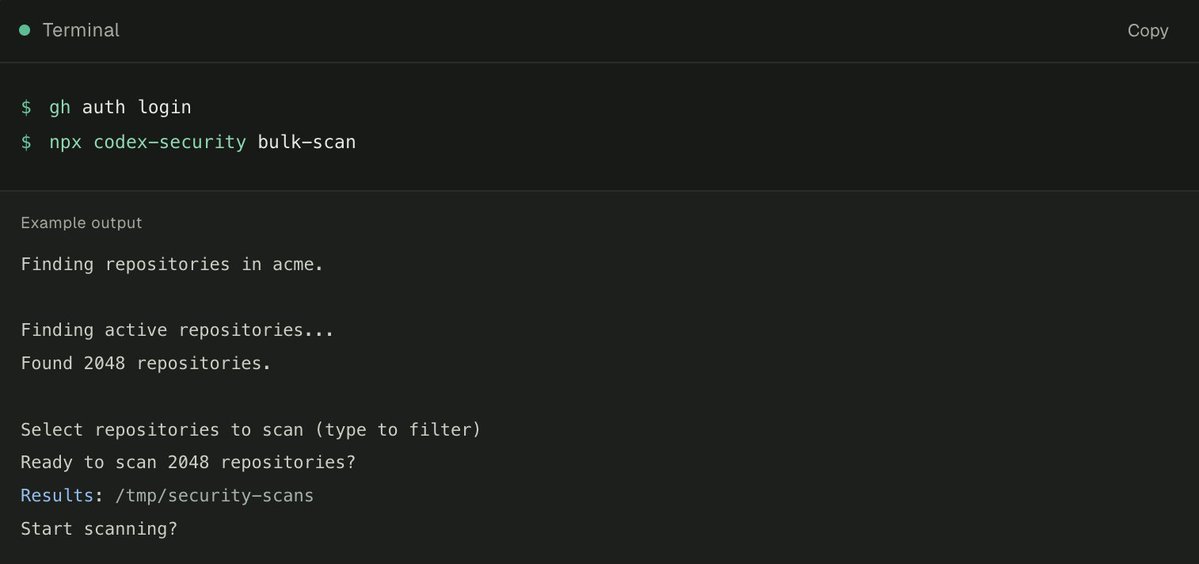
We quietly released the open-source Codex Security CLI, but Hacker News found it before we had a chance to share it here... You can now use it to scan repositories, track findings across runs, verify
We quietly released the open-source Codex Security CLI, but Hacker News found it before we had a chance to share it here... You can now use it to scan repositories, track findings across runs, verify fixes, and add security checks to CI/CD. This is an early release, and we're https://t.co/4AbAn1ZRym
Social & Blog Posts8
X/Twitter@OpenAIOpenAI
Research Papers2
HF PapersOpenAIresearch4d ago
Other
provider-benchmarksOpenAIYesterday
Introducing GPT-5.2
Introducing GPT-5.2 | OpenAI Skip to main content Research Products Business Developers Company Foundation (opens in a new window) Log in Try ChatGPT (opens in a new window) Research Products Business Developers Company Foundation (opens in a new window) Try ChatGPT (opens in a new window) Login OpenAI December 11, 2025 Product Release Introducing GPT‑5.2 The most advanced frontier model for professional work and long-running agents. Loading… Share Model performance Model per
ChatGPT Voice is now in the desktop app. Control your computer and direct multiple agents running in ChatGPT Work or Codex, using just your voice. It's powered by GPT-Live, so it can speak, listen, an
ChatGPT Voice is now in the desktop app. Control your computer and direct multiple agents running in ChatGPT Work or Codex, using just your voice. It's powered by GPT-Live, so it can speak, listen, and coordinate work in the app at the same time. Rolling out globally today https://t.co/ODZWKqecCf
We're opening applications for the OpenAI Student Collective—a program for undergraduate Campus Leads bringing AI innovation to their campuses. Campus Leads will work directly with OpenAI and receive
We're opening applications for the OpenAI Student Collective—a program for undergraduate Campus Leads bringing AI innovation to their campuses. Campus Leads will work directly with OpenAI and receive hands-on training, funding, credits, swag, and access to a global community of https://t.co/aJdwFBQm3c
We’re giving scientists, mathematicians, and engineers free access to our frontier models—starting with 10,000 researchers and expanding to 100,000 through 2027. ChatGPT for Academic Researchers is bu
We’re giving scientists, mathematicians, and engineers free access to our frontier models—starting with 10,000 researchers and expanding to 100,000 through 2027. ChatGPT for Academic Researchers is built to accelerate discovery across disciplines. https://t.co/nrHn1no0wQ
We quietly released the open-source Codex Security CLI, but Hacker News found it before we had a chance to share it here... You can now use it to scan repositories, track findings across runs, verify
We quietly released the open-source Codex Security CLI, but Hacker News found it before we had a chance to share it here... You can now use it to scan repositories, track findings across runs, verify fixes, and add security checks to CI/CD. This is an early release, and we're https://t.co/4AbAn1ZRym
At the core of our mission is working through how to ensure increasingly powerful AI benefits everyone. We believe that, at some point in the future, AI acceleration for frontier model development may
At the core of our mission is working through how to ensure increasingly powerful AI benefits everyone. We believe that, at some point in the future, AI acceleration for frontier model development may be so high that the world will need to pace the rate of AI advancement. We
We're opening applications for the OpenAI Student Collective—a program for undergraduate Campus Leads bringing AI innovation to their campuses. Campus Leads will work directly with OpenAI and receive
We're opening applications for the OpenAI Student Collective—a program for undergraduate Campus Leads bringing AI innovation to their campuses. Campus Leads will work directly with OpenAI and receive hands-on training, funding, credits, swag, and access to a global community of https://t.co/aJdwFBQm3c
ChatGPT Voice is now in the desktop app. Control your computer and direct multiple agents running in ChatGPT Work or Codex, using just your voice. It's powered by GPT-Live, so it can speak, listen, an
ChatGPT Voice is now in the desktop app. Control your computer and direct multiple agents running in ChatGPT Work or Codex, using just your voice. It's powered by GPT-Live, so it can speak, listen, and coordinate work in the app at the same time. Rolling out globally today https://t.co/ODZWKqecCf
ClinFusion: A Vision-Centric Multimodal LLM System for Holistic Medical Understanding
Multimodal large language models (MLLMs) hold immense potential to revolutionize clinical practice, yet deploying them in the medical domain is fundamentally a vision-centric challenge: models must absorb knowledge from heterogeneous 2D and 3D medical images, and evaluation protocols must align with radiologists' clinical practice and provide an accurate, fine-grained and factualness-driven assessment. In this paper, we introduce ClinFusion, a vision-centric MLLM designed for holistic medical understanding that systematically addresses these limitations. We propose a compositional and cascaded vision encoder architecture featuring a Cascade Spatial-Aware Locality Fusion operator that unifies diverse 2D and native 3D medical image understanding within a fused encoder. We further introduce a vision-grounded evaluation framework, including MedIF-Bench for instruction-following assessment and a region-of-interest-grounded method for clinically aligned and factualness-driven report generation evaluation. We show that ClinFusion sets a new state-of-the-art across a comprehensive suite of 2D and 3D multimodal medical benchmarks---spanning visual question answering, report generation, and instruction following---as well as textual medical tasks, outperforming leading open-source medical MLLMs (e.g., Hulu-Med, Lingshu) on 20 out of 24 benchmarks and demonstrating multimodal capabilities better than powerful proprietary models such as GPT-5.2 and Gemini-3-Flash on 13 out of 16 benchmarks, and can be further augmented with agentic tool use for retrieval-augmented and tool-assisted clinical workflows. A blinded evaluation by board-certified radiologists confirms that ClinFusion produces the highest-ranked reports, and validates our RoI-grounded metric as achieving the strongest correlation with expert judgment among all automatic evaluation metrics examined.
Where Quality Breaks in Compressed Short-Text Generation: Staged Bottleneck Localization
Compressed short-text generators can fail in two different places: the codec may discard information before generation starts, or the latent generator may produce weak codes. Without separating these failure modes, researchers can spend compute improving the wrong component. We study this problem in a controlled 64-to-16 TinyStories case study built from a hierarchical VQ-VAE-2 codec and a masked discrete diffusion generator (MDLM). We use a staged validation protocol that separates codec reconstruction fidelity, latent generation quality, and auxiliary latent diagnostics under one shared external GPT-2 scorer, while reporting complementary semantic metrics for the geometry study. In the tested configuration, codec reconstruction alone raises median external perplexity from 15.17 to 27.36 (+80.4%) and p95 from 25.10 to 98.91 (+294.1%), showing that the dominant quality loss appears before latent generation begins. Under the same scorer, code-space MDLM remains materially stronger than token-space diffusion, reducing mean, median, and p95 by 32.9%, 30.9%, and 36.6%, respectively. Geometry-aware regularization improves local latent proxies but does not improve decoded-text metrics in the available runs. The contribution is methodological rather than algorithmic: the paper presents a reusable staged diagnosis for one concrete pipeline and shows that, in this setting, codec fidelity rather than latent denoising sets the practical quality ceiling.