Live access is not confirmed for this model. No current purchase price is advertised.
Related provider subscriptions
No current subscription pricing is tracked for this model.
Confirm this specific model, usage limits, and billing terms with the provider. A subscription does not automatically include API credits.
No login needed to compare. Prices are in USD; provider charges are separate from AI Market Cap plans. Context length, caching, tools, taxes, and regional terms can change the final cost. Open weights do not mean free hosting.
---
Quality Score
---
Arena ELO
Undisclosed
Parameters
---
Context
Evidence profile
How complete is this record?
This measures the amount of verifiable public evidence we have, not how capable the model is. A missing field means it has not been verified yet, not that its value is zero.
Recent launch, pricing, benchmark, and API signals linked to this model or its provider.
LaunchesOpenAI2d ago
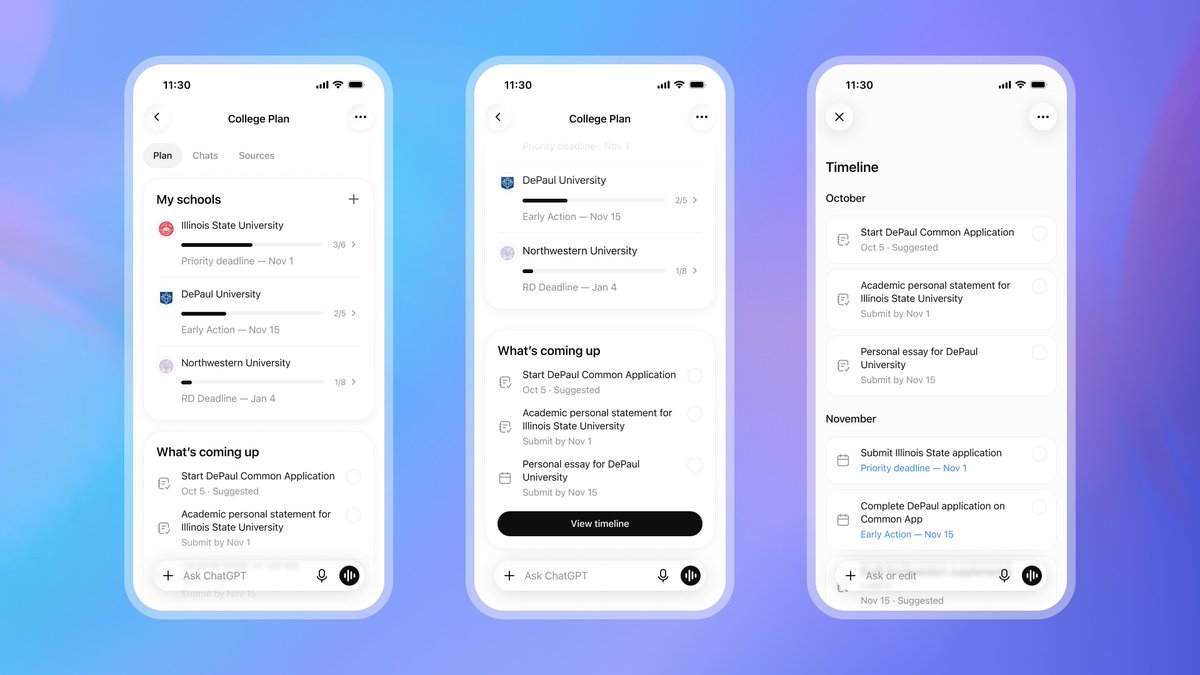
We're sharing progress on ChatGPT for Teens, our ChatGPT experience for people under 18, alongside a preview of College Planner, new study tools, and support for college advisers and teen voices. Chat
We're sharing progress on ChatGPT for Teens, our ChatGPT experience for people under 18, alongside a preview of College Planner, new study tools, and support for college advisers and teen voices. ChatGPT for Teens applies automatically to accounts identified as belonging to https://t.co/XNEA5IuTFo
ChatGPT Start searching API Dashboard Try ChatGPT Home API Overview Get started with the OpenAI API Models Explore models and compare capabilities Agents Build persistent agents on hosted infrastructure Tools Connect models to tools and data Audio & voice Build speech and realtime voice experiences Production Deploy and scale your API integrations API reference Explore endpoints, parameters, and responses ChatGPT Sign in with ChatGPT Apps powered by your user's ChatGP
GPT-6 and Intelligent UI, now rolling out in ChatGPT for everyone. Intelligent UI in ChatGPT delivers fast, interactive answers that make everyday questions more visual, complex topics easier to grasp
GPT-6 and Intelligent UI, now rolling out in ChatGPT for everyone. Intelligent UI in ChatGPT delivers fast, interactive answers that make everyday questions more visual, complex topics easier to grasp, and interactive tools for your task available on the spot. https://t.co/XL2gDCPBwG
SynthID Detector is now available to everyone. 🌐 Check whether online content was generated using @GoogleAI, or with tools from our industry partners – including @OpenAI, @NVIDIA, Kakao and coming so
SynthID Detector is now available to everyone. 🌐 Check whether online content was generated using @GoogleAI, or with tools from our industry partners – including @OpenAI, @NVIDIA, Kakao and coming soon, @Apple. Try it out → https://t.co/cPW2aNnqr6 https://t.co/TGYA0uZ0dx
ChatGPT Start searching API Dashboard Try ChatGPT Home API Overview Get started with the OpenAI API Models Explore models and compare capabilities Agents Build persistent agents on hosted infrastructure Tools Connect models to tools and data Audio & voice Build speech and realtime voice experiences Production Deploy and scale your API integrations API reference Explore endpoints, parameters, and responses ChatGPT Sign in with ChatGPT Apps powered by your user's ChatGP
ChatGPT Start searching API Dashboard Try ChatGPT Home API Overview Get started with the OpenAI API Models Explore models and compare capabilities Agents Build persistent agents on hosted infrastructure Tools Connect models to tools and data Audio & voice Build speech and realtime voice experiences Production Deploy and scale your API integrations API reference Explore endpoints, parameters, and responses ChatGPT Sign in with ChatGPT Apps powered by your user's ChatGP
We're sharing progress on ChatGPT for Teens, our ChatGPT experience for people under 18, alongside a preview of College Planner, new study tools, and support for college advisers and teen voices. Chat
We're sharing progress on ChatGPT for Teens, our ChatGPT experience for people under 18, alongside a preview of College Planner, new study tools, and support for college advisers and teen voices. ChatGPT for Teens applies automatically to accounts identified as belonging to https://t.co/XNEA5IuTFo
GPT-6 and Intelligent UI, now rolling out in ChatGPT for everyone. Intelligent UI in ChatGPT delivers fast, interactive answers that make everyday questions more visual, complex topics easier to grasp
GPT-6 and Intelligent UI, now rolling out in ChatGPT for everyone. Intelligent UI in ChatGPT delivers fast, interactive answers that make everyday questions more visual, complex topics easier to grasp, and interactive tools for your task available on the spot. https://t.co/XL2gDCPBwG
SynthID Detector is now available to everyone. 🌐 Check whether online content was generated using @GoogleAI, or with tools from our industry partners – including @OpenAI, @NVIDIA, Kakao and coming so
SynthID Detector is now available to everyone. 🌐 Check whether online content was generated using @GoogleAI, or with tools from our industry partners – including @OpenAI, @NVIDIA, Kakao and coming soon, @Apple. Try it out → https://t.co/cPW2aNnqr6 https://t.co/TGYA0uZ0dx
A Closer Look at Agentic BBO: Benchmarking LLM Agents for Black-Box Optimization
Black-box optimization (BBO) arises in many scientific and engineering problems where objective evaluations are expensive and limited. Recent large language model (LLM) agents offer a new way to approach BBO by combining task semantics, computation, optimization tools, and feedback-driven decision making, showing great potential due to the integration with mathematically rigorous tools. However, existing agentic BBO studies use different task domains and system configurations, making their results difficult to compare and the effects of individual design choices hard to isolate. We therefore introduce AgenticBBO-Bench, a cross-domain benchmark for agentic BBO spanning synthetic functions, hyperparameter optimization, database tuning, chip design, and molecular design under a unified finite-budget evaluation protocol. In our experiments, agentic BBO achieves higher family-averaged scores than direct LLM-based methods in all five domains and outperforms the best numerical optimizers in four. We further study three factors shaping agent performance: optimization tools, task information and prior knowledge, and the role of the LLM during search. Our results show that additional numerical tools do not consistently improve performance, task semantics are broadly useful while more specific priors are less reliable, and numerical optimizers can effectively absorb gains from search trajectories established by the agent. Finally, we introduce a five-task frontier challenge within AgenticBBO-Bench and evaluate seven LLMs under the Codex agent harness, where GPT-6 Astra and DeepSeek-V4.1-Flash lie on the Pareto frontier of performance and cost among the evaluated models. Our code is available at https://github.com/lamda-bbo/agentic-bbo.
SuperNav: An Agentic Navigation System for Any Task in Any Scene
General-purpose service robots need navigation systems that can handle diverse human requests in unfamiliar environments, combining task generality with scene generality. Some existing methods fine-tune multimodal large language models (MLLMs) to predict navigation actions, making their behavior dependent on the coverage of navigation training data and potentially limiting generalization to new requests and environments. Our key insight is to let the MLLM focus on interpreting requests, understanding scenes, and making decisions while preserving its general-purpose capabilities and delegating motion execution to navigation tools. To realize this idea, we introduce SuperNav, which equips a pretrained MLLM with a specialized agent harness without navigation-specific fine-tuning of the MLLM. Our harness supports these decisions with Navigation Skills, agent-oriented Tools for physical interaction, and task-progress and context management. A unified visual-point interface connects decision-making to motion by allowing the model to specify destinations directly in images and revise its decisions from execution feedback. Together, these components support sustained navigation across different task requirements and environments. SuperNav outperforms four evaluated baselines on instance-level, multi-object, and demand-driven tasks. Category-level evaluation on HM3D and deployment on a real quadruped robot further demonstrate its applicability across environments. Project Page: https://zju3dv.github.io/SuperNav/
SpatialOPSD: Self-Distilling Spatial Intelligence from Verified Coding Agent Traces
Spatial coding agents significantly improve spatial reasoning in Multimodal Large Language Models (MLLMs) by using external tools to generate verified execution traces. However, this paradigm inherently suffers from prohibitive inference-time overhead and external dependencies. In this paper, we explore whether an MLLM can internalize this agentic capability to operate entirely tool-free. We begin with a simple observation: prompting an MLLM with summarized execution traces of a spatial coding agent naturally unlocks the model's internal spatial Chain-of-Thought (CoT). Motivated by this, we introduce SpatialOPSD, an on-policy self-distillation framework that internalizes spatial reasoning into a standalone MLLM by formulating verified agent traces as privileged information. To mitigate privileged-information leakage during distillation, we introduce Repetition-Aware Distillation, which combines repetition masking with unlikelihood regularization. Experiments across multiple benchmarks demonstrate that self-distilling SpatialOPSD achieves higher average accuracy than SFT and GRPO on both spatial and OOD datasets, exhibiting superior performance and generalization.
RobotWorld: Benchmarking Multimodal Agents for Robot Use Across Diverse Tasks and Embodiments
General-purpose agents increasingly write code, use tools, and complete complex digital tasks, raising the question of how far these capabilities carry into the physical world. To investigate this, we introduce RobotWorld, a challenging simulation testbed for robot use: turning instructions and observations into physical task execution through robot interfaces. Its 84 tasks span manipulation, mobile manipulation, locomotion, driving, and aerial control, with explicit interaction budgets and executable success checks. By analysing task outcomes alongside execution traces, we identify both the capabilities that transfer and the gaps that prevent reliable completion. Furthermore, we find that current agents can construct sophisticated perception and control workflows, including image segmentation, camera calibration, spatial estimation, and dynamics-based computation. These capabilities, however, do not consistently compose into successful behaviour: agents lose task-relevant object states despite reaching commanded poses, fail to correct ineffective actions, recover too late, or mistake unfinished tasks for completion. This uneven transfer also differs across models: Astra succeeds more often on spatial and constrained-contact goals, whereas Opus 5.5 succeeds more often on continuous-balance and timed-interaction goals. By linking these outcomes to execution behaviour, RobotWorld provides both a rigorous proving ground and an empirical account of the remaining capability gaps, thereby establishing concrete targets for training and designing more reliable physical-world agents.
ChatGPT Start searching API Dashboard Try ChatGPT Home API Overview Get started with the OpenAI API Models Explore models and compare capabilities Agents Build persistent agents on hosted infrastructure Tools Connect models to tools and data Audio & voice Build speech and realtime voice experiences Production Deploy and scale your API integrations API reference Explore endpoints, parameters, and responses ChatGPT Sign in with ChatGPT Apps powered by your user's ChatGP
ChatGPT Start searching API Dashboard Try ChatGPT Home API Overview Get started with the OpenAI API Models Explore models and compare capabilities Agents Build persistent agents on hosted infrastructure Tools Connect models to tools and data Audio & voice Build speech and realtime voice experiences Production Deploy and scale your API integrations API reference Explore endpoints, parameters, and responses ChatGPT Sign in with ChatGPT Apps powered by your user's ChatGP
ChatGPT Start searching API Dashboard Try ChatGPT Home API Overview Get started with the OpenAI API Models Explore models and compare capabilities Agents Build persistent agents on hosted infrastructure Tools Connect models to tools and data Audio & voice Build speech and realtime voice experiences Production Deploy and scale your API integrations API reference Explore endpoints, parameters, and responses ChatGPT Sign in with ChatGPT Apps powered by your user's ChatGP
Navigation Models GLM-ASR-2512 Guides API Reference Coding Plan Released Notes Terms and Policy Help Center Get Started Quick Start Overview Pricing Core Parameters SDKs Guide Migrate to GLM-5.3 Models GLM-5.3-Flash/FlashX New GLM-5.3 Hot GLM-5.2 GLM-OCR GLM-ASR-2512 Capabilities Thinking Mode Deep Thinking Streaming Messages Tool Streaming Output Function Calling Context Caching Structured Output Tools Web Search Stream Tool Call Agents GLM Slide/Poster Agent(beta) Translati
Navigation Models GLM-5.3-Flash/FlashX Guides API Reference Coding Plan Released Notes Terms and Policy Help Center Get Started Quick Start Overview Pricing Core Parameters SDKs Guide Migrate to GLM-5.3 Models GLM-5.3-Flash/FlashX New GLM-5.3 Hot GLM-5.2 GLM-OCR GLM-ASR-2512 Capabilities Thinking Mode Deep Thinking Streaming Messages Tool Streaming Output Function Calling Context Caching Structured Output Tools Web Search Stream Tool Call Agents GLM Slide/Poster Agent(beta) T
Navigation Models GLM-5.3-Flash/FlashX Guides API Reference Coding Plan Released Notes Terms and Policy Help Center Get Started Quick Start Overview Pricing Core Parameters SDKs Guide Migrate to GLM-5.3 Models GLM-5.3-Flash/FlashX New GLM-5.3 Hot GLM-5.2 GLM-OCR GLM-ASR-2512 Capabilities Thinking Mode Deep Thinking Streaming Messages Tool Streaming Output Function Calling Context Caching Structured Output Tools Web Search Stream Tool Call Agents GLM Slide/Poster Agent(beta) T
Navigation Models GLM-OCR Guides API Reference Coding Plan Released Notes Terms and Policy Help Center Get Started Quick Start Overview Pricing Core Parameters SDKs Guide Migrate to GLM-5.3 Models GLM-5.3-Flash/FlashX New GLM-5.3 Hot GLM-5.2 GLM-OCR GLM-ASR-2512 Capabilities Thinking Mode Deep Thinking Streaming Messages Tool Streaming Output Function Calling Context Caching Structured Output Tools Web Search Stream Tool Call Agents GLM Slide/Poster Agent(beta) Translation Ag
Navigation Models GLM-5.3-Flash/FlashX Guides API Reference Coding Plan Released Notes Terms and Policy Help Center Get Started Quick Start Overview Pricing Core Parameters SDKs Guide Migrate to GLM-5.3 Models GLM-5.3-Flash/FlashX New GLM-5.3 Hot GLM-5.2 GLM-OCR GLM-ASR-2512 Capabilities Thinking Mode Deep Thinking Streaming Messages Tool Streaming Output Function Calling Context Caching Structured Output Tools Web Search Stream Tool Call Agents GLM Slide/Poster Agent(beta) T
Navigation GLM-5V-Turbo Guides API Reference Coding Plan Released Notes Terms and Policy Help Center Get Started Quick Start Overview Pricing Core Parameters SDKs Guide Migrate to GLM-5.3 Models GLM-5.3-Flash/FlashX New GLM-5.3 Hot GLM-5.2 GLM-OCR GLM-ASR-2512 Capabilities Thinking Mode Deep Thinking Streaming Messages Tool Streaming Output Function Calling Context Caching Structured Output Tools Web Search Stream Tool Call Agents GLM Slide/Poster Agent(beta) Translation Agen
Navigation Models GLM-5.3-Flash/FlashX Guides API Reference Coding Plan Released Notes Terms and Policy Help Center Get Started Quick Start Overview Pricing Core Parameters SDKs Guide Migrate to GLM-5.3 Models GLM-5.3-Flash/FlashX New GLM-5.3 Hot GLM-5.2 GLM-OCR GLM-ASR-2512 Capabilities Thinking Mode Deep Thinking Streaming Messages Tool Streaming Output Function Calling Context Caching Structured Output Tools Web Search Stream Tool Call Agents GLM Slide/Poster Agent(beta) T
Navigation Models GLM-5.3-Flash/FlashX Guides API Reference Coding Plan Released Notes Terms and Policy Help Center Get Started Quick Start Overview Pricing Core Parameters SDKs Guide Migrate to GLM-5.3 Models GLM-5.3-Flash/FlashX New GLM-5.3 Hot GLM-5.2 GLM-OCR GLM-ASR-2512 Capabilities Thinking Mode Deep Thinking Streaming Messages Tool Streaming Output Function Calling Context Caching Structured Output Tools Web Search Stream Tool Call Agents GLM Slide/Poster Agent(beta) T
Navigation Models GLM-5.3-Flash/FlashX Guides API Reference Coding Plan Released Notes Terms and Policy Help Center Get Started Quick Start Overview Pricing Core Parameters SDKs Guide Migrate to GLM-5.3 Models GLM-5.3-Flash/FlashX New GLM-5.3 Hot GLM-5.2 GLM-OCR GLM-ASR-2512 Capabilities Thinking Mode Deep Thinking Streaming Messages Tool Streaming Output Function Calling Context Caching Structured Output Tools Web Search Stream Tool Call Agents GLM Slide/Poster Agent(beta) T