Recent launch, pricing, benchmark, and API signals linked to this model or its provider.
LaunchesMicrosoft4w ago
Thrilled to announce by popular demand MAI-Code-1-Flash is now generally available for GitHub Copilot Business and GitHub Copilot Enterprise - fast, efficient, and custom designed to help you build mo
Thrilled to announce by popular demand MAI-Code-1-Flash is now generally available for GitHub Copilot Business and GitHub Copilot Enterprise - fast, efficient, and custom designed to help you build more for less on @github
Let’s go a bit deeper into Frontier Tuning launched at Build and see a live demo! Frontier Tuning is how we enable you to develop custom AI by building a reinforcement learning environment (RLE) to hi
Let’s go a bit deeper into Frontier Tuning launched at Build and see a live demo! Frontier Tuning is how we enable you to develop custom AI by building a reinforcement learning environment (RLE) to hill climb on your data, tools, and knowledge. Think of it like a training gym https://t.co/XhZHTuks39
What does it take to build coding models that meet developers where they work? Go behind the scenes with Microsoft AI to explore how we build and optimize code. From training and evaluation to perform
What does it take to build coding models that meet developers where they work? Go behind the scenes with Microsoft AI to explore how we build and optimize code. From training and evaluation to performance, safety, and real-world developer feedback. https://t.co/kkzNkci2ru
Mage-Flow: An Efficient Native-Resolution Foundation Model for Image Generation and Editing
Large-scale visual generators are increasingly capable but costly to train, fine-tune, and deploy. We introduce Mage-Flow, a compact 4B-scale generative stack for efficient text-to-image generation and instruction-based image editing. The stack is built from two co-designed components: Mage-VAE, a lightweight high-fidelity latent tokenizer, and a Native-Resolution Multimodal Diffusion Transformer trained with rectified flow matching. Mage-VAE uses one-step diffusion-style encoding and decoding with anchor-latent regularization, preserving the reconstruction quality of strong public VAEs while reducing tokenization cost by more than an order of magnitude. Together with native-resolution packing and stack-level CUDA kernel fusion, the stack supports flexible-resolution training and improves end-to-end training throughput by about 2.5times. Built on this foundation, we develop a complete model family with Base, RL-aligned, and Turbo variants for both generation and editing. Diffusion-NFT improves prompt following, text rendering, aesthetic quality, and editing fidelity, while few-step distillation with adversarial perceptual guidance produces 4-step Turbo models for low-latency inference. Despite its compact scale, Mage-Flow and Mage-Flow-Edit achieves competitive performance across standard generation and editing benchmarks. More importantly, the Turbo variants make high-resolution generation and editing practical for interactive use: at 1024^2 resolution on a single NVIDIA A100 GPU, Mage-Flow-Turbo generates an image in 0.59s, and Mage-Flow-Edit-Turbo edits an image in 1.02s, while maintaining a small memory footprint. These results show that careful tokenizer--backbone--system co-design can deliver strong high-resolution generation and editing within an efficient 4B model family.
Object-Centric Residual RL for Zero-Shot Sim-to-Real VLA Enhancement
Vision-Language-Action (VLA) models can generalize across diverse manipulation tasks, but their imitation-learning-based policies remain brittle in precise physical interactions due to compounding execution errors; Can a reinforcement learning policy trained purely in simulation improve the robustness of real-world VLAs zero-shot? Residual RL, which learns a corrective policy on top of a frozen VLA, offers a natural framework, but existing approaches face a fundamental sim-to-real dilemma: privileged-state methods require lossy distillation for deployment; image-based methods suffer from the visual domain gap; and real-world RL is costly and unsafe. We propose an object-centric residual RL framework that refines VLA actions using object poses, enabling a compact observation space that transfers consistently between simulation and reality. To align the two domains, we additionally replay the same teleoperation demonstrations in simulation to train a sim counterpart of the real-world VLA. The residual RL policy is trained only in simulation with pose noise injection and dropout, and transfers zero-shot to the real robot. Across five manipulation tasks on a real Franka Research 3 (FR3) robot, our method improves the success rate from 42% to 76% zero-shot, and the improved rollouts can be further reused to retrain the base VLA for self-improvement without additional teleoperation. Project page: https://www.microsoft.com/en-us/research/articles/object-centric-residual-rl/
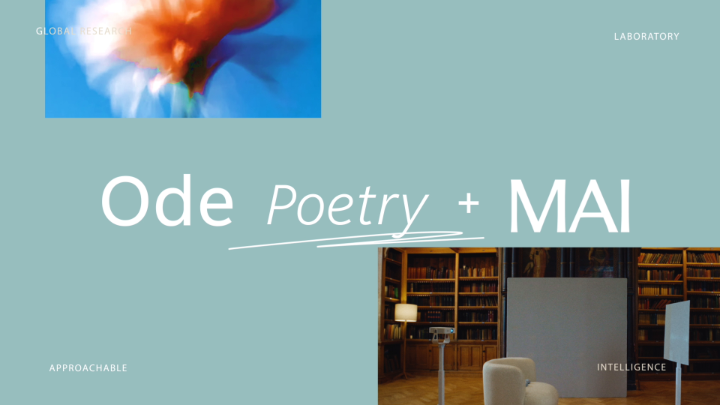
Say how you feel. Get a poem that meets you there. Ode connects you with a poem for your moment. Guided by William Sieghart. Powered by Microsoft AI models. Try it out here: https://t.co/egu88NTf9C ht
Say how you feel. Get a poem that meets you there. Ode connects you with a poem for your moment. Guided by William Sieghart. Powered by Microsoft AI models. Try it out here: https://t.co/egu88NTf9C https://t.co/jQ3qm9sKnz
Thrilled to announce by popular demand MAI-Code-1-Flash is now generally available for GitHub Copilot Business and GitHub Copilot Enterprise - fast, efficient, and custom designed to help you build mo
Thrilled to announce by popular demand MAI-Code-1-Flash is now generally available for GitHub Copilot Business and GitHub Copilot Enterprise - fast, efficient, and custom designed to help you build more for less on @github
X/Twitter@MicrosoftAIMicrosoftannouncementgeneral4w ago
We shipped a new coding model built for your everyday dev work. MAI-Code-1-Flash is fast, token-efficient, and trained inside real GitHub Copilot environments. It plans, builds, runs, and tests. All f
We shipped a new coding model built for your everyday dev work. MAI-Code-1-Flash is fast, token-efficient, and trained inside real GitHub Copilot environments. It plans, builds, runs, and tests. All from Copilot Chat in VS Code. Watch it go from a single frost banner to a full
X/Twitter@MicrosoftAIMicrosoftannouncementgeneral4w ago
MAI-Image-2.5 ranked #2 for text-to-image and #3 for image editing on @ArtificialAnlys - showing strong performance across both generation and precise image edits. From rainy-window blur to a clear, u
MAI-Image-2.5 ranked #2 for text-to-image and #3 for image editing on @ArtificialAnlys - showing strong performance across both generation and precise image edits. From rainy-window blur to a clear, usable street scene, while preserving object consistency, lighting, https://t.co/q8MFDrr8uB
X/Twitter@MicrosoftAIMicrosoftannouncementgeneral1mo ago
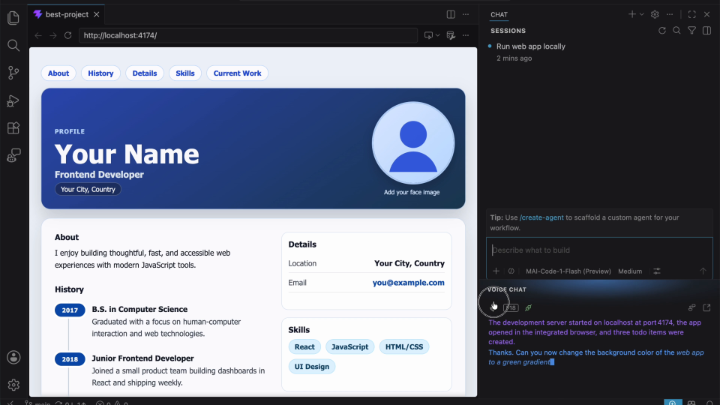
What happens when speech, transcription, and coding models work together? This prototype demo, built using a VS Code fork, showcases how MAI-Transcribe, MAI-Voice, and MAI-Code-1-Flash can work togeth
What happens when speech, transcription, and coding models work together? This prototype demo, built using a VS Code fork, showcases how MAI-Transcribe, MAI-Voice, and MAI-Code-1-Flash can work together in a unified workflow to transform spoken instructions into working code. https://t.co/z35l4fV2xQ
X/Twitter@MicrosoftAIMicrosoftannouncementgeneral1mo ago
Behind every model is a team dedicated to solving difficult challenges, exploring new ideas, and continuously pushing technology forward. Meet some of the people behind Microsoft AI. Watch the full vi
Behind every model is a team dedicated to solving difficult challenges, exploring new ideas, and continuously pushing technology forward. Meet some of the people behind Microsoft AI. Watch the full video here: https://t.co/oNxtle7FtO https://t.co/8fsVY6DnFQ
What does it take to build coding models that meet developers where they work? Go behind the scenes with Microsoft AI to explore how we build and optimize code. From training and evaluation to perform
What does it take to build coding models that meet developers where they work? Go behind the scenes with Microsoft AI to explore how we build and optimize code. From training and evaluation to performance, safety, and real-world developer feedback. https://t.co/kkzNkci2ru
Let’s go a bit deeper into Frontier Tuning launched at Build and see a live demo! Frontier Tuning is how we enable you to develop custom AI by building a reinforcement learning environment (RLE) to hi
Let’s go a bit deeper into Frontier Tuning launched at Build and see a live demo! Frontier Tuning is how we enable you to develop custom AI by building a reinforcement learning environment (RLE) to hill climb on your data, tools, and knowledge. Think of it like a training gym https://t.co/XhZHTuks39
Mage-Flow: An Efficient Native-Resolution Foundation Model for Image Generation and Editing
Large-scale visual generators are increasingly capable but costly to train, fine-tune, and deploy. We introduce Mage-Flow, a compact 4B-scale generative stack for efficient text-to-image generation and instruction-based image editing. The stack is built from two co-designed components: Mage-VAE, a lightweight high-fidelity latent tokenizer, and a Native-Resolution Multimodal Diffusion Transformer trained with rectified flow matching. Mage-VAE uses one-step diffusion-style encoding and decoding with anchor-latent regularization, preserving the reconstruction quality of strong public VAEs while reducing tokenization cost by more than an order of magnitude. Together with native-resolution packing and stack-level CUDA kernel fusion, the stack supports flexible-resolution training and improves end-to-end training throughput by about 2.5times. Built on this foundation, we develop a complete model family with Base, RL-aligned, and Turbo variants for both generation and editing. Diffusion-NFT improves prompt following, text rendering, aesthetic quality, and editing fidelity, while few-step distillation with adversarial perceptual guidance produces 4-step Turbo models for low-latency inference. Despite its compact scale, Mage-Flow and Mage-Flow-Edit achieves competitive performance across standard generation and editing benchmarks. More importantly, the Turbo variants make high-resolution generation and editing practical for interactive use: at 1024^2 resolution on a single NVIDIA A100 GPU, Mage-Flow-Turbo generates an image in 0.59s, and Mage-Flow-Edit-Turbo edits an image in 1.02s, while maintaining a small memory footprint. These results show that careful tokenizer--backbone--system co-design can deliver strong high-resolution generation and editing within an efficient 4B model family.
Object-Centric Residual RL for Zero-Shot Sim-to-Real VLA Enhancement
Vision-Language-Action (VLA) models can generalize across diverse manipulation tasks, but their imitation-learning-based policies remain brittle in precise physical interactions due to compounding execution errors; Can a reinforcement learning policy trained purely in simulation improve the robustness of real-world VLAs zero-shot? Residual RL, which learns a corrective policy on top of a frozen VLA, offers a natural framework, but existing approaches face a fundamental sim-to-real dilemma: privileged-state methods require lossy distillation for deployment; image-based methods suffer from the visual domain gap; and real-world RL is costly and unsafe. We propose an object-centric residual RL framework that refines VLA actions using object poses, enabling a compact observation space that transfers consistently between simulation and reality. To align the two domains, we additionally replay the same teleoperation demonstrations in simulation to train a sim counterpart of the real-world VLA. The residual RL policy is trained only in simulation with pose noise injection and dropout, and transfers zero-shot to the real robot. Across five manipulation tasks on a real Franka Research 3 (FR3) robot, our method improves the success rate from 42% to 76% zero-shot, and the improved rollouts can be further reused to retrain the base VLA for self-improvement without additional teleoperation. Project page: https://www.microsoft.com/en-us/research/articles/object-centric-residual-rl/
FastContext: Training Efficient Repository Explorer for Coding Agents
Large Language Model (LLM) coding agents have achieved strong results on software engineering tasks, yet repository exploration remains a major bottleneck: locating relevant code consumes substantial token budget and pollutes the agent's context with irrelevant snippets. In most agents, the same model explores the repository and solves the task, leaving exploratory reads and searches in the solver's history. We present FastContext, a dedicated exploration subagent that separates repository exploration from solving. Invoked on demand, FastContext issues parallel tool calls and returns concise file paths and line ranges as focused context. FastContext is powered by specialized exploration models spanning 4B--30B parameters. We bootstrap them from strong reference-model trajectories and refine them with task-grounded rewards for broad first-turn search, multi-turn evidence gathering, and precise citation generation. Across SWE-bench Multilingual, SWE-bench Pro, and SWE-QA, integrating FastContext into Mini-SWE-Agent improves end-to-end resolution rates up to 5.5\% while reducing coding-agent token consumption up to 60\%, with marginal overhead. These results show that repository exploration can be separated from solving and handled effectively by specialized models. Code and data: https://github.com/microsoft/fastcontext