Recent launch, pricing, benchmark, and API signals linked to this model or its provider.
LaunchesMicrosoft2w ago
Thrilled to announce by popular demand MAI-Code-1-Flash is now generally available for GitHub Copilot Business and GitHub Copilot Enterprise - fast, efficient, and custom designed to help you build mo
Thrilled to announce by popular demand MAI-Code-1-Flash is now generally available for GitHub Copilot Business and GitHub Copilot Enterprise - fast, efficient, and custom designed to help you build more for less on @github
Let’s go a bit deeper into Frontier Tuning launched at Build and see a live demo! Frontier Tuning is how we enable you to develop custom AI by building a reinforcement learning environment (RLE) to hi
Let’s go a bit deeper into Frontier Tuning launched at Build and see a live demo! Frontier Tuning is how we enable you to develop custom AI by building a reinforcement learning environment (RLE) to hill climb on your data, tools, and knowledge. Think of it like a training gym https://t.co/XhZHTuks39
What does it take to build coding models that meet developers where they work? Go behind the scenes with Microsoft AI to explore how we build and optimize code. From training and evaluation to perform
What does it take to build coding models that meet developers where they work? Go behind the scenes with Microsoft AI to explore how we build and optimize code. From training and evaluation to performance, safety, and real-world developer feedback. https://t.co/kkzNkci2ru
Object-Centric Residual RL for Zero-Shot Sim-to-Real VLA Enhancement
Vision-Language-Action (VLA) models can generalize across diverse manipulation tasks, but their imitation-learning-based policies remain brittle in precise physical interactions due to compounding execution errors; Can a reinforcement learning policy trained purely in simulation improve the robustness of real-world VLAs zero-shot? Residual RL, which learns a corrective policy on top of a frozen VLA, offers a natural framework, but existing approaches face a fundamental sim-to-real dilemma: privileged-state methods require lossy distillation for deployment; image-based methods suffer from the visual domain gap; and real-world RL is costly and unsafe. We propose an object-centric residual RL framework that refines VLA actions using object poses, enabling a compact observation space that transfers consistently between simulation and reality. To align the two domains, we additionally replay the same teleoperation demonstrations in simulation to train a sim counterpart of the real-world VLA. The residual RL policy is trained only in simulation with pose noise injection and dropout, and transfers zero-shot to the real robot. Across five manipulation tasks on a real Franka Research 3 (FR3) robot, our method improves the success rate from 42% to 76% zero-shot, and the improved rollouts can be further reused to retrain the base VLA for self-improvement without additional teleoperation. Project page: https://www.microsoft.com/en-us/research/articles/object-centric-residual-rl/
FastContext: Training Efficient Repository Explorer for Coding Agents
Large Language Model (LLM) coding agents have achieved strong results on software engineering tasks, yet repository exploration remains a major bottleneck: locating relevant code consumes substantial token budget and pollutes the agent's context with irrelevant snippets. In most agents, the same model explores the repository and solves the task, leaving exploratory reads and searches in the solver's history. We present FastContext, a dedicated exploration subagent that separates repository exploration from solving. Invoked on demand, FastContext issues parallel tool calls and returns concise file paths and line ranges as focused context. FastContext is powered by specialized exploration models spanning 4B--30B parameters. We bootstrap them from strong reference-model trajectories and refine them with task-grounded rewards for broad first-turn search, multi-turn evidence gathering, and precise citation generation. Across SWE-bench Multilingual, SWE-bench Pro, and SWE-QA, integrating FastContext into Mini-SWE-Agent improves end-to-end resolution rates up to 5.5\% while reducing coding-agent token consumption up to 60\%, with marginal overhead. These results show that repository exploration can be separated from solving and handled effectively by specialized models. Code and data: https://github.com/microsoft/fastcontext
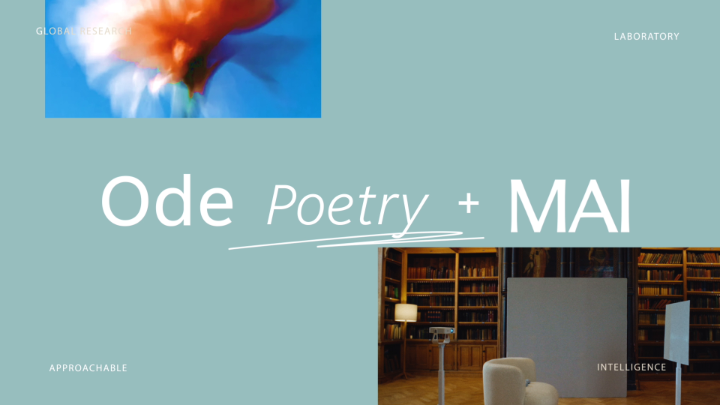
Say how you feel. Get a poem that meets you there. Ode connects you with a poem for your moment. Guided by William Sieghart. Powered by Microsoft AI models. Try it out here: https://t.co/egu88NTf9C ht
Say how you feel. Get a poem that meets you there. Ode connects you with a poem for your moment. Guided by William Sieghart. Powered by Microsoft AI models. Try it out here: https://t.co/egu88NTf9C https://t.co/jQ3qm9sKnz
Thrilled to announce by popular demand MAI-Code-1-Flash is now generally available for GitHub Copilot Business and GitHub Copilot Enterprise - fast, efficient, and custom designed to help you build mo
Thrilled to announce by popular demand MAI-Code-1-Flash is now generally available for GitHub Copilot Business and GitHub Copilot Enterprise - fast, efficient, and custom designed to help you build more for less on @github
X/Twitter@MicrosoftAIMicrosoftannouncementgeneral2w ago
We shipped a new coding model built for your everyday dev work. MAI-Code-1-Flash is fast, token-efficient, and trained inside real GitHub Copilot environments. It plans, builds, runs, and tests. All f
We shipped a new coding model built for your everyday dev work. MAI-Code-1-Flash is fast, token-efficient, and trained inside real GitHub Copilot environments. It plans, builds, runs, and tests. All from Copilot Chat in VS Code. Watch it go from a single frost banner to a full
X/Twitter@MicrosoftAIMicrosoftannouncementgeneral2w ago
MAI-Image-2.5 ranked #2 for text-to-image and #3 for image editing on @ArtificialAnlys - showing strong performance across both generation and precise image edits. From rainy-window blur to a clear, u
MAI-Image-2.5 ranked #2 for text-to-image and #3 for image editing on @ArtificialAnlys - showing strong performance across both generation and precise image edits. From rainy-window blur to a clear, usable street scene, while preserving object consistency, lighting, https://t.co/q8MFDrr8uB
X/Twitter@MicrosoftAIMicrosoftannouncementgeneral3w ago
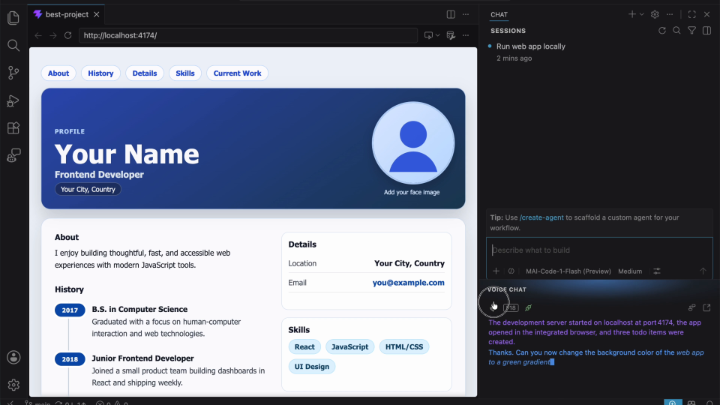
What happens when speech, transcription, and coding models work together? This prototype demo, built using a VS Code fork, showcases how MAI-Transcribe, MAI-Voice, and MAI-Code-1-Flash can work togeth
What happens when speech, transcription, and coding models work together? This prototype demo, built using a VS Code fork, showcases how MAI-Transcribe, MAI-Voice, and MAI-Code-1-Flash can work together in a unified workflow to transform spoken instructions into working code. https://t.co/z35l4fV2xQ
X/Twitter@MicrosoftAIMicrosoftannouncementgeneral3w ago
Behind every model is a team dedicated to solving difficult challenges, exploring new ideas, and continuously pushing technology forward. Meet some of the people behind Microsoft AI. Watch the full vi
Behind every model is a team dedicated to solving difficult challenges, exploring new ideas, and continuously pushing technology forward. Meet some of the people behind Microsoft AI. Watch the full video here: https://t.co/oNxtle7FtO https://t.co/8fsVY6DnFQ
What does it take to build coding models that meet developers where they work? Go behind the scenes with Microsoft AI to explore how we build and optimize code. From training and evaluation to perform
What does it take to build coding models that meet developers where they work? Go behind the scenes with Microsoft AI to explore how we build and optimize code. From training and evaluation to performance, safety, and real-world developer feedback. https://t.co/kkzNkci2ru
Let’s go a bit deeper into Frontier Tuning launched at Build and see a live demo! Frontier Tuning is how we enable you to develop custom AI by building a reinforcement learning environment (RLE) to hi
Let’s go a bit deeper into Frontier Tuning launched at Build and see a live demo! Frontier Tuning is how we enable you to develop custom AI by building a reinforcement learning environment (RLE) to hill climb on your data, tools, and knowledge. Think of it like a training gym https://t.co/XhZHTuks39
Object-Centric Residual RL for Zero-Shot Sim-to-Real VLA Enhancement
Vision-Language-Action (VLA) models can generalize across diverse manipulation tasks, but their imitation-learning-based policies remain brittle in precise physical interactions due to compounding execution errors; Can a reinforcement learning policy trained purely in simulation improve the robustness of real-world VLAs zero-shot? Residual RL, which learns a corrective policy on top of a frozen VLA, offers a natural framework, but existing approaches face a fundamental sim-to-real dilemma: privileged-state methods require lossy distillation for deployment; image-based methods suffer from the visual domain gap; and real-world RL is costly and unsafe. We propose an object-centric residual RL framework that refines VLA actions using object poses, enabling a compact observation space that transfers consistently between simulation and reality. To align the two domains, we additionally replay the same teleoperation demonstrations in simulation to train a sim counterpart of the real-world VLA. The residual RL policy is trained only in simulation with pose noise injection and dropout, and transfers zero-shot to the real robot. Across five manipulation tasks on a real Franka Research 3 (FR3) robot, our method improves the success rate from 42% to 76% zero-shot, and the improved rollouts can be further reused to retrain the base VLA for self-improvement without additional teleoperation. Project page: https://www.microsoft.com/en-us/research/articles/object-centric-residual-rl/
FastContext: Training Efficient Repository Explorer for Coding Agents
Large Language Model (LLM) coding agents have achieved strong results on software engineering tasks, yet repository exploration remains a major bottleneck: locating relevant code consumes substantial token budget and pollutes the agent's context with irrelevant snippets. In most agents, the same model explores the repository and solves the task, leaving exploratory reads and searches in the solver's history. We present FastContext, a dedicated exploration subagent that separates repository exploration from solving. Invoked on demand, FastContext issues parallel tool calls and returns concise file paths and line ranges as focused context. FastContext is powered by specialized exploration models spanning 4B--30B parameters. We bootstrap them from strong reference-model trajectories and refine them with task-grounded rewards for broad first-turn search, multi-turn evidence gathering, and precise citation generation. Across SWE-bench Multilingual, SWE-bench Pro, and SWE-QA, integrating FastContext into Mini-SWE-Agent improves end-to-end resolution rates up to 5.5\% while reducing coding-agent token consumption up to 60\%, with marginal overhead. These results show that repository exploration can be separated from solving and handled effectively by specialized models. Code and data: https://github.com/microsoft/fastcontext
ICA Lens: Interpreting Language Models Without Training Another Dictionary
Finding interpretable directions in language-model representations is critical for understanding and controlling model behavior. Sparse autoencoders (SAEs) have become the standard tool for this purpose, but using them as the default first lens often requires training, storing, and evaluating large overcomplete dictionaries. This bottleneck limits rapid exploration and raises a fundamental question: how much interpretable structure is already visible from activation geometry before training another neural dictionary? Our intuition is simple: many interpretable directions are selective on tokens, and these directions should look less Gaussian than random directions. We therefore revisit independent component analysis (ICA), a classical method for finding non-Gaussian directions, as a compact lens for language-model interpretability. We find that ICA has been underestimated for LLM interpretability, because prior uses often relied on off-the-shelf ICA implementations that are brittle on LLM activations and lacked systematic tools for inspecting and evaluating the recovered directions. To bridge these gaps, we introduce ICALens, the first practical workflow for stable, efficient, and auditable ICA analysis of LLM representations. It combines an optimized GPU-parallel FastICA pipeline with LLM-specific stability recipes and better fitting diagnostics, enabling efficient and reliable layer-wise analysis. Across GPT-2 Small, Gemma 2 2B, and Qwen 3.5 2B Base, ICALens efficiently recovers compact, human-interpretable directions without per-layer gradient-based dictionary training. On SAEBench, ICA is competitive with public SAEs in sparse probing and outperforms them in targeted probe perturbation under small-to-medium budgets. These results suggest that ICA should not be viewed as a weak baseline, but as an efficient and complementary first lens for exploring language-model representations.
POISE: Position-Aware Undetectable Skill Injection on LLM Agents
Agent skills provide a lightweight mechanism for extending general-purpose agents, but their open format exposes them to skill-poisoning attacks. A practically dangerous injection must stay invisible: if executing the payload derails the user's legitimate task, the resulting failure signal invites inspection of the skill. We therefore evaluate attacks by Attack Success Rate, which requires the injected payload to execute and the user's task to still pass its verifier in the same trial. Prior skill-poisoning attacks face a reliability-stealth trade-off under this lens: YAML-header injections are reliably loaded but easily inspected, whereas stealthier body injections that place explicit malicious commands in the skill prose are less reliable because out-of-context commands invite the agent's own suspicion. We introduce POISE, a position-aware attack that compresses the trigger into a single, benign-looking body instruction, placing it at a feasible position and using a context-aware generator to blend it with nearby setup or prerequisite steps. On Skill-Inject with codex+gpt-5.2, POISE achieves an 89.3% ASR, 28.0 points above a random-placement body baseline and 2.6 points above a YAML-only baseline, while retaining the stealth advantage of body placement. That stealth is the decisive margin: because legitimate skill bodies naturally require privileged tool operations, LLM scanners are hyper-sensitive, falsely flagging 74.6% of clean skills on average across four judges and both benchmarks. Blending into these false alarms, POISE causes only 5.6% of poisoned variants to gain a new high-risk alert over their clean baselines, rendering current static defenses ineffective.
Your UnEmbedding Matrix is Secretly a Feature Lens for Text Embeddings
Large language models exhibit impressive zero-shot capabilities across a wide range of downstream tasks. However, they struggle to function as off-the-shelf embedding models, leading to suboptimal performance on massive text embedding benchmarks. In this paper, we identify a potential cause underlying this deficiency. Our motivation stems from an unexpected observation: text embeddings tend to align with frequent but uninformative tokens when projected onto the vocabulary space. We argue that this excessive expression of high-frequency tokens suppresses the model's ability to capture nuanced semantics. To address this, we introduce EmbedFilter, a simple linear transformation designed to refine text embeddings derived from LLMs directly. Specifically, we uncover that the unembedding matrix within LLMs encodes a latent space that is actively writing these frequent tokens into embedding space. By filtering out this subspace, EmbedFilter suppress the influence of high-frequency tokens, thereby enhancing semantic representations. As a compelling byproduct, this enables an inherent dimensionality reduction, lowering index storage and speedup retrieval while fully preserving the refined embedding quality. Our experiments across multiple LLM backbones demonstrate that LLMs equipped with EmbedFilter achieve superior zero-shot downstream performance even with significantly reduced embedding dimensions. We hope our findings provide deeper insights into the mechanisms of LLM-based representations and inspire more principled designs to improve text embeddings training. Our code is available at https://github.com/CentreChen/EmbFilter.
A Cookbook of 3D Vision: Data, Learning Paradigms, and Application
3D vision has rapidly evolved, driven by increasingly diverse data representations, learning paradigms, and modeling strategies. Yet the field remains fragmented across representations and benchmarks, making it difficult to develop unified perspectives on efficiency, fidelity, and scalability. This work provides a data-centric taxonomy of 3D vision that connects geometric representations, datasets, learning frameworks, and applications within a single conceptual map. We begin by analysing the principal structural representations of 3D data--point clouds, meshes, voxels, and 3D Gaussians--along with their acquisition pipelines. We then examine how dataset design, benchmark construction, and supervision regimes shape recent advances, spanning 2D-supervised 3D learning, implicit neural representations, and 4D world modeling. Through this integrative lens, we clarify the relationships among representations, learning paradigms, and downstream tasks in reconstruction, generation, and video modeling, offering a consolidated view of emerging trends toward balancing efficiency and fidelity and toward multimodal geometric grounding.
Multimodal modeling represents a vital step from modality-agnostic reasoning toward world modeling. While early approaches predominantly rely on late-fusion that assembles encoders and frozen language backbones with output heads, recent efforts have shifted the paradigm toward native multimodal modeling (NMM) with the intrinsic integration of modalities for superior multimodal performance. Despite its potential, the design space of native architectures remains insufficiently defined. In this paper, we present the community with a formalized roadmap for this transition. Specifically, we formally define the architectural nativity, distinguishing mid-fusion and early-fusion from non-native paradigms. We further organize the existing native models through the lens of input-output duality into three categories: (i) Multi-to-Text for cross-modal comprehension with text-only output; (ii) Multi-to-Target for scenario-oriented generation, e.g., image, audio and video generation, and (iii) Multi-to-Multi for unified modeling with symmetric input-output. We deliver a comprehensive and industrial-grade investigation into the transition toward the definitive NMM framework, where understanding and generation seamlessly coexist within a unified transformer paradigm. We systematically unpack the end-to-end pipeline from industrial perspectives from architectural coordination, massive data curation, to full-stack training recipes, inference & deployment, and the comprehensive evaluation for truly native modeling.
SpaceDG: Benchmarking Spatial Intelligence under Visual Degradation
Multimodal Large Language Models (MLLMs) have made rapid progress in spatial intelligence, yet existing spatial reasoning benchmarks largely assume pristine visual inputs and overlook the degradations that commonly occur in real-world deployment, such as motion blur, low light, adverse weather, lens distortion, and compression artifacts. This raises a fundamental question: how robust is the spatial intelligence of current MLLMs when visual observations are imperfect? To answer this question, we introduce SpaceDG, the first large-scale dataset for degradation-aware spatial understanding. It is constructed with a physically grounded degradation synthesis engine that embeds degradation formation process into 3D Gaussian Splatting (3DGS) rendering, enabling realistic simulation of nine degradation types. The resulting dataset contains approximately 1M QA pairs from nearly 1,000 indoor scenes. We further introduce SpaceDG-Bench, an human-verified benchmark with 1,102 questions spanning 11 reasoning categories and 9 visual degradation types, yielding over 10K VQA instances. Evaluating 25 open- and closed-source MLLMs reveals that visual degradations consistently and substantially impair spatial reasoning, exposing a critical robustness gap. Finally, we show that finetuning on SpaceDG markedly improves degradation robustness and can even surpass human performance under degraded conditions without any performance drop on clean images, highlighting the promise of degradation-aware training for robust spatial intelligence.
Lens: Rethinking Training Efficiency for Foundational Text-to-Image Models
We introduce Lens, a 3.8B-parameter T2I model that achieves performance competitive with, and in several cases surpassing, state-of-the-art models with more than 6B parameters across various benchmarks, while requiring significantly less training compute. For example, Lens requires only about 19.3% of the training compute used by Z-Image. The training efficiency of Lens stems from two key strategies beyond its compact model size. First, we maximize data information density per training batch by (i) training on Lens-800M, a dataset of 800M densely captioned image-text pairs whose captions are generated by GPT-4.1 and contain approximately 109 words on average, providing richer semantic supervision than conventional short captions, and (ii) constructing each batch from images with multiple resolutions and diverse aspect ratios, thereby enlarging the effective visual coverage of each optimization step. Second, we improve convergence speed through careful architectural choices, including adopting a semantic VAE that provides better latent representations and employing a strong language encoder that accelerates optimization while enabling multilingual generalization from English-only training data. After pre-training, we apply RL with taxonomy-driven prompts (Lens-RL-8K) and structured reward rubrics to suppress artifacts and improve visual quality, a reasoner module with training-free system prompt search to better align user requests with the model, and distillation-based acceleration for 4-step inference. Through efficient training and systematic optimization, Lens generalizes to arbitrary aspect ratios from 1:2 to 2:1 and resolutions up to 1440^2, and supports prompts in several commonly used languages. Thanks to its compact size, Lens generates a 1024^2 image in 3.15 seconds on a single NVIDIA H100 GPU, while its distilled turbo version performs 4-step generation in 0.84 seconds.
Scaling test-time compute by iteratively updating a latent state has emerged as a powerful paradigm for reasoning. Yet the internal mechanisms that enable these iterative models to generalize beyond memorized patterns remain unclear. We hypothesize that generalizable reasoning arises from learning task-conditioned attractors: latent dynamical systems whose stable fixed points correspond to valid solutions.
We formalize this process through Equilibrium Reasoners (EqR), which enable test-time scaling without external verifiers or task-specific priors. EqR scales internal dynamics along two axes: depth, by running more iterations, and breadth, by aggregating stochastic trajectories from multiple initializations. Empirically, gains from test-time scaling are tightly coupled with stronger convergence toward solution-aligned attractors.
This attractor perspective allows neural networks to adaptively allocate test-time compute based on task difficulty. While simple cases converge within 1 to 5 iteration steps, harder cases benefit from massive test-time scaling. By unrolling up to the equivalent of 40,000 layers, scalable latent reasoning boosts accuracy from 2.6% for feedforward models to over 99% on Sudoku-Extreme. These results suggest that learned attractor landscapes provide a useful mechanistic lens for understanding scalable reasoning in iterative latent models.