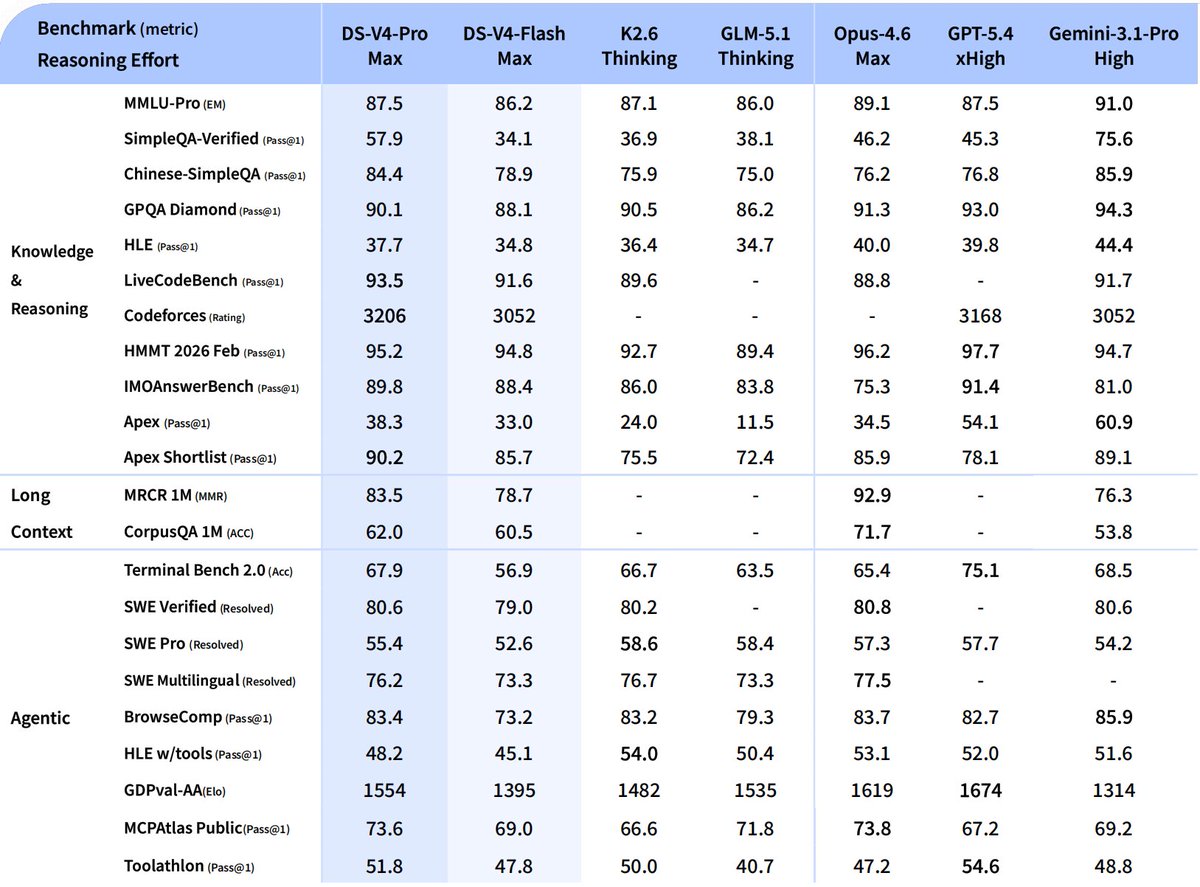
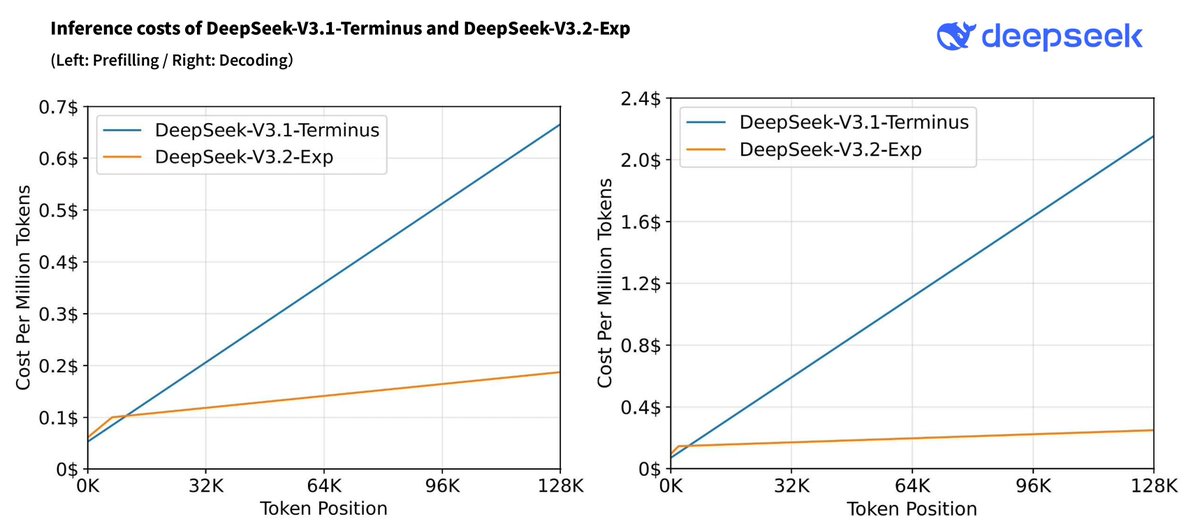
DeepSeek V4 Flash is an efficiency-optimized Mixture-of-Experts model from DeepSeek with 284B total parameters and 13B activated parameters, supporting a 1M-token context window. It is designed for fast inference and...
Running this yourself: can likely run on your own machine.
Model updates refreshed3h agoSep 16, 2026news + changelog
No current subscription pricing is tracked for this model.
Confirm this specific model, usage limits, and billing terms with the provider. A subscription does not automatically include API credits.
No login needed to compare. Prices are in USD; provider charges are separate from AI Market Cap plans. Context length, caching, tools, taxes, and regional terms can change the final cost. Open weights do not mean free hosting.
46.9
Quality Score
---
Arena ELO
284B
Parameters
1M
Context
Evidence profile
How complete is this record?
This measures the amount of verifiable public evidence we have, not how capable the model is. A missing field means it has not been verified yet, not that its value is zero.
DeepSeek-V4-Flash 🔹 Reasoning capabilities closely approach V4-Pro. 🔹 Performs on par with V4-Pro on simple Agent tasks. 🔹 Smaller parameter size, faster response times, and highly cost-effective A
DeepSeek-V4-Flash 🔹 Reasoning capabilities closely approach V4-Pro. 🔹 Performs on par with V4-Pro on simple Agent tasks. 🔹 Smaller parameter size, faster response times, and highly cost-effective API pricing. 3/n https://t.co/dAkP1f2aX0
X/Twitter@deepseek_aiDeepSeekpricingpricing4mo ago
DeepSeek-V4-Flash 🔹 Reasoning capabilities closely approach V4-Pro. 🔹 Performs on par with V4-Pro on simple Agent tasks. 🔹 Smaller parameter size, faster response times, and highly cost-effective A
DeepSeek-V4-Flash 🔹 Reasoning capabilities closely approach V4-Pro. 🔹 Performs on par with V4-Pro on simple Agent tasks. 🔹 Smaller parameter size, faster response times, and highly cost-effective API pricing. 3/n https://t.co/dAkP1f2aX0
SLAI T-Rex: Full-Parameter Post-training of the DeepSeek-V4 Family on Ascend SuperPOD
Full-parameter post-training of trillion-parameter-scale MoE models introduces substantial system-level challenges for large-scale distributed training, including severe memory pressure, non-overlapped communication overhead, and inefficient kernel execution. While most large-scale LLM training systems are built around GPU-based clusters, this report presents an end-to-end optimization practice on the Ascend NPU SuperPOD. Using the DeepSeek-V4 model family as the target workload, we develop a hierarchical optimization framework spanning model-level parallelism, computation-communication orchestration, and low-level kernel execution. The resulting system achieves 34.22% Model FLOPs Utilization (MFU) with a 2.93x improvement over the open-source baseline recipe while maintaining training stability. Building on this optimized infrastructure, we further establish a CPT and SFT workflow for complex Operations Research (OR) tasks. We refer to the integrated framework as SLAI T-Rex. Using DeepSeek-V4-Flash, we develop OR-oriented CPT and SFT data pipelines that combine collected domain resources with solver-verified synthetic optimization documents. The resulting dataset contains 10K high-quality SFT samples spanning four task categories and three problem representations. The specialized model achieves the highest average zero-shot Pass@1 score among the evaluated models, reaching 71.81% and outperforming GPT-5.4-Mini and the base DeepSeek-V4-Flash model by 3.98 and 11.27 percentage points, respectively. Overall, this work demonstrates a full-stack pathway from efficient trillion-parameter model post-training on Ascend infra to domain-specialized Flash models for solver-grounded mathematical modeling, advancing frontier-model systems for complex reasoning.
AutoTrainess: Teaching Language Models to Improve Language Models Autonomously
Training language models (LMs) remains a highly human-intensive process, even as frontier language model agents become increasingly capable at software engineering and other long-horizon tasks. A central challenge is that autonomous post-training is not just a coding problem: it requires the agent to repeatedly plan iterations, construct benchmark-aligned data, run stable training jobs, evaluate checkpoints, and preserve experiment state across many hours of interaction. We present AutoTrainess, a LM agent that exposes these operations as a repository of agent-computer interfaces for planning, data preparation, training, evaluation, and logging. Rather than leaving the agent to operate in a raw CLI environment with an underspecified action space, AutoTrainess externalizes prior human experience as explicit workflows, rules, and execution constraints that guide the agent toward effective and reliable training behavior. On PostTrainBench, AutoTrainess consistently outperforms CLI-only baselines, achieving 26.94 average score with GPT-5.4 (Codex) versus 23.21 for CLI-only. It also generalizes across models and harnesses, improving DeepSeek-V4-Flash (OpenCode) from 12.13 to 19.58.
τ-Rec: A Verifiable Benchmark for Agentic Recommender Systems
As recommender systems transition toward agentic, multi-turn conversational interfaces, evaluation paradigms have struggled to keep pace. Current benchmarks often rely on "LLM-as-a-judge" evaluations, which introduce subjectivity, high costs and inconsistency. We present τ-Rec, a benchmark for agentic recommender systems that replaces subjective evaluation with verifiable rewards and a reveal-tagged elicitation (RTE) mechanism that controls how task constraints surface during dialogue. By testing agents against structured catalog predicates and employing a pass^k reliability metric, τ-Rec provides a systematic test for consistent reasoning. Our evaluation of nine configurations across five model families -- GPT-5.4, Claude Sonnet 4.6, Gemini 2.5 Flash, DeepSeek V4 Flash, Qwen3-32B and GPT-5 mini -- reveals a steep reliability cliff, where even the best model achieves only ~57% at pass^1 and ~38% at pass^4, highlighting a critical gap in current conversational agent deployment. All code and data are publicly available at https://github.com/nbharaths/tau-rec.
Bayesian-Agent: Posterior-Guided Skill Evolution for LLM Agent Harnesses
LLM agents increasingly rely on external inference conditions: prompts, tools, memory, SOPs, skills, and harness feedback. These assets can improve task execution without changing model weights, but they are often revised by heuristic reflection or by reusing observed successes and failures as if counts alone were reliable belief. We introduce Bayesian-Agent, a native and cross-harness framework that treats reusable skills and SOPs as hypotheses about whether a frozen model will succeed under a particular prompt, context, and harness environment. Bayesian-Agent records verified trajectory evidence, maintains a feature-conditioned categorical posterior over each skill, and maps posterior state into inspectable actions such as patch, split, compress, retire, and explore. Model-facing prompts receive executable guardrails and failure-mode patches, while posterior summaries remain available for audit. With deepseek-v4-flash, incremental repair improves SOP-Bench from 80\% to 95\%, Lifelong AgentBench from 90\% to 100\%, and RealFin-Bench from 45\% to 65\%. We further evaluate Bayesian-Agent's native backend and optional GenericAgent, mini-swe-agent, and Claude Code backends. The results include positive, negative, saturated, and case-study settings, suggesting that agent skill evolution is best viewed as posterior-guided harness optimization rather than uncalibrated prompt accumulation. The source code is available at https://github.com/DataArcTech/Bayesian-Agent.
Nemotron-Cascade 2: Post-Training LLMs with Cascade RL and Multi-Domain On-Policy Distillation
We introduce Nemotron-Cascade 2, an open 30B MoE model with 3B activated parameters that delivers best-in-class reasoning and strong agentic capabilities. Despite its compact size, its mathematical and coding reasoning performance approaches that of frontier open models. It is the second open-weight LLM, after DeepSeekV3.2-Speciale-671B-A37B, to achieve Gold Medal-level performance in the 2025 International Mathematical Olympiad (IMO), the International Olympiad in Informatics (IOI), and the ICPC World Finals, demonstrating remarkably high intelligence density with 20x fewer parameters. In contrast to Nemotron-Cascade 1, the key technical advancements are as follows. After SFT on a meticulously curated dataset, we substantially expand Cascade RL to cover a much broader spectrum of reasoning and agentic domains. Furthermore, we introduce multi-domain on-policy distillation from the strongest intermediate teacher models for each domain throughout the Cascade RL process, allowing us to efficiently recover benchmark regressions and sustain strong performance gains along the way. We release the collection of model checkpoint and training data.
Nemotron-Cascade 2: Post-Training LLMs with Cascade RL and Multi-Domain On-Policy Distillation
We introduce Nemotron-Cascade 2, an open 30B MoE model with 3B activated parameters that delivers best-in-class reasoning and strong agentic capabilities. Despite its compact size, its mathematical and coding reasoning performance approaches that of frontier open models. It is the second open-weight LLM, after DeepSeekV3.2-Speciale-671B-A37B, to achieve Gold Medal-level performance in the 2025 International Mathematical Olympiad (IMO), the International Olympiad in Informatics (IOI), and the ICPC World Finals, demonstrating remarkably high intelligence density with 20x fewer parameters. In contrast to Nemotron-Cascade 1, the key technical advancements are as follows. After SFT on a meticulously curated dataset, we substantially expand Cascade RL to cover a much broader spectrum of reasoning and agentic domains. Furthermore, we introduce multi-domain on-policy distillation from the strongest intermediate teacher models for each domain throughout the Cascade RL process, allowing us to efficiently recover benchmark regressions and sustain strong performance gains along the way. We release the collection of model checkpoint and training data.
DeepSeek V4 Flash 0423 is now available through Ollama Cloud. 1M context window listed. DeepSeek-V4-Flash is the official release of DeepSeek-V4-Flash, built for efficient reasoning across a 1M-token context window, outperforming DeepSeek-V4-Pro (Preview).