Live access is not confirmed for this model. No current purchase price is advertised.
Related provider subscriptions
No current subscription pricing is tracked for this model.
Confirm this specific model, usage limits, and billing terms with the provider. A subscription does not automatically include API credits.
No login needed to compare. Prices are in USD; provider charges are separate from AI Market Cap plans. Context length, caching, tools, taxes, and regional terms can change the final cost. Open weights do not mean free hosting.
25.8
Quality Score
---
Arena ELO
5B
Parameters
---
Context
Evidence profile
How complete is this record?
This measures the amount of verifiable public evidence we have, not how capable the model is. A missing field means it has not been verified yet, not that its value is zero.
Recent launch, pricing, benchmark, and API signals linked to this model or its provider.
LaunchesMicrosoftYesterday
More ways to discover, access, and build with MAI models. MAI models are now available through Vercel, giving developers another way to bring Microsoft AI models into the products and experiences they
More ways to discover, access, and build with MAI models. MAI models are now available through Vercel, giving developers another way to bring Microsoft AI models into the products and experiences they’re building. This includes our existing MAI models plus today’s newest
Thrilled to announce by popular demand MAI-Code-1-Flash is now generally available for GitHub Copilot Business and GitHub Copilot Enterprise - fast, efficient, and custom designed to help you build mo
Thrilled to announce by popular demand MAI-Code-1-Flash is now generally available for GitHub Copilot Business and GitHub Copilot Enterprise - fast, efficient, and custom designed to help you build more for less on @github
The Muon optimizer incurs a significant overhead cost due to its cubic-time Newton-Schulz orthogonalization step. When weights are sharded, communication overhead compounds this computational cost, eroding the benefits of Muon in many settings. We present Dion3, a revision of Muon that targets this overhead at every level of the stack. Our Gram Newton-Schulz algorithm reduces the FLOP cost of orthogonalization, our CuteDSL kernels accelerate it by exploiting symmetry, and our megabatching strategy reduces communication overhead. Moreover, we propose a simple change to the update rule that cuts costs even further: selecting only a fraction of the momentum matrix's rows to orthogonalize at each step. This update rule improves on Dion (another "compressed" version of Muon), in both speed and performance. Overall, Dion3 matches or improves on the loss achieved by Muon but reduces optimizer step time by up to 6x. Dion3 is available via the dion package (https://github.com/microsoft/dion) as a drop-in replacement for Muon.
Object-Centric Residual RL for Zero-Shot Sim-to-Real VLA Enhancement
Vision-Language-Action (VLA) models can generalize across diverse manipulation tasks, but their imitation-learning-based policies remain brittle in precise physical interactions due to compounding execution errors; Can a reinforcement learning policy trained purely in simulation improve the robustness of real-world VLAs zero-shot? Residual RL, which learns a corrective policy on top of a frozen VLA, offers a natural framework, but existing approaches face a fundamental sim-to-real dilemma: privileged-state methods require lossy distillation for deployment; image-based methods suffer from the visual domain gap; and real-world RL is costly and unsafe. We propose an object-centric residual RL framework that refines VLA actions using object poses, enabling a compact observation space that transfers consistently between simulation and reality. To align the two domains, we additionally replay the same teleoperation demonstrations in simulation to train a sim counterpart of the real-world VLA. The residual RL policy is trained only in simulation with pose noise injection and dropout, and transfers zero-shot to the real robot. Across five manipulation tasks on a real Franka Research 3 (FR3) robot, our method improves the success rate from 42% to 76% zero-shot, and the improved rollouts can be further reused to retrain the base VLA for self-improvement without additional teleoperation. Project page: https://www.microsoft.com/en-us/research/articles/object-centric-residual-rl/
Bring your mood board to life with MAI-Image-2.6. Our latest image model can modify color, style, and visual details while maintaining consistency across iterations. https://t.co/HyHOy8Nt4s
More ways to discover, access, and build with MAI models. MAI models are now available through Vercel, giving developers another way to bring Microsoft AI models into the products and experiences they
More ways to discover, access, and build with MAI models. MAI models are now available through Vercel, giving developers another way to bring Microsoft AI models into the products and experiences they’re building. This includes our existing MAI models plus today’s newest
X/Twitter@MicrosoftAIMicrosoftannouncementgeneral1mo ago
Bring your mood board to life with MAI-Image-2.6. Our latest image model can modify color, style, and visual details while maintaining consistency across iterations. https://t.co/HyHOy8Nt4s
X/Twitter@MicrosoftAIMicrosoftannouncementgeneral2mo ago
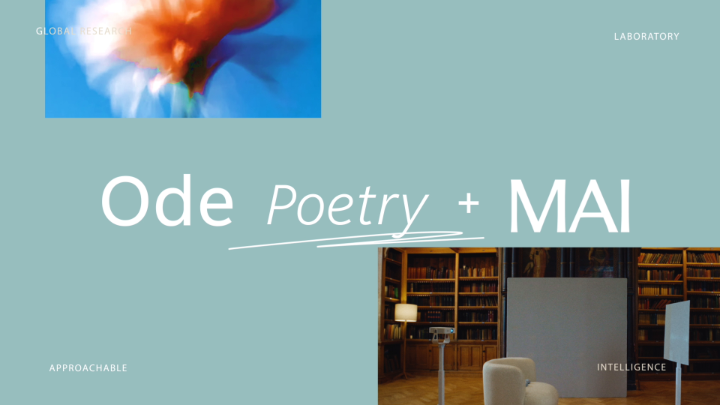
Say how you feel. Get a poem that meets you there. Ode connects you with a poem for your moment. Guided by William Sieghart. Powered by Microsoft AI models. Try it out here: https://t.co/egu88NTf9C ht
Say how you feel. Get a poem that meets you there. Ode connects you with a poem for your moment. Guided by William Sieghart. Powered by Microsoft AI models. Try it out here: https://t.co/egu88NTf9C https://t.co/jQ3qm9sKnz
Thrilled to announce by popular demand MAI-Code-1-Flash is now generally available for GitHub Copilot Business and GitHub Copilot Enterprise - fast, efficient, and custom designed to help you build mo
Thrilled to announce by popular demand MAI-Code-1-Flash is now generally available for GitHub Copilot Business and GitHub Copilot Enterprise - fast, efficient, and custom designed to help you build more for less on @github
X/Twitter@MicrosoftAIMicrosoftannouncementgeneral3mo ago
We shipped a new coding model built for your everyday dev work. MAI-Code-1-Flash is fast, token-efficient, and trained inside real GitHub Copilot environments. It plans, builds, runs, and tests. All f
We shipped a new coding model built for your everyday dev work. MAI-Code-1-Flash is fast, token-efficient, and trained inside real GitHub Copilot environments. It plans, builds, runs, and tests. All from Copilot Chat in VS Code. Watch it go from a single frost banner to a full
X/Twitter@MicrosoftAIMicrosoftannouncementgeneral3mo ago
MAI-Image-2.5 ranked #2 for text-to-image and #3 for image editing on @ArtificialAnlys - showing strong performance across both generation and precise image edits. From rainy-window blur to a clear, u
MAI-Image-2.5 ranked #2 for text-to-image and #3 for image editing on @ArtificialAnlys - showing strong performance across both generation and precise image edits. From rainy-window blur to a clear, usable street scene, while preserving object consistency, lighting, https://t.co/q8MFDrr8uB
X/Twitter@MicrosoftAIMicrosoftannouncementgeneral3mo ago
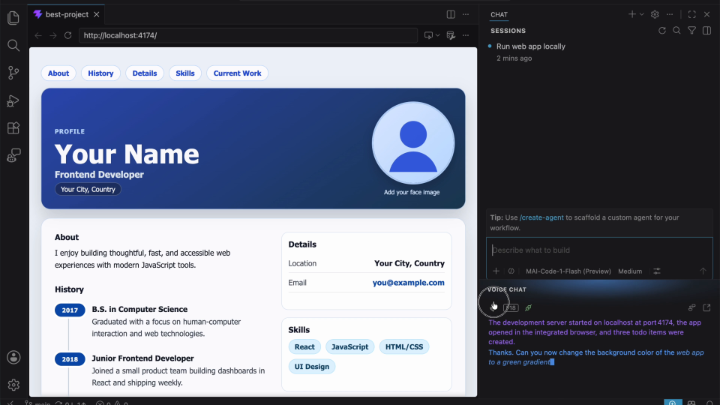
What happens when speech, transcription, and coding models work together? This prototype demo, built using a VS Code fork, showcases how MAI-Transcribe, MAI-Voice, and MAI-Code-1-Flash can work togeth
What happens when speech, transcription, and coding models work together? This prototype demo, built using a VS Code fork, showcases how MAI-Transcribe, MAI-Voice, and MAI-Code-1-Flash can work together in a unified workflow to transform spoken instructions into working code. https://t.co/z35l4fV2xQ
X/Twitter@MicrosoftAIMicrosoftannouncementgeneral3mo ago
Behind every model is a team dedicated to solving difficult challenges, exploring new ideas, and continuously pushing technology forward. Meet some of the people behind Microsoft AI. Watch the full vi
Behind every model is a team dedicated to solving difficult challenges, exploring new ideas, and continuously pushing technology forward. Meet some of the people behind Microsoft AI. Watch the full video here: https://t.co/oNxtle7FtO https://t.co/8fsVY6DnFQ
The Muon optimizer incurs a significant overhead cost due to its cubic-time Newton-Schulz orthogonalization step. When weights are sharded, communication overhead compounds this computational cost, eroding the benefits of Muon in many settings. We present Dion3, a revision of Muon that targets this overhead at every level of the stack. Our Gram Newton-Schulz algorithm reduces the FLOP cost of orthogonalization, our CuteDSL kernels accelerate it by exploiting symmetry, and our megabatching strategy reduces communication overhead. Moreover, we propose a simple change to the update rule that cuts costs even further: selecting only a fraction of the momentum matrix's rows to orthogonalize at each step. This update rule improves on Dion (another "compressed" version of Muon), in both speed and performance. Overall, Dion3 matches or improves on the loss achieved by Muon but reduces optimizer step time by up to 6x. Dion3 is available via the dion package (https://github.com/microsoft/dion) as a drop-in replacement for Muon.
Object-Centric Residual RL for Zero-Shot Sim-to-Real VLA Enhancement
Vision-Language-Action (VLA) models can generalize across diverse manipulation tasks, but their imitation-learning-based policies remain brittle in precise physical interactions due to compounding execution errors; Can a reinforcement learning policy trained purely in simulation improve the robustness of real-world VLAs zero-shot? Residual RL, which learns a corrective policy on top of a frozen VLA, offers a natural framework, but existing approaches face a fundamental sim-to-real dilemma: privileged-state methods require lossy distillation for deployment; image-based methods suffer from the visual domain gap; and real-world RL is costly and unsafe. We propose an object-centric residual RL framework that refines VLA actions using object poses, enabling a compact observation space that transfers consistently between simulation and reality. To align the two domains, we additionally replay the same teleoperation demonstrations in simulation to train a sim counterpart of the real-world VLA. The residual RL policy is trained only in simulation with pose noise injection and dropout, and transfers zero-shot to the real robot. Across five manipulation tasks on a real Franka Research 3 (FR3) robot, our method improves the success rate from 42% to 76% zero-shot, and the improved rollouts can be further reused to retrain the base VLA for self-improvement without additional teleoperation. Project page: https://www.microsoft.com/en-us/research/articles/object-centric-residual-rl/