The Vision Transformer (ViT) is a transformer encoder model (BERT-like) pretrained on a large collection of images in a supervised fashion, namely ImageNet-21k, at a resolution of 224x224 pixels.
Running this yourself: can likely run on your own machine.
Model updates refreshed15h agoOct 14, 2026news + changelog
Live access is not confirmed for this model. No current purchase price is advertised.
Related provider subscriptions
No current subscription pricing is tracked for this model.
Confirm this specific model, usage limits, and billing terms with the provider. A subscription does not automatically include API credits.
No login needed to compare. Prices are in USD; provider charges are separate from AI Market Cap plans. Context length, caching, tools, taxes, and regional terms can change the final cost. Open weights do not mean free hosting.
30.7
Quality Score
---
Arena ELO
86M
Parameters
---
Context
Evidence profile
How complete is this record?
This measures the amount of verifiable public evidence we have, not how capable the model is. A missing field means it has not been verified yet, not that its value is zero.
Recent launch, pricing, benchmark, and API signals linked to this model or its provider.
LaunchesGoogle5d ago
It’s Friday 🎉 Here’s a look at this week’s announcements: — https://t.co/a9bSlm0Yxk is now available globally in English, allowing anyone to use our detector portal to easily verify if images, video,
It’s Friday 🎉 Here’s a look at this week’s announcements: — https://t.co/a9bSlm0Yxk is now available globally in English, allowing anyone to use our detector portal to easily verify if images, video, or audio files were AI-generated by Google or industry partners — Nano Banana
APEX: Asynchronous Prefix Denoising for Extreme Compression
Fewer latent tokens promise cheaper diffusion. Yet aggressive latent compression creates a reconstruction-generation dilemma: adding channels improves reconstruction but makes generation harder. We introduce APEX, short for Asynchronous Prefix denoising for EXtreme compression, which pairs a hierarchical latent space with asynchronous denoising over channel groups. Our autoencoder orders channel prefixes from structure to detail, while one shared denoiser generates them at staggered local times without adding tokens. On ImageNet-512, APEX outperforms existing methods at every evaluated channel count under 64x and 128x compression. At matched training and guided sampling compute, it also outperforms a 256-token model at every evaluated budget, with larger gains at lower compute. Code is available at https://daviddinkevich.github.io/APEX.
DataVista: Diagnosing Multimodal LLMs on Data Video Understanding
Data video is a media form that integrates data visualization with video narrative, widely adopted in news reporting and business analysis. Compared with general video understanding, data video understanding places greater emphasis on accurately reading data from animated charts, integrating evidence across charts and time, and understanding how narrative organization and visual design communicate information. Yet existing benchmarks target either general videos or static charts, and data video understanding has not been systematically evaluated. We present DataVista, the first benchmark for data video understanding, containing 961 real-world data videos and 6,775 evaluation questions organized under a three-level progressive capability framework (data perception, temporal reasoning, narrative understanding) with 10 fine-grained question types across five topic domains. Systematic evaluation of 19 mainstream MLLMs shows that the best-performing model, Gemini-3.1-Pro, achieves 70.0% overall accuracy, still far below human expert performance, with models performing worst on Causal Reasoning and Narrative Structure. Increasing frame counts and adding subtitles mainly benefit data perception and temporal reasoning, with limited gains in narrative understanding. Further analysis of model responses identifies typical failure modes in chart reading, evidence judgment, and instruction understanding. The benchmark is available at https://github.com/HKUSTDial/DataVista.
Flow matching has emerged as a scalable paradigm for training high-quality generative models, but sampling from the learned probability flow requires many network evaluations. Distillation can reduce this cost to one or a few evaluations; however, one-step generation often sacrifices quality, making few-step generation the practical operating regime. Existing few-step methods perform their iterative computation along the probability flow and therefore require a fixed, manually chosen timestep discretization. This discretization is often chosen heuristically and is expensive to tune; it may also be restrictive when refinement difficulty differs across samples or spatial locations. We introduce data-space iteration, a few-step generation framework that removes flow discretization altogether. Starting from noise, a shared generator directly refines its prediction in data space, with every iteration trained to produce the best sample permitted by its capacity. Our formulation integrates with distribution matching distillation (DMD) with minimal changes, enabling a controlled comparison between iteration methods under matched training settings. On class-conditional ImageNet 256x256, data-space iteration outperforms standard discretization baselines and matches or improves upon variants selected through schedule search, without requiring schedule-specific training. These results show that data-space iteration provides a simple and effective alternative to discretized flow-space iteration for fast generation.
SAGE: Salient Factor Discovery and Generation with Visual Foundation Representations
Given a target dataset, such as faces with eyeglasses, and a background dataset, such as faces without, contrastive analysis separates salient factors specific to the target from common content shared by both. We aim for salient representations that capture target-specific detail in each image, such as the shape, color, and position of the glasses, so that they reveal subtypes without subtype labels and guide the generation of new examples of a discovered subtype, even one with no name or text description. We introduce SAGE, which learns both factors directly in the high-dimensional spatial latent of a frozen representation autoencoder and conditions a diffusion transformer on the learned salient representation of a reference image. On Digits-ImageNet and FFHQ eyeglasses, SAGE combines high-fidelity reconstruction (rFID below 2) with unsupervised subtype discovery, recovering the digits better than baselines (probe accuracy 0.950 vs.\ at most 0.281) and revealing eyewear types, finer sunglasses styles, and mislabeled images; salient-conditioned generation raises Digits-ImageNet subtype accuracy over the unfactorized latent (90.5% vs.\ 27.7%) and diversity on both datasets. On retinal OCT, SAGE's salient space separates three diseases using only normal/disease labels.
Over half of reported crimes in Singapore use sophisticated social engineering. With @GovTechSG, we’re building on-device fraud detection using our open model Gemma. By fine-tuning it on local scam ta
Over half of reported crimes in Singapore use sophisticated social engineering. With @GovTechSG, we’re building on-device fraud detection using our open model Gemma. By fine-tuning it on local scam tactics, it identifies threats in real time without compromising personal https://t.co/pkAulZoJng
It’s Friday 🎉 Here’s a look at this week’s announcements: — https://t.co/a9bSlm0Yxk is now available globally in English, allowing anyone to use our detector portal to easily verify if images, video,
It’s Friday 🎉 Here’s a look at this week’s announcements: — https://t.co/a9bSlm0Yxk is now available globally in English, allowing anyone to use our detector portal to easily verify if images, video, or audio files were AI-generated by Google or industry partners — Nano Banana
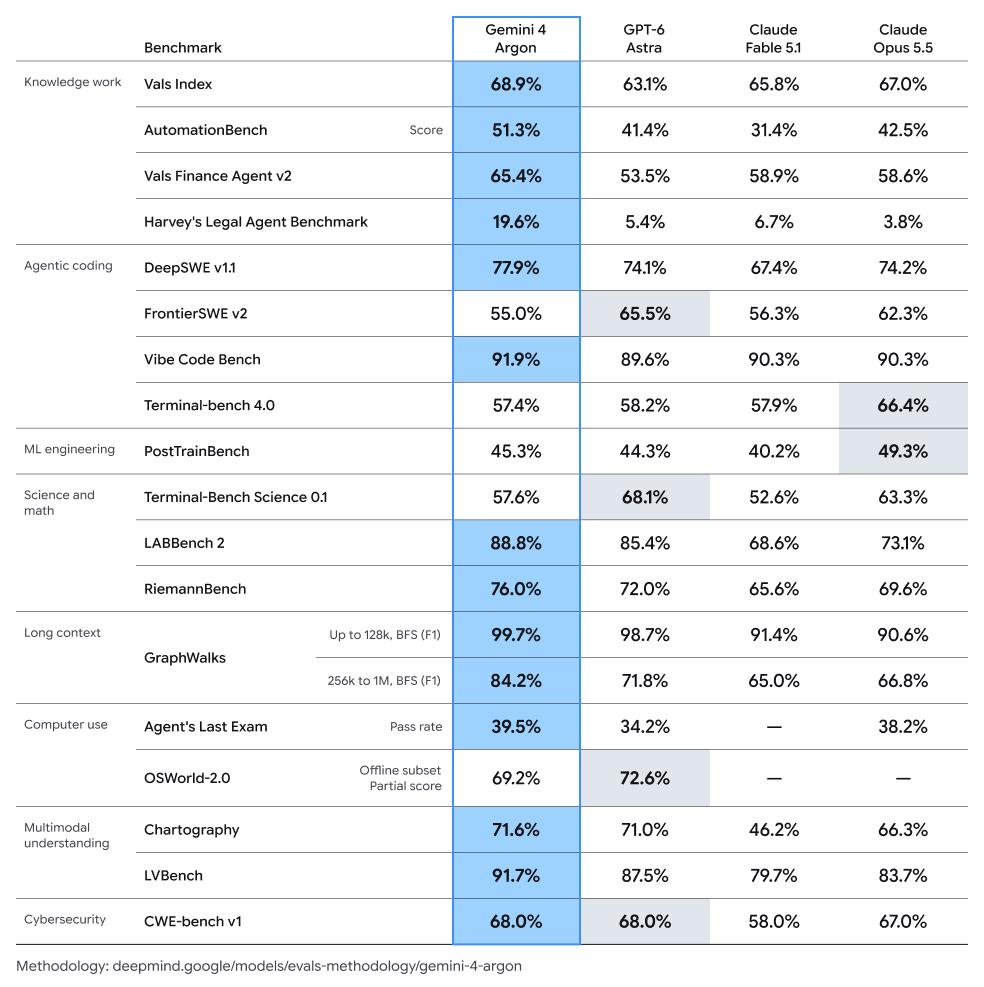
Announcing Gemini 4 Argon, our new frontier model. Argon is built to sustain deep reasoning across complex, long-horizon workflows and delivers frontier performance in complex workflows across real-wo
Announcing Gemini 4 Argon, our new frontier model. Argon is built to sustain deep reasoning across complex, long-horizon workflows and delivers frontier performance in complex workflows across real-world software engineering, enterprise knowledge work like legal and finance, and https://t.co/IpYt2KAaaq
Check out this week's updates and releases: — Gemini 3.8 Flash TTS and Gemini 3.8 Flash-Lite TTS, two of our most expressive audio generation models yet — Gemini 3.8 Live with Live Avatar, bringing ne
Check out this week's updates and releases: — Gemini 3.8 Flash TTS and Gemini 3.8 Flash-Lite TTS, two of our most expressive audio generation models yet — Gemini 3.8 Live with Live Avatar, bringing near real-time visual presence to Gemini’s conversational AI — @Gemini_Notebook
APEX: Asynchronous Prefix Denoising for Extreme Compression
Fewer latent tokens promise cheaper diffusion. Yet aggressive latent compression creates a reconstruction-generation dilemma: adding channels improves reconstruction but makes generation harder. We introduce APEX, short for Asynchronous Prefix denoising for EXtreme compression, which pairs a hierarchical latent space with asynchronous denoising over channel groups. Our autoencoder orders channel prefixes from structure to detail, while one shared denoiser generates them at staggered local times without adding tokens. On ImageNet-512, APEX outperforms existing methods at every evaluated channel count under 64x and 128x compression. At matched training and guided sampling compute, it also outperforms a 256-token model at every evaluated budget, with larger gains at lower compute. Code is available at https://daviddinkevich.github.io/APEX.
DataVista: Diagnosing Multimodal LLMs on Data Video Understanding
Data video is a media form that integrates data visualization with video narrative, widely adopted in news reporting and business analysis. Compared with general video understanding, data video understanding places greater emphasis on accurately reading data from animated charts, integrating evidence across charts and time, and understanding how narrative organization and visual design communicate information. Yet existing benchmarks target either general videos or static charts, and data video understanding has not been systematically evaluated. We present DataVista, the first benchmark for data video understanding, containing 961 real-world data videos and 6,775 evaluation questions organized under a three-level progressive capability framework (data perception, temporal reasoning, narrative understanding) with 10 fine-grained question types across five topic domains. Systematic evaluation of 19 mainstream MLLMs shows that the best-performing model, Gemini-3.1-Pro, achieves 70.0% overall accuracy, still far below human expert performance, with models performing worst on Causal Reasoning and Narrative Structure. Increasing frame counts and adding subtitles mainly benefit data perception and temporal reasoning, with limited gains in narrative understanding. Further analysis of model responses identifies typical failure modes in chart reading, evidence judgment, and instruction understanding. The benchmark is available at https://github.com/HKUSTDial/DataVista.
Flow matching has emerged as a scalable paradigm for training high-quality generative models, but sampling from the learned probability flow requires many network evaluations. Distillation can reduce this cost to one or a few evaluations; however, one-step generation often sacrifices quality, making few-step generation the practical operating regime. Existing few-step methods perform their iterative computation along the probability flow and therefore require a fixed, manually chosen timestep discretization. This discretization is often chosen heuristically and is expensive to tune; it may also be restrictive when refinement difficulty differs across samples or spatial locations. We introduce data-space iteration, a few-step generation framework that removes flow discretization altogether. Starting from noise, a shared generator directly refines its prediction in data space, with every iteration trained to produce the best sample permitted by its capacity. Our formulation integrates with distribution matching distillation (DMD) with minimal changes, enabling a controlled comparison between iteration methods under matched training settings. On class-conditional ImageNet 256x256, data-space iteration outperforms standard discretization baselines and matches or improves upon variants selected through schedule search, without requiring schedule-specific training. These results show that data-space iteration provides a simple and effective alternative to discretized flow-space iteration for fast generation.
SAGE: Salient Factor Discovery and Generation with Visual Foundation Representations
Given a target dataset, such as faces with eyeglasses, and a background dataset, such as faces without, contrastive analysis separates salient factors specific to the target from common content shared by both. We aim for salient representations that capture target-specific detail in each image, such as the shape, color, and position of the glasses, so that they reveal subtypes without subtype labels and guide the generation of new examples of a discovered subtype, even one with no name or text description. We introduce SAGE, which learns both factors directly in the high-dimensional spatial latent of a frozen representation autoencoder and conditions a diffusion transformer on the learned salient representation of a reference image. On Digits-ImageNet and FFHQ eyeglasses, SAGE combines high-fidelity reconstruction (rFID below 2) with unsupervised subtype discovery, recovering the digits better than baselines (probe accuracy 0.950 vs.\ at most 0.281) and revealing eyewear types, finer sunglasses styles, and mislabeled images; salient-conditioned generation raises Digits-ImageNet subtype accuracy over the unfactorized latent (90.5% vs.\ 27.7%) and diversity on both datasets. On retinal OCT, SAGE's salient space separates three diseases using only normal/disease labels.
Persistence Forcing: Exploiting Feature Specialization in Pixel-Space Diffusion
Pixel-space diffusion Transformers (DiTs) directly operate on high-dimensional visual data, yet their hidden representations typically undergo uniform refinement across depth. Natural images, however, are inherently organized at different levels of granularity. Global structure can often be represented compactly, whereas local textures and fine details require richer representations. Motivated by this, we introduce heterogeneous refinement in pixel-space DiTs, assigning different feature groups distinct refinement budgets across depth. Consequently, an ordered feature specialization emerges: sparsely refined features predominantly encode global visual structure, whereas more frequently refined features increasingly specialize toward localized, high-frequency details. We refer to these two groups as persistent and active features, respectively. Building on this emergent specialization, we introduce Persistence Forcing (PerF), which explicitly exploits this persistent--active feature organization for pixel-space image generation. This enables persistent features to continuously condition actively refined features, allowing stable global information to guide the ongoing refinement of finer visual details. During generative sampling, this interaction further induces a meaningful guidance direction that promotes coherent global structure and naturally complements classifier-free guidance. On ImageNet 256times256, PerF-L achieves FID of 1.91, approaching 1.86 of JiT-H with only half the parameters, while PerF-H further achieves FID of 1.63 and 1.76 on ImageNet 256times256 and 512times512, respectively.
StableVQ: Practical Guidelines for Stable Vector-Quantized Tokenizer Training
Vector Quantization (VQ) is fundamental to discrete visual tokenizers that power modern autoregressive and masked image generation models. While recent shared-projection codebook methods have substantially advanced codebook utilization, training stability remains a critical and underexplored challenge. We argue that the root cause lies in the entanglement of the Encoder--Decoder and Codebook training: because neither module can reliably fulfill its own responsibility in isolation, the system can only function when the two subsystems happen to cooperate---a fragile condition that breaks down precisely when training is most stressed. We propose StableVQ, which revisits the proper learning objective of each module and resolves the problems that arise when each is trained to fulfill its own role independently. Concretely, (1) Dynamic STE corrects the instability in the Encoder's learning objective, enabling it to robustly optimize the reconstruction space under discrete regularization even when codebook utilization is low. (2) Region VQ Loss reconceives the Codebook's learning objective so that it can independently guarantee full tracking of the encoder output distribution, without relying on encoder oscillations to drive activation. (3) Decoupled Schedule recognizes that the distinct responsibilities of the Encoder--Decoder and the Codebook demand distinct optimization dynamics, and assigns each an independent learning rate schedule to ensure robust system-level behavior. Built on top of shared-projection codebooks, StableVQ is lightweight and introduces no learnable parameters. Experiments on ImageNet demonstrate consistent improvements in training stability, codebook utilization, and reconstruction quality across diverse codebook sizes and initialization settings.