Current rates are not verified. Missing pricing does not mean free usage.
Related provider subscriptions
No current subscription pricing is tracked for this model.
Confirm this specific model, usage limits, and billing terms with the provider. A subscription does not automatically include API credits.
No login needed to compare. Prices are in USD; provider charges are separate from AI Market Cap plans. Context length, caching, tools, taxes, and regional terms can change the final cost. Open weights do not mean free hosting.
---
Quality Score
---
Arena ELO
Undisclosed
Parameters
33K
Context
Evidence profile
How complete is this record?
This measures the amount of verifiable public evidence we have, not how capable the model is. A missing field means it has not been verified yet, not that its value is zero.
Recent launch, pricing, benchmark, and API signals linked to this model or its provider.
LaunchesCohere1w ago
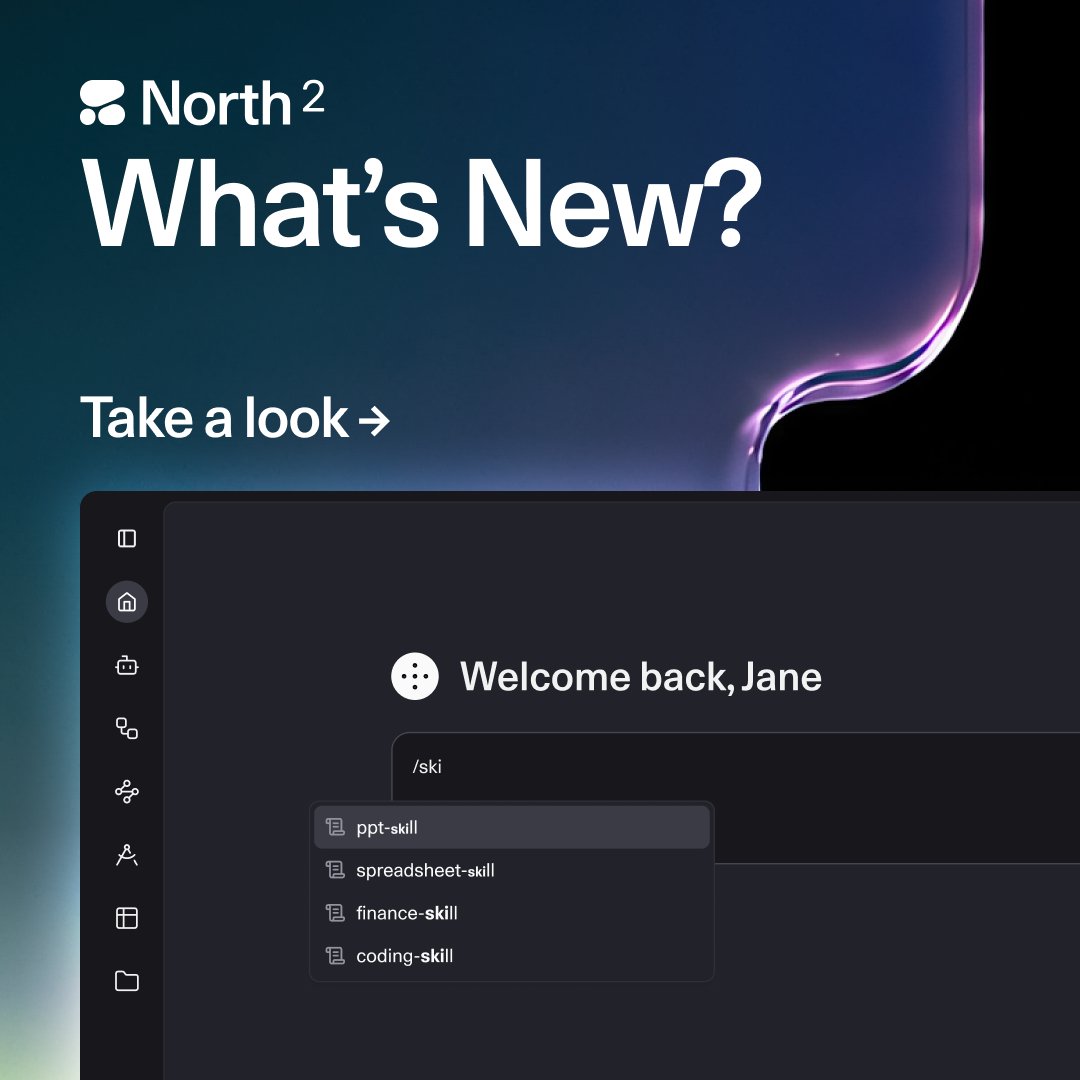
Introducing North 2. Enterprises have been compromising on agentic AI for years: platforms that aren't scalable, models that aren't sovereign, control without enterprise-grade security. That ends toda
Introducing North 2. Enterprises have been compromising on agentic AI for years: platforms that aren't scalable, models that aren't sovereign, control without enterprise-grade security. That ends today, with 15+ new features in our biggest upgrade yet: https://t.co/hxxzIRzDHk
Introducing Cohere Embed 5: our new state-of-the-art family of embeddings models. Get frontier capabilities with Embed 5 Pro or low-latency performance with Embed 5 Fast. https://t.co/Z4dKEVSs4A
Last week, we dropped North 2, our biggest upgrade to North yet. Here's what's new, including: - Admin features like cost controls and analytics - Cleaner, sleeker agent harness - Connectors to all yo
Last week, we dropped North 2, our biggest upgrade to North yet. Here's what's new, including: - Admin features like cost controls and analytics - Cleaner, sleeker agent harness - Connectors to all your favorite apps Swipe through to see more ➡️ https://t.co/k4on2Q6vpv
ExeWorldBench: Benchmarking Code-Based Executable 3D World Modeling
Coding agents are increasingly evolving beyond reproducing what a world looks like toward constructing executable worlds that capture how a world works. This shift calls for executable world modeling, which integrates two core capabilities: world understanding, reasoning about the underlying structural, mechanical, and causal principles of a world, and executable realization, translating that understanding into a code-based system whose behavior emerges from physical interactions. However, existing benchmarks provide only fragmented evaluations centered on physical reasoning, visual fidelity, or behavioral correctness, leaving the integration of these capabilities insufficiently assessed. To bridge this gap, we introduce ExeWorldBench, to our knowledge the first benchmark to comprehensively evaluate world understanding and executable realization through code-based 3D world construction. ExeWorldBench comprises three progressively challenging tasks: Mechanism Executability, which evaluates the realization of individual mechanisms from visual observations; Compositional Executability, which extends to multi-stage systems with spatial, mechanical, and causal dependencies; and Intent-Driven Executable World Synthesis, which requires constructing executable worlds from high-level goals and physical requirements. Extensive experiments on frontier models reveal substantial limitations in executable world modeling, offering insights into the development of more physically grounded and causally coherent world construction systems.
Last week, we dropped North 2, our biggest upgrade to North yet. Here's what's new, including: - Admin features like cost controls and analytics - Cleaner, sleeker agent harness - Connectors to all yo
Last week, we dropped North 2, our biggest upgrade to North yet. Here's what's new, including: - Admin features like cost controls and analytics - Cleaner, sleeker agent harness - Connectors to all your favorite apps Swipe through to see more ➡️ https://t.co/k4on2Q6vpv
Introducing North 2. Enterprises have been compromising on agentic AI for years: platforms that aren't scalable, models that aren't sovereign, control without enterprise-grade security. That ends toda
Introducing North 2. Enterprises have been compromising on agentic AI for years: platforms that aren't scalable, models that aren't sovereign, control without enterprise-grade security. That ends today, with 15+ new features in our biggest upgrade yet: https://t.co/hxxzIRzDHk
You might’ve noticed that our benchmarks for Embed 5 look a bit different 👀 Embed 5 is the first model family evaluated with RCP-nDCG@10, our latest methodology that improves on assessing real-world
You might’ve noticed that our benchmarks for Embed 5 look a bit different 👀 Embed 5 is the first model family evaluated with RCP-nDCG@10, our latest methodology that improves on assessing real-world retrieval quality. https://t.co/ezatgO0fmm
Introducing Cohere Embed 5: our new state-of-the-art family of embeddings models. Get frontier capabilities with Embed 5 Pro or low-latency performance with Embed 5 Fast. https://t.co/Z4dKEVSs4A
ExeWorldBench: Benchmarking Code-Based Executable 3D World Modeling
Coding agents are increasingly evolving beyond reproducing what a world looks like toward constructing executable worlds that capture how a world works. This shift calls for executable world modeling, which integrates two core capabilities: world understanding, reasoning about the underlying structural, mechanical, and causal principles of a world, and executable realization, translating that understanding into a code-based system whose behavior emerges from physical interactions. However, existing benchmarks provide only fragmented evaluations centered on physical reasoning, visual fidelity, or behavioral correctness, leaving the integration of these capabilities insufficiently assessed. To bridge this gap, we introduce ExeWorldBench, to our knowledge the first benchmark to comprehensively evaluate world understanding and executable realization through code-based 3D world construction. ExeWorldBench comprises three progressively challenging tasks: Mechanism Executability, which evaluates the realization of individual mechanisms from visual observations; Compositional Executability, which extends to multi-stage systems with spatial, mechanical, and causal dependencies; and Intent-Driven Executable World Synthesis, which requires constructing executable worlds from high-level goals and physical requirements. Extensive experiments on frontier models reveal substantial limitations in executable world modeling, offering insights into the development of more physically grounded and causally coherent world construction systems.
AdSpark: A Large-Scale Dataset and Benchmark for Product-Centric Advertisement Video Generation
Product-centric advertisement video generation aims to create promotional videos that preserve fine-grained product identity while presenting selling points through coherent multi-shot narratives. However, this emerging task remains underexplored due to the lack of large-scale advertisement-specific datasets and comprehensive evaluation frameworks. To address this gap, we introduce AdSpark, a large-scale dataset and benchmark for product-centric advertisement video generation, based on data from a major e-commerce platform. AdSpark-300K contains approximately 300K reference image--prompt--video triplets, comprising a real-world subset and a synthetic subset. Each sample provides structured advertisement annotations, including product identity annotations, selling-point descriptions, creative plans, and aligned audio scripts, enabling models to learn product preservation and advertisement-oriented visual storytelling. We further propose AdSpark-Bench, a diagnostic benchmark that evaluates generated advertisements across six dimensions, including visual quality, product fidelity, instruction adherence, temporal coherence, audio alignment, and advertisement effectiveness. Based on AdSpark-Bench, we evaluate representative models, revealing key challenges in product preservation, multi-shot storytelling, and selling-point visualization. Experiments with AdSpark-300K-finetuned models further validate the effectiveness of our dataset. AdSpark provides a unified dataset and benchmark for future research, and we will release the dataset upon acceptance.
ALIVE: Interaction-Aligned Object Insertion for First-Frame-Guided Video Editing
Current video editors can insert objects but often struggle to make them participate in interactions such as being picked up or manipulated. We introduce ALIVE, a framework that makes inserted objects "alive" through coherent interactions with the source video's contents, using an edited first frame and an instruction naming only the added object. We curate 35,800 editing pairs combining 3D-rendered, model-generated, and real-world videos with general editing pairs from ROSE. Each pair differs in the target object's presence while preserving the surrounding action, teaching editors coordinated object behavior and source preservation. We further train a vision-language model (VLM) to predict interaction guidance from the same inputs. We introduce the ALIVE-interaction benchmark to assess interaction fidelity, source preservation, and visual coherence using a unified VLM-based protocol, and evaluate on the general video object insertion benchmark. Without VLM guidance, ALIVE improves Overall over the strongest evaluated baseline by 43.9% and 4.4% on the two benchmarks, respectively. VLM-predicted guidance further improves the ALIVE-interaction score by 0.95 points without additional user inputs.
DistScene: Object-to-Scene Distillation for 3D Scene Generation
We present DistScene, a framework for single-image compositional 3D scene generation by jointly modeling the environment and individual objects. Unlike existing methods that represent scenes primarily as collections of objects, we model the environment as an explicit scene component to provide geometric context for object placement. Specifically, we introduce Scene-Frame Generation, which jointly generates separate environment and object components in a shared coordinate frame, allowing their geometry and relative placement to be learned together. Then we introduce Object-Centric Refinement to refine each object in a local frame with scene context. Finally, we develop Object-to-Scene Distillation to transfer pretrained object-generation priors to scene generation through automatically composed and rendered synthetic scenes. Evaluations on indoor and outdoor benchmarks demonstrate improved scene-level spatial coherence over the evaluated baselines. Project page: https://coolbeam.github.io/DistScene/
Breaking the Uniformity Trap: Scaling Video Diffusion Model via SplitMoE
Mixture-of-Experts (MoE), popularized by large language models, is a promising paradigm for scaling visual generative models. However, conventional token-wise MoE routes tokens independently within a homogeneous expert pool and regularizes expert usage toward uniformity, making it poorly matched to video data that is spatiotemporally redundant and semantically long-tailed. We show that existing visual MoEs fall into a uniformity trap: semantically under-organized routing, compounded by uniform expert-usage regularization, scatters coherent patches across disparate experts, causing routing fragmentation and structural distortion. To address this, we propose SplitMoE, a split-role sparse architecture that breaks the shackles of uniformity. To accommodate the inherent semantic imbalance, we explicitly bifurcate the expert pool into semantic experts and generic experts, with semantic experts capturing high-level semantic abstraction and generic experts preserving residual visual information and flexible generative capacity. Leveraging prototype-guided routing and pull-push regularization, SplitMoE enables tokens to cluster naturally by semantic attributes rather than arbitrary balancing constraints. Extensive results show that under an equivalent activated-parameter budget, SplitMoE outperforms traditional load-balanced MoEs in convergence speed, routing coherence, and video generation quality across standard benchmarks. By revealing an emergent coarse-to-fine denoising logic, SplitMoE provides the community with a modality-aware scaling path, serving as a critical reference for building large-scale video world models.